A New Design for a Flexible, Wearable White-Light LED
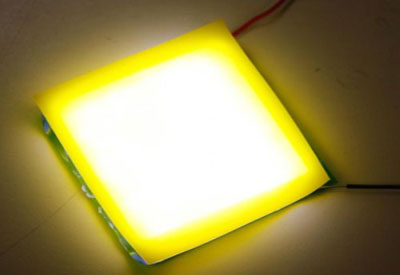
By taking advantage of novel design patterns, researchers from National Chiao Tung University in Taiwan have developed a highly flexible white light LED that uses cheap, readily accessible components. Potential uses include wearable displays and non-flat surfaces, such as curved and flexible television screens. The LED was completely fabricated from pre-existing technologies, allowing others to easily replicate and build on the platform.
“Compared to organic light-emitting diodes, this design of flexible LEDs can be very attractive, due to the low cost, prolonged lifetime and high efficiency. In addition, all of the technologies associated with this design are currently available,” says Chien-Chung Lin, Associate Professor, College of Photonics, National Chiao Tung University, Taiwan.
The researchers’ off-the-shelf LED device gets its flexibility from its two primary materials, polyimide and polydimethylsiloxane. To construct it, Lin and his colleagues first covered a polyimide substrate with copper foil shielding tape. In a process known as flip-chip bonding, which reduces thermal resistance and results in higher heat dissipation than traditional wire bonding, they mounted 81 Blue LED chips, measuring 1.125 mm x 1.125 mm, to the foil in an upside down position.
To provide a warm white-yellow light, the researchers then added another layer consisting of a yellow phosphor film that had been mixed and spin-coated in polydimethylsiloxane, or PDMS, a widely used silicone-based organic polymer. It was chosen for its high degree of transparency, stability, and flexibility. The final film measured five centimeters by five centimeters, but there is no reasonable limitation to the size of the film.
The researchers ran the device for a standard 1,000 hours, to test its durability, finding that its emission decayed by only 5%. Its potential for use in wearables was demonstrated when subjected to bending tests. It held its power output when bent to a curvature with a 1.5-cm radius. It also exhibited a light efficiency of 120 lumens per watt.
“Because the components are all available by current technology, the combined reliability can be very good,” says Lin. “Most of the novel processes or materials require a lengthy procedure to verify their reliability, but our design uses only available parts to avoid this issue.”
Future work for Lin and his colleagues includes reducing the LED device’s thickness, as well as increasing its functional lifetime and energy efficiency.
A paper by Lin, Professor Hao-Chung Kuo, and their research team appears this week in Optics Express, a journal published by The Optical Society (OSA): “Large-area, uniform white light LED source on a flexible substrate,” Optics Express 23, 1167-1178 (2015);
https://www.osapublishing.org/oe/abstract.cfm?uri=oe-23-19-A1167
Source: The Optical Society, http://www.osa.org/en-us/about_osa/newsroom/news_releases/2015/a_new_design_for_an_easily_fabricated,_flexible_an/,_flexible_an/