IALD Announces Winners of the 35th Annual IALD International Lighting Design Awards
June 25, 2018
Luminaries of the lighting profession gathered at Chicago’s trendy Revel Fulton Market last month to honour the winners of the 35th Annual International Association of Lighting Designers (IALD) International Lighting Design Awards. Seventeen projects from eleven countries were on display, including interiors, workspaces, museums, hospitality sites, and a place of worship. This year’s winners represent some of the most innovative and inspiring work found anywhere in the world of architectural lighting design.
The highest point score winner across all categories, in addition to receiving an award of excellence for their project, receives the IALD Radiance Award for Excellence in Lighting Design. Winners of the Radiance Award do not know in advance of their award-winning status prior to the evening, only that they should be present at the evening’s award ceremony.
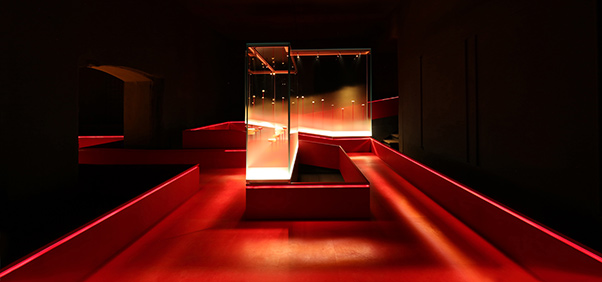
Accepting the Radiance Award for Excellence in Lighting Design were Stephanie Grosse-Brockhoff and Andreas Schulz, IALD, part of the project team from Licht Kunst Licht for the German Ivory Museum in Erbach, Germany.
Of the 17 projects recognized, two entries earned Special Citations, eight earned awards of merit and seven earned awards of excellence. Below, immerse yourself in the winning projects by viewing the 35th Annual Awards Book or watching our YouTube playlist of all the winning videos.
What made the German Ivory Museum a winner
This sleek exhibit space in Erbach, Germany houses a small but exquisite collection of ivory objects. With light designed by Licht Kunst Licht and architecture by Sichau & Walter, the design of the Germany Ivory Museum space creates a memorable contrast between exhibits and their surroundings, without distracting from the form of each piece on display.
Designers and architects learned early that no funds would be made available to refurbish the old palace where the ivory is exhibited. So they conceived of an exhibition detached from the building envelope that would “visually dissolve the space.” A pier, clad in red leather, interconnects the glass cases and provides a striking colour contrast to the monochromatic objects on display.
Each display showcase is a luminous cube; the partially frosted glazing and inauspicious accentuating illumination make the figurines magically emerge from a sort of fog. Designers wanted to avoid any reflections in the glass from sources inside or outside of the case. All light sources outside the showcase remain fully concealed by virtue of clever positioning or careful accessories, and all luminaires inside the display cases have a focused light distribution and a snoot.
The cabinets consist of fully glazed hoods without any corner profiles where lighting devices and wiring might be hidden. To maintain the effect demanded by the design concept, designers introduced a small profile tracing in the interior upper cabinet corner to accommodate all lighting elements, concealing cables and splices behind a blind cover. On-site testing revealed that silver anodized elements were less visible than black, so fittings and cables were adjusted and invisibly embedded into the glass mitre joints.
Judges were impressed with this careful attention to detail. One judge commented that this approach was ultimately in service of the user experience: “Controlling light spill and reflection unquestionably captures the focus of the visitor with the exhibit, rendering the envelope invisible.”
In tune with the red hue of the exhibition design, the light colour of the display lighting is 3000K. The only deviance is at the base of the cases: the lower third of the glass panes is frosted and fitted with edge light integrated in the base.
Find out more about
- the German Ivory Museum lighting project: https://www.iald.org/IALD/media/Media-Library/IALD International Lighting Design Awards/2018/RADIANCE-German-Ivory-Museum.pdf
- all the award-winning projects: https://www.iald.org/About/Lighting-Design-Awards/2018-Award-Winners