Study Shows Value of Sensor-controlled, Bi-Level Lighting
February 8, 2019
Considerable energy savings can be achieved with sensor-controlled, bi-level corridor lighting, according to results of a field demonstration led by the Lighting Research Center (LRC) at Rensselaer Polytechnic Institute.
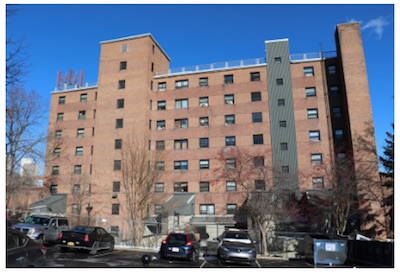
The field demonstration looked at sensor-controlled, bi-level corridor lighting in a multi-family apartment building.
“Saving lighting energy in multi-family corridors is becoming more feasible,” says Jennifer Brons, who authored a report on the field demonstration. “LED luminaires can easily dim light output when corridors are vacant, rather than turning off entirely. Most importantly, the occupants had positive comments about safety and comfort with sensor-controlled, bi-level lighting.”
Dimming light output when corridors are vacant, rather than turning off entirely, is referred to as “bi-level” or “adaptive” lighting. Sensors can be mounted in each luminaire, or can be wirelessly linked to multiple luminaires.
Project background
With support from the New York State Energy Research and Development Authority, the LRC and Taitem Engineering collaborated with Albany Housing Authority to upgrade 60 corridor lights on six floors of a below-market-rate apartment building in Albany, New York, known as Lincoln Square Two. Monitoring results from 14 other apartment buildings enabled energy savings calculations comparing market rate vs. below market rate buildings.
Lincoln Square Two is part of a complex of high-rise apartments built in the 1960s. The project involved upgrading 60 corridor lights (6 floors, 10 per floor).
Previous lighting consisted of linear T8 fluorescent lamps4 in surface-mounted luminaires spaced typically 13 feet
(4 m) apart. Although lamps were in good working order, plastic cube louvers had yellowed with age, thus distorting colours and reducing luminaire light output. Before the retrofit, average illuminance on the floor was 106 lux (10 fc).
For this research, each of the previous fluorescent luminaires were replaced one-for-one with LED luminaires controlled by integrated ultrasonic occupancy sensors. Luminaires were rotated to orient parallel to the corridor to improve light distribution on the walls. Each of the new luminaires was set to operate at 100% output when occupied (average 303 lux at floor level); when vacant, luminaires dimmed independently to 20% of full output. Twenty of the new luminaires were set for each of the three delay time settings: 5, 10, or 15 minutes.
Resident feedback
The LRC administered a questionnaire to compare occupant acceptance to the conventional, fixed-output fluorescent lighting in use before the retrofit. Despite the higher light levels with the new lighting, most occupants did not consider the hallways too bright after retrofit. Over three-quarters (78%) of the occupants approve of the new bi-level lighting. More of the occupants had positive ratings after retrofit than before retrofit.
The occupants also offered positive comments about the retrofit. Multiple people commented that they like how the individually controlled luminaires ramp up light output successively as they walk through the corridor. One person likes that the sensors act as a notification that others are present. Several people simply prefer having more light in the corridors, independent of sensor features. There were no negative comments about the sensors.
Estimated annual energy use
Energy impacts were studied for the three delay time settings. Luminaires programmed with the shortest sensor delay time (5 minutes) operated at high output for less time (22%) compared to those programmed with longer (15 minute) delay times (31%). This resulted in 14% less annual energy use for the short delay time setting compared to the long delay time setting.
Proximity to elevator lobbies increased the amount of time luminaires were at high output, and therefore reduced energy savings in these areas. However, even in busy elevator lobbies, bi-level lighting used about half as much energy as only upgrading to fixed-output LEDs.
The LRC calculated annual energy use for 48 luminaires comparing the previous T8 fluorescent luminaires to two conditions: LED luminaires without sensors, and bi-level lighting programmed with a 5-minute time delay. At this high-rise residential site, use of sensors to create bi-level lighting more than doubled energy savings compared to upgrading to fixed-output LEDs.
Key findings
The Lincoln Square bi-level lighting demonstration showed that
- over three-quarters (78%) of the occupants approved of the new bi-level lighting
- 5-minute delay time was not objectionable
- dimming to 20% light output when vacant was not objectionable
- use of sensors to create bi-level lighting more than doubled energy savings compared to upgrading to fixed-output LEDs
- the lower the dim setting when vacant, the greater the energy savings due to bi-level lighting
Read the full study here.