Stanpro: Reducing Light Pollution Through Your Choice of Outdoor Lighting

December 16, 2025
Stanpro Insights on How to Reduce Light Pollution with the Right Choice of Exterior Lighting
Since the advent of the Industrial Revolution, western societies have gotten into the habit of living in a world surrounded by light, both inside and outside the home, which allows people to pursue their activities after the sun has gone down. And yet, have you ever given any thought to the negative effects of an overly lit environment? The overriding consequence is light pollution of our cities! What can be done to counter this phenomenon? Light pollution is an occurrence that manifests itself at dusk. It is caused by an overabundance of misdirected, ineffective, and useless lighting systems, most notably in urban areas where artificial light sources such as street lamps, are used excessively.
How Street Lamps Light Exterior Spaces
Light projected by a street lamp can be deconstructed into three parts. Firstly, there is the light that shines upwards, as represented by Zone A in the above diagram. This lighting angle is lost and useless to people walking around outside. It is also the predominant reason for the reduction of visibility of the stars in city skylines. The Amateur Astronomers Federation of Québec has revealed that “97% of the populations of North America and Europe live in lighting-polluted skies”.
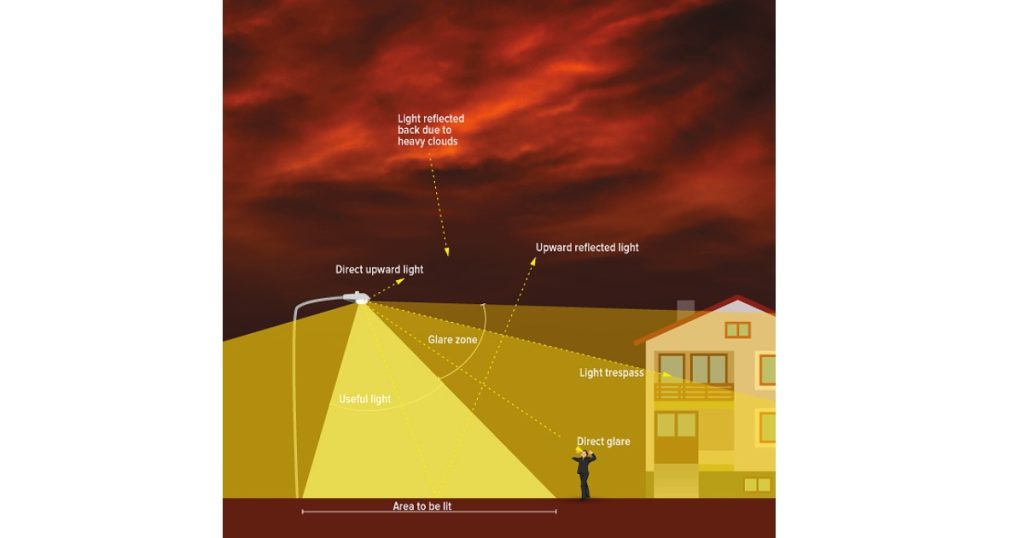
Secondly, there is the light that shines at a 10-degree angle above the horizon and that results in a glare, as identified by Zone B in the above diagram. This light is also detrimental to surrounding areas as it generates intrusive lighting. Finally, the last is the only true light, as defined by Zone C in the above diagram.
In light of the above, humanity needs to ask a pertinent question: What future do we wish to offer generations to come? Artificial lights have replaced stars and darkness, which are harmful to human health. Scientists have noted that the production of melatonin is delayed when our circadian rhythm is exposed to excessive lighting. The circadian rhythm is the process that regulates sleeping patterns. Consequently, with a disproportionate amount of light outside, the time it takes for our bodies to fall asleep at night is extended and our sleep is less than satisfactory.
Over time, studies suggest that this might increase human risk of suffering from obesity, depression, diabetes, etc. Stanpro invites you to read their articles entitled LED and Its Possible Health Effects – Part 1 and Part 2 to learn more about the potential harm of artificial light on the general population. People also need to consider how light pollution affects animals and their behaviour. It is known that some species hunt, reproduce, migrate and hibernate in the dark. Intense brightness, at night, tends to disrupt the usual behaviour of these nocturnal animals; they confuse artificial light with the light of the moon.
This disturbance can also affect the chances of survival of some prey who have adapted to darkness to better avoid nighttime predators. Thus, on a larger scale, excessive and useless lighting can have damaging repercussions on several ecosystems. The exaggerated use of misdirected or useless lighting causes an enormous waste of energy. This economic impact on cities, industries and individuals cannot be discounted. The AAFQ estimates that the cost of wasted light energy projected toward the sky stands at 45 million dollars each year in Québec alone.
Raging a war against light pollution does not mean people should discontinue lighting cities; they simply need to light them more adequately! People need to find an effective and relevant lighting process based on spatial considerations. The International Dark-Sky Association (IDA) programme was founded in 2001 to promote responsible lighting policies and to educate the public on the preservation of the dark sky. The Association encourages the use of lighting systems that help reduce light pollution based on the following criteria:
- Lighting spaces only when it is necessary
- Lighting targeted zones in spaces that require it
- Opting for low intensity light fixtures
- Reducing the diffusion of blue light and glare
- Encouraging fully covered, downward-pointing lighting
Visit the IDA page that talks about lighting basics to learn more about lamps that meet night sky standards. You may also want to read Stanpro’s article entitled LED Street Lights: Not Too Dark, Not Too Bright, Just Right that contains further information on lighting exterior spaces without increasing light pollution. To counter light pollution, people need to make suitable lighting choices. To do so, there must be a focus on quality lighting systems that are safe and adequately calibrated to reduce their impact on our environment.
The IDA recommends using a light that does not exceed 3,000 kelvins and directing that light toward the area where it is required. The Dark-Sky certification from the IDA indicates one’s promise to respect the recommendations of the Association’s programme regarding outdoor lighting. Check out Stanpro’s outdoor light fixtures that are Dark-Sky certified HERE.
For more information on Stanpro solutions HERE


Light Pollution