New CSA Test Method for Horticultural LEDs
May 17, 2018
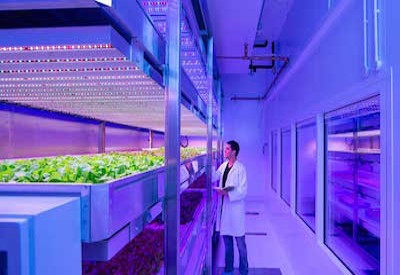
Many farmers are making the switch from traditional farms to commercial greenhouses and vertical farms because they produce better yields, help address natural resource constraints, and offer shelter from unfavourable weather and climate change. But greenhouses especially consume a lot of electricity, which is costly. LEDs — with long lifespans and energy-efficient properties — help mitigate these costs. That’s why the horticultural LED market is expected grow 22% annually until 2020.*
Due to the corrosive environment inside these farms, horticultural LEDs must be tested more rigorously and meet additional requirements that don’t apply to general-purpose LEDs. But there are limitations to current testing methods, including:
- repeatability due to DUT (device-under-test) active cooling
- exposure to high heat and humidity
- small typical sphere ports
- inflated results produced by typical testing instruments
- missing performance characteristics due to spatial colour non-uniformities
- limiting horticultural LEDs to being measured on moving mirror Type C-goniometers
- data application issues when taking far-field measurements for near-field applications
New test method a potential game-changer
CSA Group looked at whether .ies file projections could be applied to near-field applications by using .ies file interpreting software to model the output on near-field planes, and measure on the same near-field planes. After analyzing the results, CSA Group determined that this approach, called near-field planar scanning, overcame many of the previous testing limitations.
The new approach has eliminated DUT size limitations because the device does not have to be enclosed. Limitations associated with active cooling are also no longer a concern because the orientation of the DUT is completely static throughout the test, and it can be tested in a wide open volume with easy access to remote cooling devices. And finally, near-field colour non-uniformities can be captured because the DUT is measured in the near-field instead of the far-field where the colours are well mixed.
CSA Group is working to standardize this method through its involvement in committees and working groups under ASABE (American Society of Agricultural and Biological Engineers) and IES (Illuminating Engineering Society of North America). It would give end users the benefit of having apples-to-apples comparisons between prospective products. Lighting designers would also be able to use existing design software to accurately model the photon flux density at the canopy when the light sources are applied at near-field distances.
Download the full white paper to learn more about this innovative testing method: www.csagroup.org/article/growing-opportunities-led-manufacturers-horticultural-market/?utm_source=Kerwill&utm_medium=referral&utm_campaign=LED.
Photo source: Philips Lighting
* Technavio, Global LED Lighting Market for Horticultural Application 2016-2020, Oct. 2016