Circadian Rhythm More Sensitive to Lighting Colour Cues
Circadian Clock Mammals

Dec 8 2015

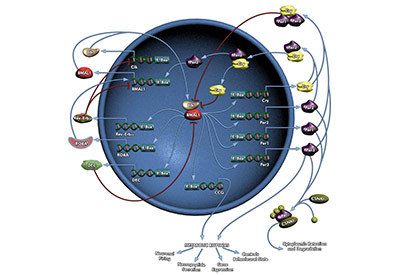
Research by scientists at The University of Manchester has revealed that the colour of light has a major impact on how our body clock measures the time of day. It’s the first time the impact of colour has been tested, and demonstrates that colour provides a more reliable way of telling the time than measuring brightness.
Dr. Timothy Brown from the Faculty of Life Sciences led the research. He posits that “in theory colour could be used to manipulate our clock, which could be useful for shift workers or travellers wanting to minimize jet lag.” Taking the theory further, using light to adjust our circadian rhythm could offer enormous potential for optimizing personal productivity and well-being.

In a paper published on April 20 in the Open Access journal PLOS Biology, the researchers looked at the change in light around dawn and dusk to analyze whether colour could be used to determine time of day. Besides the well-known changes in light intensity that occur as the sun rises and sets they found that during twilight, light is reliably bluer than during the day.

The scientists next recorded electrical activity from the body clock while mice were shown different visual stimuli. They found that many of the cells there were more sensitive to changes in colour between blue and yellow than to changes in brightness.
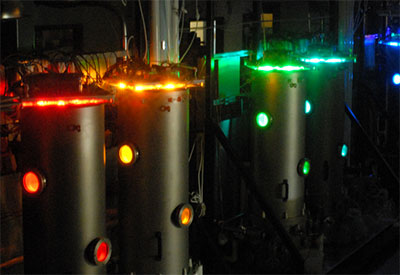
The scientists then used measurements of the changes in the colour spectra taken from the top of the University’s Pariser Building, to construct an artificial sky that recreated the daily changes in colour and brightness.

Mice were placed beneath the sky for several days and their body temperature was recorded. As expected for nocturnal creatures, the highest body temperatures occurred just after night fell when the sky turned a darker blue – indicating that their body clock was working optimally.
When just the brightness of the sky was changed, with no change in the colour, the mice became more active before dusk, demonstrating that their body clock wasn’t properly aligned to the day night cycle.

“This is the first time that we’ve been able to test the theory that colour affects the body clock in mammals,” said Dr. Brown. “It has always been very hard to separate the change in colour to the change in brightness but using new experimental tools and a psychophysics approach we were successful.” The same findings can be applied to humans, he continued.

Read the journal article, “Colour As a Signal for Entraining the Mammalian Circadian Clock;” http://journals.plos.org/plosbiology/article?id=10.1371/journal.pbio.1002127
 

Related Articles


Changing Scene

  • Jan 14, 2026 - GVA Lighting Promotes Gareth Bruce to Vice President – Sales & Marketing

    GVA Lighting Promotes Gareth Bruce to Vice President – Sales & Marketing

    GVA Lighting is pleased to announce the promotion of Gareth Bruce to Vice President of Sales and Marketing, effective December 5th, 2025. Gareth joined GVA in May 2024 as Regional Sales Manager – Southeast, bringing more than two decades of lighting industry experience from Philips / Signify. He was promoted to Director of North American Sales in September 2024 and has since… Read More…

  • Jan 14, 2026 - Intralec Electrical Products Proudly Representing SATCO NUVO Lighting Solutions

    Intralec Electrical Products Announces SATCO NUVO Representation

    Intralec is proud to represent SATCO | NUVO lighting solutions for commercial, residential, and industrial applications. SATCO | NUVO is a major supplier of lighting products, with solutions for nearly every lighting market across the commercial, residential, and industrial landscape. With over 1.5 million square feet of inventory throughout North America and thousands of products… Read More…


Design

  • EB Horsman: Can LED Roadway Lighting Enhance Road Safety & Efficiency?

    EB Horsman: Can LED Roadway Lighting Enhance Road Safety & Efficiency?

    At EB Horsman, they recognize that effective roadway lighting is a crucial component of public safety. With Lumec’s LED roadway lighting solutions, communities can ensure reliable, high-quality illumination that supports safer travel for everyone, day or night, while also improving energy efficiency and long-term operational performance. High-quality roadway lighting is a critical component of public… Read More…

  • Prolux Lighting & Controls: Project Spotlight – Residential House in the Kootenays

    Prolux Lighting & Controls: Project Spotlight – Residential House in the Kootenays

    Have a look at this custom residential home in the Kootenays, where Prolux utilized the HALO RL6 Slope Ceiling Direct Mount fixtures by Cooper Lighting Solutions designed specifically for sloped ceilings. These luminaires provided consistent, high-quality illumination while maintaining a clean, low-profile ceiling aesthetic. Their direct-mount design allowed for seamless integration throughout the home, supporting… Read More…


New Products

  • Philips Hue Transforms Lighting Design with the Hue SpatialAware Feature That Understands Your Space

    Philips Hue Transforms Lighting Design with the Hue SpatialAware Feature That Understands Your Space

    Signify is introducing Hue SpatialAware, which will transform how Philips Hue users experience light scenes. This feature analyzes the layout of your room and the placement of your Philips Hue lights to create the optimal lighting experience tailored to your unique environment. It’s like having a lighting designer in your pocket, allowing you to experience… Read More…

  • Liteline: New LUNA Fire Driver for 3.5″ Fixture

    Liteline: New LUNA Fire Driver for 3.5″ Fixture

    Introducing a new lower-cost driver option for LUNA Fire! This 12W, 120V driver with TRIAC/ELV dimming is designed to significantly reduce cost while maintaining performance, giving you more flexibility.  The LUNA Fire meets UL 1598 / 2108/ 263, CSA C22.2 #250.0 / 250.2, and ULC-S101 safety and building construction requirements granting inherent 2-hour fire-rated protection. It… Read More…