Nedco: Tunable White and Human-Centric Lighting

November 11, 2026
Controls Layer Part 2: What Tunable White Is, Why People Use It, and How It Fits Into a Building
Part two of a three-part series
Part 1 looked at how lights respond to people and daylight. Part 2 looks at a different question: can the colour of light change over the day to suit how people feel and work? That is the idea behind tunable white.
What Tunable White Is
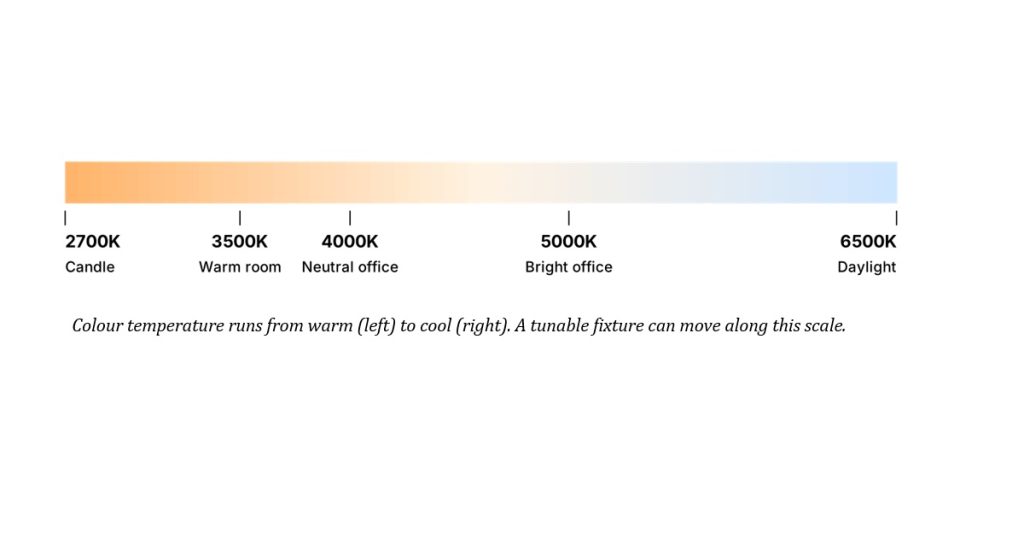
A standard white light has one fixed colour temperature, measured in kelvin (K). Warm light sits around 2700K, the colour of a candle or an older incandescent bulb. Cool light sits at 5000K or higher, closer to a clear midday sky.
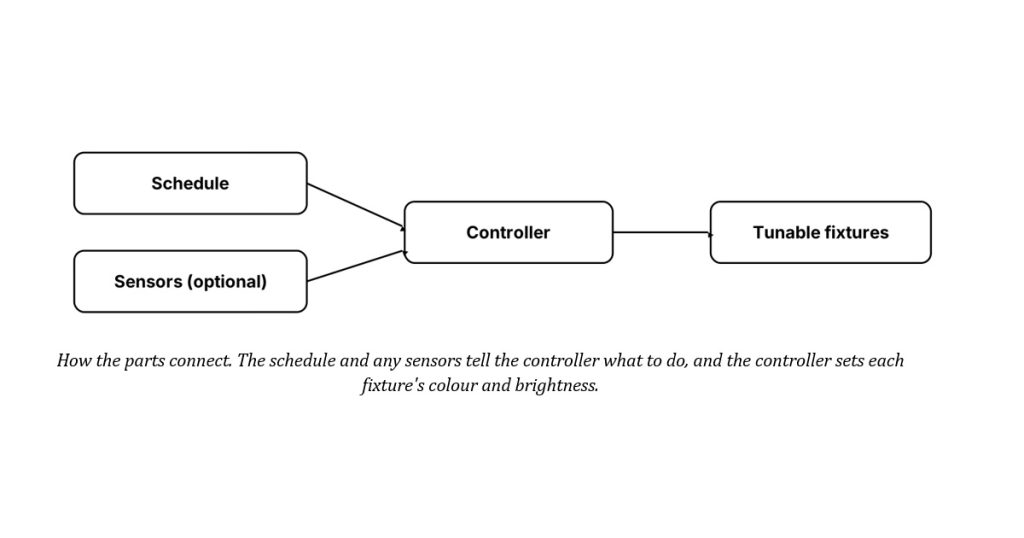
A tunable white fixture can move between these settings. A control system changes its colour temperature and brightness on a schedule or in response to sensors, so the same room can feel calm in the evening and focused in the afternoon.
Why Colour Temperature Matters
Light affects the body’s internal clock. Daylight is bright and blue-rich in the morning and midday, then warms and dims toward evening. Researchers have studied whether indoor light that follows this pattern can help with alertness during the day and with winding down at night.
The research is promising but not conclusive. Results vary with the person, the space and the type of task, so tunable white should be seen as one tool for supporting comfort and routine, not a guaranteed fix for sleep or productivity.
What a System Includes
| Part | What It Does |
| Tunable Fixtures | Produce a range of colour temperatures, typically 2700K to 6500K, usually using two sets of LEDs blended together |
| Controller | Sends the instructions that change colour and brightness, often over a standard building protocol |
| Schedule | Sets how the light changes across the day, such as a morning, midday and evening profile |
| Sensors (Optional) | Adjust the light based on daylight levels or whether anyone is in the room |
A Typical Day
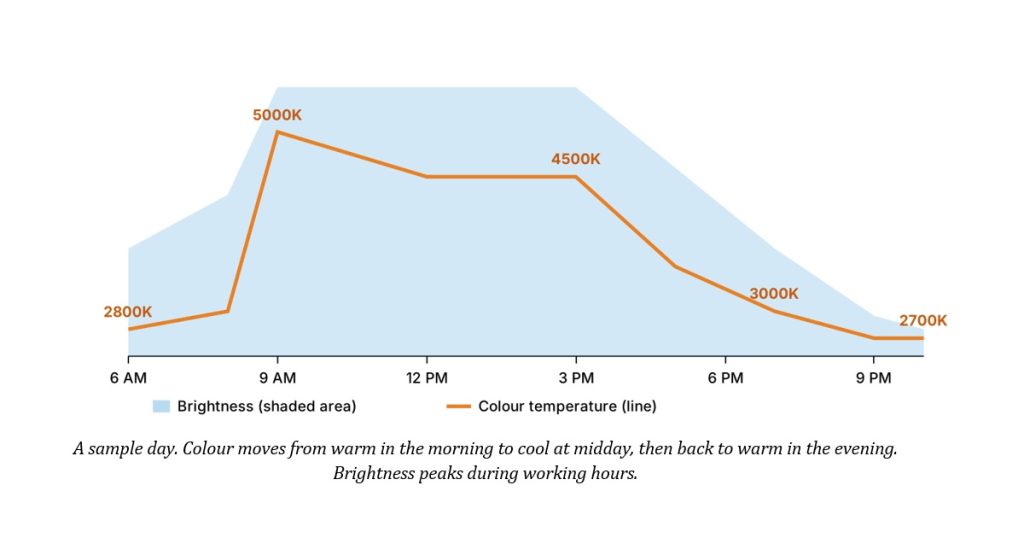
The schedule below is an example. Real settings are chosen with the building’s users, not copied from a template.
| Time | Colour | Brightness | Intent |
| Early Morning | Warm, around 2700K to 3000K | Low to medium | A gentle start to the day |
| Late Morning | Cool, around 5000K | Full | Focus during peak hours |
| Afternoon | Neutral, around 4500K | Full | Steady comfort over a long shift |
| Evening | Warm, around 3500K | Medium | A transition toward the end of the day |
| Night | Very warm, around 2700K | Very low or off | Rest |
Not every building runs on the same clock. Shift work, 24-hour facilities and weekend use all change when people are present, so schedules work best when they can be set by zone.
Where It Is Used
Hotels
Guests arriving after a long flight can use the room’s lighting to ease into local time. Many hotels use a cool setting in the morning and a warm one in the evening.
Hospitals
Patients often have disrupted sleep in hospital. Staff can use tunable light to encourage a more regular day and night pattern while still adjusting it for care.
Offices
People working far from a window may not get much natural light. A schedule that moves from warm to cool and back again can give the space a more natural rhythm, and occupancy sensors keep the energy use in check.
How It Works with Other Controls
- Daylight sensing can reduce the artificial light when there is enough natural light, and tunable white can then match the colour of the daylight that is coming in.
- Occupancy sensing can keep unused rooms at a low setting and bring up the full schedule when someone enters.
- Together, these tools control when light is on, how bright it is, and what colour it is.
Common Questions
Will People Notice the Change?
They will if it happens too quickly. Slow transitions over 15 to 30 minutes are usually barely noticeable, which is why most schedules change gradually.
Does It Cost Much More?
Tunable fixtures usually cost more than standard LEDs, though the gap has been narrowing. The value depends on how much the building’s users benefit and how the system is planned.
Does It Need a Lot of Setup?
Yes, a little. Most systems need some tuning after installation, typically over a few weeks, to match the schedule to how the space is really used.

For more information on Nedco lighting solutions HERE

Tunable White Tunable White