Lumens as a Service: the Business Opportunity for Advanced Lighting in Commercial Buildings
January 22, 2019
The convergence of technological advancements in and cost reductions of LEDs and smart lighting control technologies has created a major business opportunity in commercial buildings, reports the Rocky Mountain Institute in a recently published study. These developments now allow service providers to cost-effectively capture new value streams through proven advanced LED lighting retrofit solutions — with both mass deployment of LED technologies and market demonstrations of “as a service” approaches creating high confidence in their performance and financial returns as they are brought together.
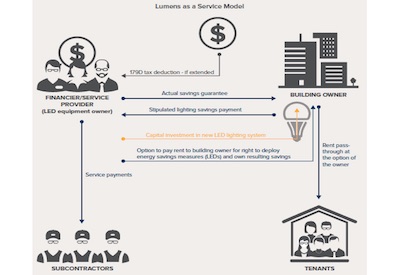
Service providers can more effectively tap into this multibillion-dollar market and create new revenue streams by making a Lumens as a Service (LaaS) business model their go-to-market strategy. With LaaS, service providers can deliver the latest lighting technologies to their clients, funded by the value created from the future energy savings of a lumen-optimized lighting system.
The rapid emergence of cost-effective LEDs and fixture-integrated smart controls has generated great interest among service providers and commercial building owners and property managers, but the market opportunity remains under-tapped because of the continued use of business models that limit the adoption of these transformational lighting solutions.
What’s fuelling the LaaS opportunity
The report identifies a number of factors that are helping to create opportunities. Among them:
- significant led cost reductions and quality improvements. Owing to technological advancements and increasing economies of scale, LED lighting now delivers reliability, enhanced lighting quality, and energy efficiency compared with early products — including the ability to tune LEDs to deliver the specific colour temperature that occupants want at high-output lumen performance — along with rapidly declining costs. Thus, LEDs are now a proven and leading lighting option for commercial buildings.
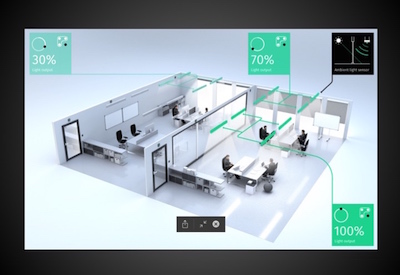
- advancements in digital lighting controls are enabling remote control and optimized lighting outcomes. Wireless technology, digital controls, and decreasing costs are enabling significant multibillion-dollar annual investments in lighting controls, which enable a high level of control over lighting systems whereby every diode can be digitally controlled to deliver optimized lighting performance. The wireless nature of digital controls also means that they can easily be installed without needing new wiring or disrupting existing building infrastructure. These enhanced technological capabilities can deliver additional benefits that, in turn, further enable lighting-performance optimization and position the digital lighting controls market for continued growth.
- the LED lighting market alone is anticipated to reach 45% growth per year through 2020 and ultimately a US$63 billion market size. However, this market opportunity is based on traditional business models for delivering new LED lighting technologies. New business models, such as LaaS, can both accelerate adoption of LED lighting and expand the overall market opportunity. Service providers offering financing or serving as a key channel for finance providers enable the LaaS business model.
- combining LEDs with smart controls enables a third-party service model for commercial lighting. The combined maturation and advancement of LED and smart lighting control technologies enable third-party monitoring, control, and ownership of lighting assets. This in turn allows for a service agreement structure that delivers optimized and stipulated lighting performance in workplace environments in the form of LaaS. The enhanced capabilities these technologies provide — available at a highly accessible cost — make third-party control of lighting a possibility and a compelling business pursuit for both service providers and commercial building customers. With this approach, service providers remotely monitor, manage, and optimize lighting performance for customers according to agreed upon performance levels for a particular space.
- LED retrofit options can match customer requirements. The market currently offers three distinct options for retrofitting existing fluorescent troffers — the most commonly found fixture type in commercial offices — with smart LED fixtures that vary in their up-front costs, cost savings, and performance improvements.
- installing led retrofit kits over existing troffer housing helps sustain LaaS as a simple service agreement, ain part because the service provider’s equipment does not fundamentally change core building infrastructure.
The report goes on to explore features and benefits of the LaaS business model, and closes with a strategy for acquiring customers.
A three-pronged approach to acquiring customers
Customer acquisition is a costly and time-consuming activity for a service-based business model. As service providers prepare to deploy a LaaS offering, the report identifies for consideration three key options.
- Lead with a LaaS model. The LaaS model enables service providers to scale advanced commercial lighting solutions that bundle leading technologies to deliver customers optimized lighting performance. Service providers can reduce their costs over time to deliver lumens to customers by continuing to replace lighting equipment as better options become available. Because LaaS is attractive to customers for such reasons as improved illumination and increased NOI, service providers can benefit from scaling the use of service agreements to deliver LaaS to numerous customers.
- Emphasize trigger points in commercial building life cycles. Although not necessary for customer acquisition, it’s generally easier to attract new LaaS customers when work is likely already underway and space disruption can be minimized, including such key trigger points as building purchases and investments, tenant fit-outs, and new lease structuring.
- Distinguish between customers and tenant lease types, if useful. Although it’s preferable from a scaling perspective to design a LaaS model that is agnostic to customer type, it is also important to be mindful of the needs of different customer segments (e.g., building owners, property managers and tenants) and the terms of different tenant lease types (e.g., triple-net, gross, and modified gross leases). In particular, contract length flexibility is likely a key consideration for service providers that want to attract different customers with varied time horizons.
Read the full report: www.rmi.org/insight/lumens-as-a-service/.