Light and Darkness: A Lighting Vision for the City of London
March 25, 2018
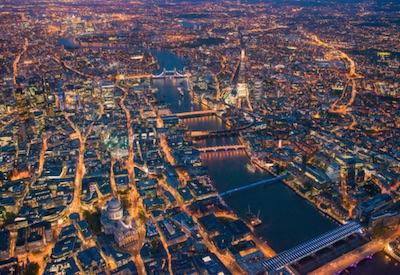
Public consultation has just closed on a dramatic and ambitious proposal to re-light the City of London, described as a “once in a generation” opportunity afforded by the upgrading of the street, amenity and architectural lighting owned and operated by the City of London.
Prepared by Speirs + Major for the City of London Corporation, the lighting vision aims to provide the vision, methodology, standards and guidance to meet the City’s future requirements. It seeks to deliver a creative, holistic, cohesive, forward looking and intelligent approach in which light and darkness are better balanced to meet both a functional and aesthetic need.
The ongoing development of the area will act as a further catalyst for change. This lighting strategy provides analysis and guidance to help facilitate the delivery of the new lighting and includes a number of opportunities and recommendations for the future.
The City of London is home to one of the world’s most important international finance districts. It also possesses a unique collection of heritage sites. Moreover, it has a burgeoning twenty-four-hour-a-day economy that is rapidly growing on the back of increased development. The City’s relatively small residential population is also beginning to expand. The next few years will see the realization of exciting new initiatives such as Crossrail, Culture Mile and the Illuminated River. As a result of these developments the streets, open public spaces and riverside will become increasingly busy with pedestrians, bicycles and vehicles, not only by day but also after dark.
Various layers of light combine to produce the character and identity of the City of London. These include:
- spill light from buildings
- street and amenity lighting
- floodlighting of both public and private buildings
- landscape lighting
- illuminated media and signs
These coalesce not only to meet visual needs but also to create ambience and atmosphere. Of these layers, only two are fully owned and controlled by the City: the street and amenity lighting and the highlighting of a number of historic buildings, bridges and monuments. Both of these lighting systems are in need of upgrading or replacement. While the rest of the lighting within the City is largely owned by third parties — often private commercial interests — there is little coherence in terms of the quality or amount of light provided through such schemes. They therefore demand increasing scrutiny through the planning system.
The need for a comprehensive lighting strategy at this moment in time arises from the need to replace the majority of the public lighting systems, which are now coming to the end of their life. This in turn provides a once in a generation opportunity to provide a more innovative, imaginative, holistic and consistent approach to lighting within the City of London. Careful planning and design will not only allow the proper consideration of key issues such as movement, safety, security and accessibility, but also the reduction of energy use and light pollution. It will also help improve the character of the City and the way that people experience it after dark.
This lighting strategy represents a new vision for the City of London after dark. In so doing, it aims to set a new benchmark for urban lighting, not only in London, but nationally and internationally.
The strategy identifies a number of opportunities:
- Movement: providing improved levels of illumination for the various routes and open spaces with a particular focus on pedestrian and bicycle movement.
- Character — using light to accentuate the unique qualities of the overall network and each distinct area after dark
- Legibility — illuminating key ‘urban elements’, and in particular key buildings and bridges to help improve intuitive way-finding and orientation at night
- Standards — reassessing the existing lighting levels and uniformity to help reduce energy use and light pollution but without compromise to safety and security
- Sources — upgrading the existing light sources to newer low energy, longer life LED with improved colour appearance and colour rendering to help improve safety and security whilst reducing energy costs and maintenance
- Luminaires — upgrading both contemporary and heritage street lanterns, bulkheads and other fitting types together with supporting electrical and mechanical infrastructure to help improve performance including the reduction of glare
- Control — installing a City-wide smart lighting control system to allow dimmability in response to diurnal change and light spill from buildings to help improve overall management, provide greater flexibility and reduce energy and maintenance costs
- Mounting — re-assessing mounting positions and heights of fittings as part of any upgrade to the lighting infrastructure including the occasional use of columns to help improve scale and enhance character
- Visitor attraction — illuminating important archeological, heritage and cultural sites and public art assists with tourism and education
- Well-Being — reducing light spill and light pollution, particularly adjacent to residential properties, will help improve well-being
- Bio-Diversity — better environmental control of the lighting will assist in reducing adverse impacts on local ecologies
- Planning — Embedding lighting within the planning system will help improve design and control aesthetic outcomes
- Management — a more holistic approach to lighting will assist with communications between key stakeholders resulting in greater efficiency, less waste, lower costs and improved maintenance
Recommendations address key areas of design and management that are recognized as priorities for the design, delivery and maintenance of the public lighting: safety, security, accessibility, sustainability, culture, planning and management: www.cityoflondon.gov.uk/services/environment-and-planning/city-public-realm/public-consultations/Documents/City-of-london-lighting-strategy-part-2.pdf
Adapted from Speirs + Major’s strategy document: www.cityoflondon.gov.uk/services/environment-and-planning/city-public-realm/public-consultations/Documents/City-of-london-lighting-strategy-part-1.pdf
{loadposition slideShow30}
Photo source: Light + Darkness in the City/A Lighting Vision for the City of London
1: Private lighting contributes to illumination of public realm
2: Historic light sources disappear among high light levels
3: Lighting integrated into overall design
4: Low level lighting reinforces sense of privacy
5: Well illuminated areas support night time economy
6: Integrated lighting to changes in level supports pedestrian safety