The Evolution of OLED Technology for Lighting
Michael Helander
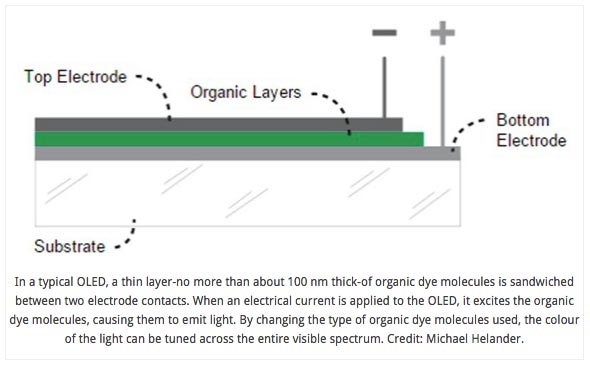
Although a relatively new technology, organic light-emitting diodes, OLEDs, are labelled today’s most promising display technology. As its name suggests, OLED is an advancement upon LED or light-emitting diode that allows for even thinner and brighter displays. The next-generation of energy-efficient lighting, OLEDs generate light by passing electricity through a thin layer of carbon-based organic dyes. Currently, the technology is most commonly used for television screens, computer monitors and cellphone screens. The lighting industry is just starting to scratch the surface in using this technology.
OLED technology was invented in 1987 by two chemists and researchers, Ching Tang and Steven Van Slyke, from the Eastman Kodak Company. Kodak was one of the first companies to experiment with OLEDs by putting the technology into digital cameras. In the early 2000s, the technology was then successfully commercialized into high-end smartphone displays and has more recently been used in televisions and laptops by major corporations like LG and Samsung.
The bendable characteristics of OLEDs allow for many possibilities to use the technology in lighting applications. The paper-thin flexible light sources emit warm, natural light, ideal for many lighting designers and architects. Traditional lighting relies on complicated optics, reflectors and diffusers to turn point sources of light from bulbs into wide area illumination. OLED is the only source of light that allows surfaces to be light emitting without glare, enabling new and exciting design possibilities.
Despite the level of interest in OLED technology and its potential, it has been a challenge to bring OLED technology to the consumer market at a reasonable price point, especially in lighting applications. Until very recently, the performance of OLED lighting just wasn’t up to par. The light panels weren’t able to achieve a greater efficiency than LEDs nor did they have a long enough lifespan to make the technology worthwhile for use in lighting. Historically, the technology has also been incredibly difficult to mass manufacture from an economic perspective. However, developments from around the world from major players such as Philips and OSRAM, as well as a handful of new entrants, including LG Chemical and Konica-Minolta, have recently moved the technology closer to mass market.
Today, OLED lighting is gaining momentum and has finally reached a competitive level with incumbent lighting technologies like LEDs. Since OLED is by nature an area source of light, it can actually be more efficient than LEDs in terms of delivering usable light in certain applications. The challenge with LED is that although you might start with a highly efficient LED chip, by the time you add all the optics, reflectors and diffusers, the majority of the light is lost, making the entire system less efficient. On the other hand, when working with OLED, what you see is what you get since no additional optics are required.
Although the efficiency of OLEDs is now equal to LEDs, one area where OLED is still at a bit of a disadvantage is its price point. Despite the fact that OLED lighting is still more expensive than incumbent technologies on a per lumen basis, its unique form factor and ease of integration into luminaire designs make current prices cost competitive at the luminaire level for many higher end applications.
As performance metrics continue to improve and costs decrease as production volumes increase, the first wave of consumer-ready OLED lighting products is just over the horizon. OLED lighting is now ready to enter the stage of initial adoption, similar to where LED lighting was circa 2008. The rate of adoption of OLED lighting products will largely depend on how quickly costs continue to come down and how the industry sorts out standardization in terms of specifications, interconnects and drivers. Balancing the desire of manufacturers to standardize the form factors (i.e., shapes and sizes) to drive down costs through economies of scales, versus the desire of lighting designers to differentiate products through customized form factors, is another challenge going forward for OLED lighting.
Like any new technology, OLEDs will succeed by gaining momentum in niche markets first before entering mass markets. While we will likely have to wait a few more years for flexible OLED wallpaper, the first wave of consumer-ready OLED lighting products is now available on the market. Within five years, OLED will be a major player in the lighting space. For lighting designers and architects, OLED enables a new paradigm for light: moving away from point sources and fixtures into light as a building material.
Michael G. Helander is the President and CEO of OTI Lumionics, a company working to make OLED technology accessible to new markets and innovative applications through low-cost manufacturing solutions. The company’s first commercial product, aerelight, is an OLED task lamp. Helander holds a Bachelor of Applied Science in Engineering Science and a PhD in Materials Engineering from the University of Toronto.
This article first appeared as an International Year of Light blog. Check out other blogs: http://light2015blog.org/2015/04/15/the-evolution-of-oled-technology-for-lighting/.