Use of Night Lighting Continues to Grow
December 11, 2017
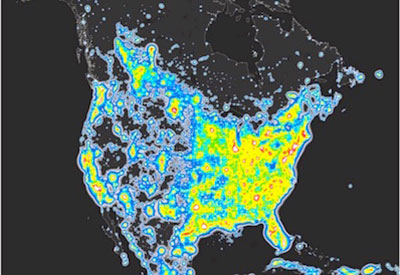
From 2012 to 2016, Earth’s artificially lit outdoor area grew by 2.2% per year, with a total radiance growth of 1.8% per year, reports an article published in the journal Science Advances. Continuously lit areas brightened at a rate of 2.2% per year. Researchers observed large differences in national growth rates, with lighting remaining stable or decreasing in only a few countries. These data are not consistent with global scale energy reductions, indicating instead greater light pollution, with negative consequences for flora, fauna, and human well-being.
Historically, increases in luminous efficacy have led to greater light use rather than energy savings, notes the article. A critical question for sustainable development is whether the use of outdoor light will continue to grow exponentially or whether developed countries are nearing saturation in demand.
The researchers question whether, if demand saturation has not been reached, the increasing luminous efficacy made possible by the solid-state lighting revolution (12) will increase light emissions instead of saving energy.
The research was conducted using data from Visible Infrared Imaging Radiometer Suite Day-Night Band (VIIRS DNB), which came online just as outdoor use of LED lighting began in earnest. This sensor provides the first-ever global calibrated nighttime radiance measurements in a spectral band of 500 to 900 nm, which is close to the visible band, with a much higher radiometric sensitivity than previous methods. This improved spatial resolution allows for neighbourhood (rather than city or national) scale changes in lighting to be investigated .
Results
The data show that over the period of 2012-2016, both lit area and the radiance of previously lit areas increased in most countries in the 500–900-nm range, with global increases of 2.2% per year for lit area and 2.2% per year for the brightness of continuously lit areas. These factors decreased in very few countries.
Many large cities had decreases in DNB radiance in the city centre but increases in outlying areas. These decreases can often be directly attributed to replacement of older lamps with LEDs. This is vividly demonstrated by photographs of Milan, Italy, taken by astronauts on the International Space Station in 2012 and 2015. The streetlights in the city changed from yellow/orange (sodium vapour) to white (LED), whereas the surrounding areas remained yellow/orange. As a result, the radiance observed by the DNB decreased because of the sensor’s lack of sensitivity to light in the range of 400 to 500 nm
Discussion
Two major arguments for changing to LEDs for outdoor lighting are cost savings and reductions in energy consumption. These goals have been realized in many cities, so decreases in observed DNB radiance likely indicate local energy savings. However, on a global and often national scale, these local decreases are outweighed by increases in radiance in other areas, most likely because of additional lighting being installed. The “energy saving” effects of outdoor LED lighting for country-level energy budgets are therefore smaller than might be expected from the increase in luminous efficacy compared to older lamps
Large differences in per capita light use compared to per capita GDP suggest that in brightly lit countries, major decreases in energy consumption for outdoor lighting could potentially be achieved through reduced light use.
In the near term, it appears that artificial light emission into the environment will continue to increase, further eroding Earth’s remaining land area that experiences natural day-night light cycles. This is concerning, because artificial light is an environmental pollutant. In addition to threatening the 30% of vertebrates and more than 60% of invertebrates that are nocturnal, outdoor artificial light also affects plants and microorganisms, and is increasingly suspected of affecting human health. In the longer term, perhaps the demand for dark skies and unlit bedrooms will begin to outweigh the demand for light in wealthy countries
Read the study here: http://advances.sciencemag.org/content/3/11/e1701528.full