Understanding 3CCT Technology: How Selectable Colour Temperatures Work in Modern Lighting

December 18, 2025
3CCT: CSC LED Insights on How CCT Technology Ensures Optimal Lighting Performance for a Wide Range of Applications
As lighting technology continues to evolve, selectable CCT (Correlated Colour Temperature) has quickly become one of the most valuable features for contractors, distributors, and end users. Once limited to a fixed colour temperature, such as a standard 4000K, LED luminaires can now deliver multiple colour temperatures within a single fixture. This flexibility not only streamlines inventory and simplifies decision-making but also ensures optimal lighting performance for a wide range of applications.
In this article, let’s take a deeper technical look at what makes a CSC LED product “3CCT,” how selectable colour temperatures are created, and why this innovation has become a major advantage in today’s lighting market.
How Selectable CCT Works
A traditional LED fixture contains only one type of LED chip, designed to emit a single colour temperature. For example, a 4000K luminaire uses LED chips engineered specifically to produce neutral white light.
Selectable CCT luminaires, on the other hand, contain multiple sets of LED chips, each designed to produce a different colour temperature.
Using a typical 3CCT fixture, such as CSC LED’s HB8 High Bay, the LED board incorporates:
- 3000K LED chips (warm white)
- 5000K LED chips (cool white)
A built-in switch allows you to toggle between:
- 3000K
- 4000K
- 5000K
How the Fixture Creates Each CCT
- 3000K Setting (Warm White): Only the warm-white 3000K chips receive power. The light produced has a warmer, softer appearance suitable for hospitality, retail, comfort-focused applications and outdoor settings where you want to help limit light pollution.
- 5000K Setting (Cool White): Only the cool-white 5000K chips are powered. This produces a crisp, high-visibility light commonly used in industrial, warehouse, or task-oriented environments.
- 4000K Setting (Neutral White): This is where selectable CCT technology becomes especially interesting. Instead of illuminating a dedicated set of 4000K chips, the driver mixes the output of both the 3000K and 5000K LED sets.
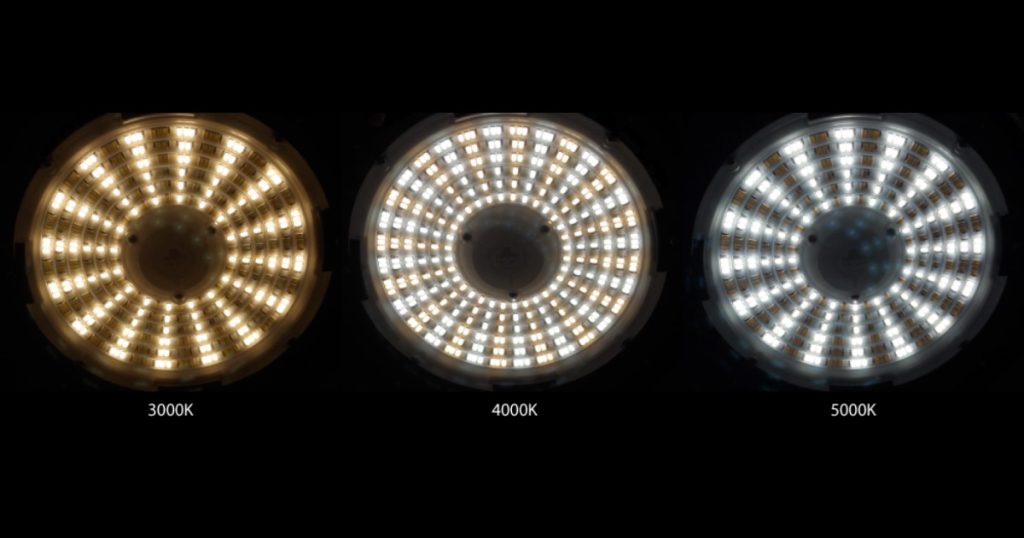
The driver precisely controls the current supplied to each chip group, adjusting both intensity and balance until the combined light achieves a 4000K colour temperature. This careful blending produces a neutral white light preferred in offices, commercial spaces, and general-purpose applications.
Why 4000K Often Produces the Highest Lumen Output
If you’ve reviewed CSC LED’s product spec sheets, you may have noticed that the 4000K mode often delivers the highest lumen output in a 3CCT luminaire. This is because:
- Both sets of LEDs (3000K + 5000K) are illuminated simultaneously.
- More active chips = more total light output.
This is completely normal and expected in fixtures designed with CCT mixing technology.
Benefits of Selectable CCT Technology
Selectable CCT fixtures offer significant advantages across multiple stages of a project:
1. Greater Flexibility in the Field
- Contractors can easily adapt colour temperature to meet client preferences or match existing lighting—without replacing the fixture.
2. Reduced Inventory for Distributors
- One SKU can serve multiple applications, reducing shelf space and simplifying stock management.
3. Higher Satisfaction for End Users
- Facilities can fine-tune lighting as needs change—warmer for ambiance, cooler for visibility, or neutral for everyday use.
4. Reduced Risk of Ordering Errors
- No need to guess the correct CCT during project planning. The choice can be made on-site.
5. Consistency Across Different Fixtures
- Because the driver controls both LED sets precisely, mixed CCT modes remain consistent and accurate over time.
If you’d like to see these concepts demonstrated in real time, including how the chips illuminate at each setting and how to verify output using a light meter, you can watch the full video below:
For more information on CSC LED lighting solutions HERE


3CCT 3CCT 3CCT