Isabelle Lessard, Engineer Responsible for Urban lighting in Montreal — a Passion that Looks Beyond Prejudices

October 16, 2018
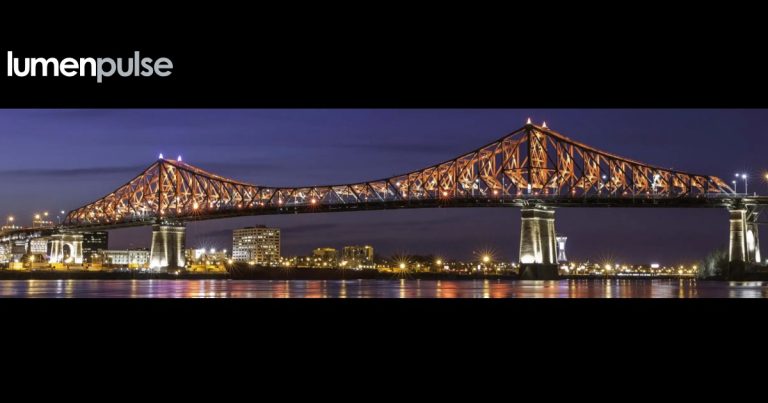
The title is a bit long, but it provides an immediate idea of the person behind the installation and management of intelligent lighting in Montreal, a project that has received awards and nominations since its commissioning and collected a following. Montreal is converting over 134,000 streetlights to LEDs and also implementing an intelligent lighting management system. Behind this revolution, a young electrical engineer, Isabelle Lessard. Read on to learn more about her journey, the challenges she has identified, and how she sees the future of urban lighting.
A graduate of the School of Advanced Technology (ETS), it was by chance that Isabelle Lessard fashioned a career in lighting. “I loved science, was leaning towards astronomy, and came across a smart home project at the Institute Teccart. That’s when I turned to electronics, then to ETS, for electrical engineering. At the end of my studies I was hired at Nortel, which as we know went into a resounding bankruptcy one year after my arrival. We were then thousands of engineers looking for a job. The City of Montreal was looking for an outstanding specialist. I was assigned to traffic lights and street landscaping, which included electricity and lighting. Retirements and reallocations of human resources meant that in 2005 I had become the city’s only lighting professional.”
It might seem difficult to navigate between political and administrative objectives in a public administration, but Isabelle tells us, “I had opportunities and bosses who trusted me completely and offered me freedom and the necessary latitude in my work. I proposed the lighting conversion project in 2010, and my employer gave me carte blanche.”
Challenges at the height of her passion for lighting awaited her in this project to convert streetlamps to LED and intelligent lighting. Some were specific to a public administration: in-depth studies of best practices, pilot projects, feasibility study, and presenting a $100 million project to municipal leaders.
“The project started in 2015 with a tender for the intelligent lighting system. “Our feasibility study was at 4000 degrees Kelvin and it was at this point that the controversy over blue light and health made headlines and became controversial. The public health direction notice delayed and the municipal government decided to go to 3000 K.”
The tender for the luminaires was issued in 2017 and the first installations took place in the fall. The intelligent system was developed in parallel.
“We were bold in the system we chose. We made a bet that turned out to be a winner. For me it was unthinkable that the city would attach itself to a single manufacturer for the next 20 years. We needed more than promises of interoperability to control 135,000 luminaires. We have attracted the market to our vision and demanded the proven interoperability of three manufacturers. The market has met the needs of the city. We have won our bet and it is now a model that can be replicated by other cities. It’s a world premiere.”
Where is the smart city headed?
Cities need a robust infrastructure to allow the passage of all types of data, cameras, motion detectors. There will be fibre cohabitation, radio frequencies, wireless, the platforms are interconnected. Urban lighting fixtures will also have to evolve. One of our challenges now is to maintain the aesthetics of a lamppost while grafting the multiple sensors and systems necessary to provide services and meet the city’s needs. By day the lamppost is an architectural element; in the evening it provides lighting and safety functions. We need to integrate intelligence and meet the needs of all the city’s services while keeping in mind that Montreal is a UNESCO City of Design.
Another challenge is to keep people informed. Sensationalist headlines about blue light have created feelings of anxiety among citizens. We need to teach people that our way of designing lighting with LED technology is more efficient, that we need less light for the same lighting, and that 100% of the light is directed where it is desired. Standards and recommendations lag behind the technology; we need to review the photometric studies.
“Lighting control systems will be imposed everywhere,” says Isabelle. “It’s just a matter of time, and systems will have to be adaptive. The infrastructure we are putting in place today will eventually be used for other services.”
Isabelle has fought prejudices in public administration and public health, married aesthetics to intelligence, and guaranteed system interoperability. What about being a woman in her community?
Her biggest challenge was to graduate from the ETS. There were very few women. Before us we lived in a world of men, but in the new generation there is little difference between men and women. Lighting is not taught in school, it is a new profession that we learn together by investing time, energy and a large dose of passion.
Line Goyette is Managing Editor of EIN; linegoyette@kerrwil.com