Evaluation Guide: 4 Steps to a Successful Lighting Evaluation (Part 2)

In the March 25 issue of Electrical Industry Newsweek, Aaron Kless laid out the first 2 parts of a 4-part guide to assessing the costs and benefits of various lighting solutions, incorporating lessons learned from more than 100 million square feet of installed intelligent LED systems across many of the most challenging production environments worldwide. Step 1 identified various evaluation criteria; step 2, identifying incentives and tax deductions. Appearing below are the remaining 2 parts. — Read Part 1 —
Step 3: gather your facility data and test potential solutions
•Facility size: whether a new build or lighting retrofit, the first step in a thorough lighting evaluation is documenting basic data about your facility and how lighting will be used. This includes:
•Applications type(s): overall square footage for the entire facility and individual spaces. Primary activity in the facility, and how major spaces are being used? For example, a contract manufacturing plant with 171,000-square feet of production, 35,000-square feet of storage and 25,000 square feet of shipping and receiving space will have different lighting requirements in each space.
•Required light levels: what light levels are needed in each of the spaces? Do they vary by space? Are there industry standards or government legislated requirements?
•Hanging height: how high are the ceilings and do they vary within the facility? Are there any challenges or impediments to hanging fixtures anywhere in the facility? Mounting height is one of many factors that determine how many units, and of what type, need to be installed to achieve desired illumination levels. Accurate height measurements are important.
•Natural light: skylights, windows and frequently opened bay doors play a significant role in helping facilities to save energy. It is important to document the number, size and location of these natural sources of light so that fixtures can be placed in a way that allows incoming light to be used effectively.
•Occupancy: For lighting purposes, occupancy refers to how frequently a space is occupied and therefore requires lighting. While a building can be considered 100% occupied with only 1 person present, lighting occupancy refers to the percentage of the building that requires lighting based on where the staff are at any given time. For example, if there are 10 workers in 100,000 square-foot facility, the facility would be considered 10% occupied, although which 10% of the building is occupied at any moment changes as staff move through the space.
•Climate issues: refrigerated and frozen facilities challenge traditional HID and HIF lighting — with restrike times, shortened ballast life, etc. — so it is important to document temperature ranges for any chilled spaces.
•Unique challenges: does your facility have over-sized machinery that makes reaching fixtures particularly difficult, hazmat rooms that require specially-rated fixtures, or work zones that require unusually intense lighting?
For facilities evaluating lighting retrofits (versus new build), it is also important to document
•existing light type(s) & wattage. Be specific and list all combinations of lighting, for example: (147) 400-watt metal halide and (52) 8-lamp T5 fluorescent fixtures.
•existing light levels. Measuring in foot candles or Lux, record existing light levels within all relevant work zones.
•fixture spacing. The distance between current fixtures can be maintained with the upgrade, or modified depending on selected fixtures’ light output and optics.
•1-for-1, 1-for-2. In some projects, consider whether — based on ceiling height, fixture optics and lumen output levels — you might be able to reduce the fixture count and still achieve target light levels. This strategy can optimize project economics by reducing both fixture count and installation costs.
•energy cost. What is your base cost per kWh? What are your peak demand charges?
•lighting energy bills. What are your lighting energy costs?
If you need help collecting this data, lighting efficiency consultants are a valuable resource for completing in-house evaluations, and a lighting audit is typically one of the first tasks they will perform when arriving at the facility in question.
Comparing solutions: apples-to-apples
With a thorough understanding of where you are today, your project goals and the criteria for taking advantage of any available utility incentives or tax benefits, evaluating lighting alternatives becomes that much easier.
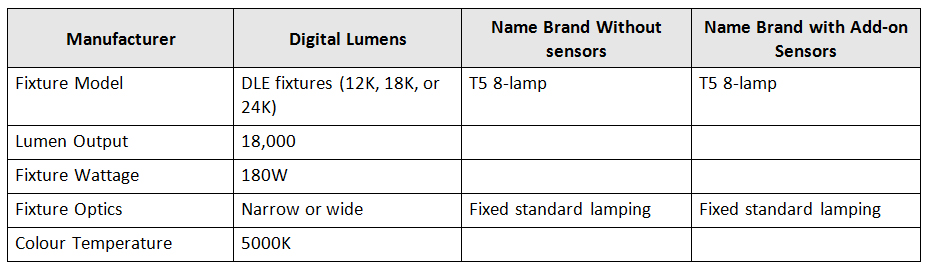
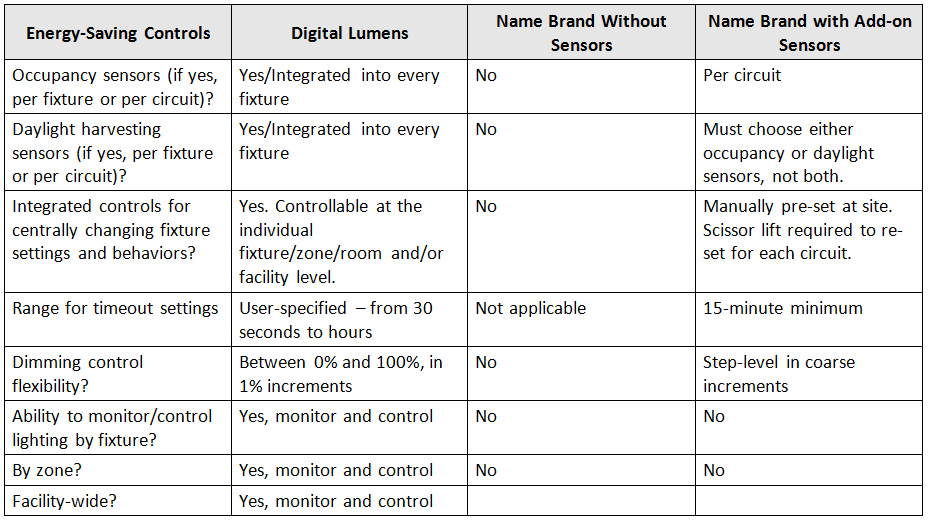
Now, it is time to do an “apples-to-apples” comparison of the potential solutions — both on paper and in your client’s facility. “Apples to apples” is the key principle for this stage so that you consider functionally comparable solutions. We strongly recommend documenting key information on alternatives in a spreadsheet for easy access and review. Make sure to include only products that meet or exceed minimum light quality, performance and efficiency goals, and meet specific requirements for
•IP Rating and UL (or comparable international) listing
•incentive and tax benefit
•code compliance
•energy-savings goals
Sample evaluation matrix
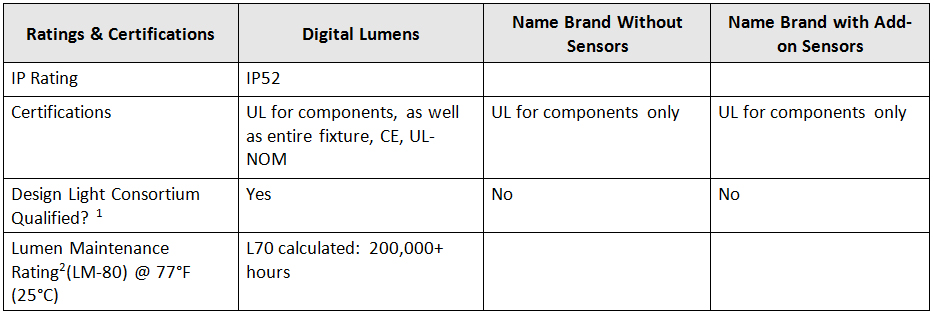 1. The “Energy Star” of industrial lighting, this listing is frequently required by utilities to grant highly valuable custom incentives
2. Projected, based on TM-21 data. L70 = Time to 70% lumen maintenance. For additional details, refer to the Statement of Lumen Maintenance available online at digitallumens.zendesk.com
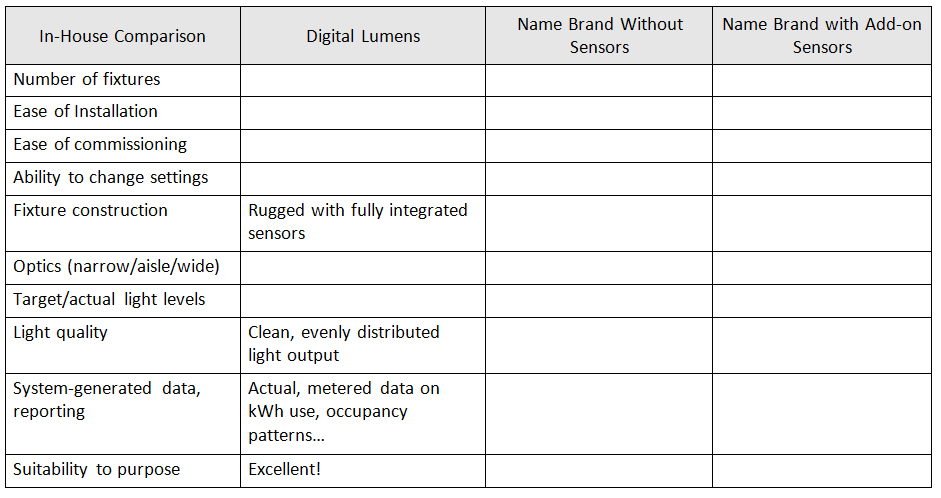
In-house evaluation: a critical step
Step 4: perform a detailed financial analysis
Now, it is time to sharpen the pencils and compare the solutions on paper. As outlined previously, it is critical to evaluate the solutions along multiple dimensions because some solutions may have a faster payback, but markedly higher lifetime costs, so it is worth the modest investment in spreadsheet time for the longer-term financial benefits.
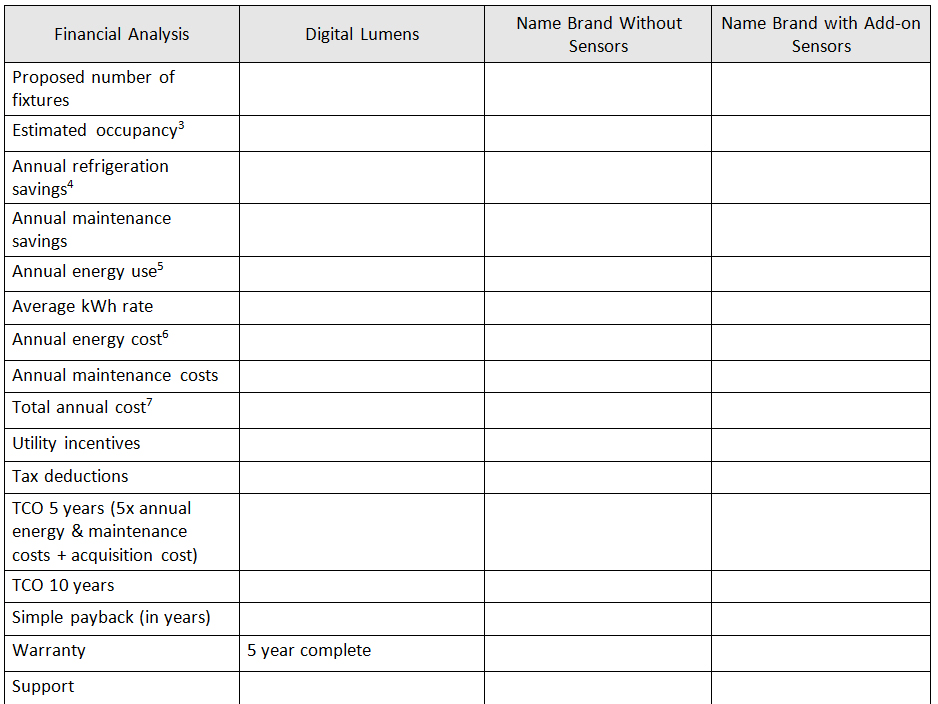
3. Using extensive data from customer installations, average occupancy rates by application are 15% for cold storage • 41% for dock areas • 29% for dry storage • 41% for manufacturing
4. To be conservative, we use a 25% savings rate for planning purposes, although the average rate observed within our customer base is 45%
5. (Number of fixtures x wattage x occupancy rate) + refrigeration savings
6. Annual energy use x kWh rate
7. Annual energy + maintenance costs
Reviewing the findings
You have done the work — established evaluation criteria, gathered detailed operational data, tested various systems in your facility, and run the numbers (payback, ROI and TCO). You now have a thorough, well-researched foundation for recommending a lighting system. Will you take advantage of the opportunity to reduce lighting energy use, while improving performance and gaining new levels of operational insight? We certainly hope so.
Aaron Kless, Director of Application Engineering, Digital Lumens, leads the team responsible for the deployment of energy efficient industrial LED lighting installations across the globe.