True-to-Life Lighting Demonstrations: What’s the Best Way to Faithfully Showcase Quality of Light?
April 17, 2018
Many manufacturers claim that their products deliver the best quality of light. That’s good, because lighting professionals say they need the best quality of light to make their designs really come to life. But what does quality of light actually mean, and how can it be demonstrated most faithfully to be sure it will be the same in the actual application?
Quality of light is both objective and subjective; a science and an art. On the one hand it can be measured; on the other hand it depends on personal judgments. It certainly depends heavily on the application. For example, for road lighting, quality of light involves providing good visibility while limiting glare. In a fashion store, quality of light means matching the image of the brand and attracting the target audience by, for example, creating high contrast areas within the store. These different definitions make it difficult to pin down what high quality of light means to a customer, particularly when people’s ages and cultural differences also need to be taken into account. A general rule of thumb is that the quality of light is high if the lighting serves its purpose.
Professionals and their clients generally look for high quality of light, but the big question is how they can decide which of the different options is best. There are different methods of demonstrating and explaining lighting, and it is not always clear which method will most faithfully showcase what the light and quality of lighting will be like after installation. We’ll now look at the most relevant ones.
One way is to present and share data on certain quality of light parameters, which can help some professionals if they have sufficient knowledge to interpret the data. Quality of light can be defined in terms of illuminance and luminance, colour rendering index (CRI), colour temperature, glare factors, etc. What is essential is to present all the data in a consistent way so that clear comparisons can be made easily.
A second common approach is to show what the end result will look like. A range of methods are available — both computer-based and manual — and each with their pros and cons. Hand rendering can show how light works in a space. Even the highest end renderings still only give an impression (compared to seeing something in reality), and one advantage of using a pencil and paper is that it is immediately apparent that reality is not being presented, but an impression. This leaves room for the imagination, which for some situations and applications such as architectural lighting, can be beneficial. Some skill is needed though to perform hand renderings effectively.
Computer rendering methods can be fairly quick, taking the elements necessary to make lighting calculations and then projecting them onto the surfaces that the computer is told are present. These systems assume a limited number of inter-reflections in the space. This method can have value in seeing very approximately where light falls and giving some idea of intensity.
Higher up the tree is ray tracing software, which can provide good quality images by tracing the paths that rays of light take and taking into account the materials that have been used. The quality of the output then relies entirely on how faithfully the material attributes are linked to reality. For example, not just specifying “light wood” but exactly what type, texture and other features of the wood.
Both these methods depend heavily on two key factors. First, the calculations and the basic lighting models need to replicate reality, at least to some extent. Second, the people actually using the space (e.g., in an office, a store or on the road) need to be included in the assumptions. In short, there are a lot of factors that make computer rendering difficult to do well.
A third approach is to show what light can do in practice. Here, methods vary from showing the effect of light against a wall or other surface, to mock-ups on buildings, to demonstration centres. Like the calculation and rendering methods, each has its own advantages and disadvantages linked to their level of complexity, accessibility and level of reality they show.
The level of reality is determined by how faithfully the demonstration fits a real situation. In other words, whether the location of the lighting and the scale and type of materials used all match the final installation.
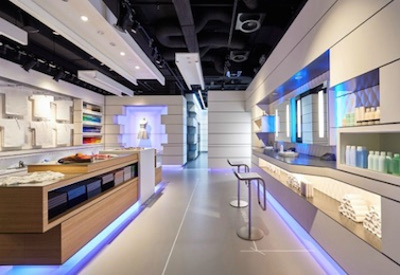
Another way to use demonstrations is to assist in a dialogue and show examples of applications. Here, unique facilities such as Philips Lighting Application Centres can play a role, with their full-scale areas dedicated to many key applications of light including fashion stores, supermarkets, offices, warehouses, sports facilities, and road, residential and urban architecture. These centres play a particularly valuable role when the audience does not know or cannot imagine the value that light can bring.
These centres welcome city mayors, building owners, investors, designers, contractors and others exposing them to a new discussion, visually, on quality of light and what it means. Even for those already expert in lighting, buildings and infrastructures, these centres are often seen as a tool they can use to explain to their clients what quality of light can bring.
It’s apparent that everyone is concerned by quality of light, but unless they can understand what it means then it is likely to remain a subject for lighting specialists only. This is why showcasing quality of light is so important. It enables quality of light to be actually illustrated to a broad range of people with different interests. It enables them to see for themselves what high — or poor — quality of light looks like, and helps them to take decisions to target the former rather than the latter.
This article was first published online by Philips Lighting: www.lighting.philips.com/main/support/connect/lighting-technology/lighting-design-and-quality/the-best-way-to-faithfully-showcase-quality-of-light?linkId=48535984.
Matthew Cobham is Head of Lighting Application, Europe & OLAC, for Philips Lighting