New Atlas Shows Extent of Light Pollution – What Does It Mean for Our Health?
July 12 2016
The new comprehensive World Atlas of Artificial Night Sky Brightness has just appeared in Science Advances. Written by a group of distinguished scientists led by Italian Fabio Falchi, it is a noteworthy accomplishment. The first atlas appeared in 2001, but was based on a less precise satellite measurement system. This latest atlas provides far more clarity.
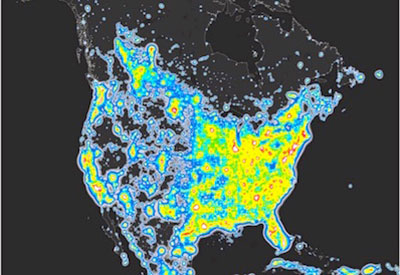
The atlas measures what is called artificial sky glow — reflected light scatter in the atmosphere from the electric lighting below — across the world. Sky glow results from light pollution, or the excess of electric light during the night. But “light pollution” is not like “water pollution” which is pollution of water. It’s actually “night pollution by electric light” (Image: map of North America’s artificial sky brightness, in twofold increasing steps, as a ratio to the natural sky brightness).
So what is the magnitude of the problem?
As one measure of how far we have come in obliterating the night sky, Falchi and colleagues estimate that, thanks to sky glow, the Milky Way is no longer visible to one-third of humanity, with the most heavily industrialized regions suffering the greatest loss: 60% of Europeans and 80% of North Americans can no longer see the Milky Way at night.
But the problem with light pollution isn’t just about stargazing. As Falchi and his colleagues point out, it also has effects on environmental and public health. As an epidemiologist who has been studying the possible impact of electric lighting on health for decades, I am greatly concerned about this.
How do we measure artificial light pollution?
The atlas uses light measurements taken by the Suomi National Polar-orbiting Partnership satellite, which orbits 800 kilometres above the Earth and takes pictures of the ground below at night. The satellite can sense the intensity of any light source it detects and plot its location. These measurements are then converted by some sophisticated modeling to produce colourful maps of each region of the world that show the level of sky glow over cities, towns and adjacent countrysides.
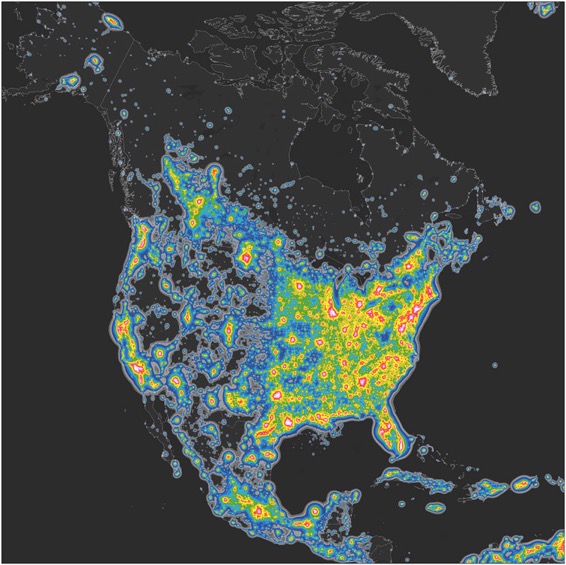
Map of North America’s artificial sky brightness, in twofold increasing steps, as a ratio to the natural sky brightness.
While the maps are rather pretty and appealing to view, the underlying message is ominous. The more sky glow, the more obscure the night sky is. For instance, in Times Square in the heart of New York City, at midnight you might be able to count only a dozen stars in the sky, if that. In those areas of the map that show red, the authors tell us, people don’t experience true night because of an artificial twilight from sky glow.
In fact, as Falchi and colleagues note, “…the most light-polluted country is Singapore, where the entire population lives under skies so bright that the eye cannot fully dark-adapt to night vision.”
In the most affected regions of the megacities in Europe, the Americas and Asia, the local light levels outside on the street are at times enough to prevent or delay transition to our normal nighttime physiology which should begin at about sunset. The health effects of these local light sources at night, and the sky glow they cause, are the subject of intense research, and have not yet been fully calculated.
Developing societies are also embracing electric lighting of the night, and light pollution is expanding its domain at an epidemic rate. I must emphasize that this represents a huge change in the environment.
Sky glow isn’t just a problem in megacities and urban areas. As the authors note, Death Valley gets sky glow from Las Vegas and Los Angeles, and thereby experiences light pollution.
What does sky glow mean for you?
Humans, like most other life forms on the planet, have what is called an endogenous circadian rhythmicity. This is a built-in cycle for sleep and wake patterns, hunger, activity, hormone production, body temperature and a vast array of other physiological processes. The cycle lasts roughly 24 hours, and light, especially sunlight, and darkness are important signals to keep it on track.
The sky glow reported in the atlas is, by itself, probably below the threshold for directly affecting our circadian rhythms, as measured by suppression of the circadian hormone melatonin.
But the sky glow the atlas measures is the atmospheric reflection of electric lights in the immediate human environment. Those local light sources are in many, if not most, cases sufficient to cause circadian disruption. These include the lighting inside homes and commercial buildings as well as some forms of street lighting.
So the maps also indicate those places where light at night, in all its forms, can most disrupt our normal circadian rhythms, both inside buildings and for those who are outside at night.
This circadian physiology has developed over billions of years. Humans have been living with electricity only since the late 19th century, and with widespread access in industrialized countries only since the 20th century. While that sounds like a long time, it’s tiny drop in the evolutionary bucket. We are only beginning to understand the health consequences artificial light has on our circadian physiology.
The increasing illumination of night has converged with our growing understanding of circadian physiology, and how light at night can disrupt that physiology. The suspicion has emerged recently that some serious maladies could result from circadian disruption such as poor sleep, obesity, diabetes, certain cancers and mood disorders. The most potent environmental exposure that can cause circadian disruption is ill-timed electric lighting, particularly at night.
There are also some severe ecological consequences of light pollution that include mortality events on migrating birds and sea mammals.
Turn off the lights
Just as technology has created the problem of light pollution by invention of the electric light bulb, the technology of biological science is showing us what forms of light and at what times of day are most, or least, harmful to our circadian health.
This knowledge is now being exploited to produce light sources that are appropriate for time of day. At the most basic, best is bright light with high blue content (e.g., compact fluorescent) in the morning and dim light with low blue content (e.g., low wattage incandescent) beginning at dusk. And turn off the bright blue screens of tablets and smart phones; read an actual book in the evening.
One of many implications of this work is the engineering of street lighting. The wholesale conversion to “white” LED street lighting is coming under increasing scrutiny because that lighting produces the blue wavelengths that are least friendly to our nighttime physiology and circadian health.
Maybe it’s time rethink street lighting. Energy efficiency is an important consideration, but so too is health of the planet.
Richard G. ‘Bugs’ Stevens Professor, School of Medicine, University of Connecticut. He does not work for, consult, own shares in or receive funding from any company or organization that would benefit from this article, and has disclosed no relevant affiliations beyond the academic appointment above.