Futuristic Brain Probe Allows for Wireless Control of Neurons
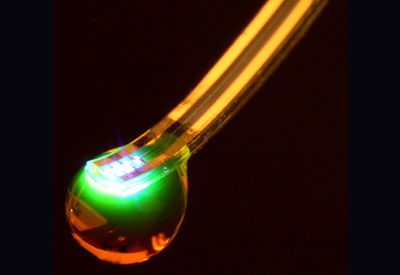
Mind bending probe: scientists used soft materials to create a brain implant a tenth the width of a human hair that can wirelessly control neurons with lights and drugs. Courtesy of Jeong lab, University of Colorado Boulder. Scientists have developed an ultra-thin, minimally invasive device for controlling brain cells with drugs and light. Researchers at the Washington University School of Medicine, St. Louis, and University of Illinois, Urbana-Champaign, created a remote controlled, next-generation tissue implant that allows neuroscientists to inject drugs and shine lights on neurons deep inside the brains of mice. The revolutionary device is described online in the journal Cell. Its development was partially funded by the National Institutes of Health. A study has shown that scientists can wirelessly determine the path a mouse walks with a press of a button.
“It unplugs a world of possibilities for scientists to learn how brain circuits work in a more natural setting,” says Michael R. Bruchas, Ph.D., associate professor of anesthesiology and neurobiology at Washington University School of Medicine and a senior author of the study.
The Bruchas lab studies circuits that control a variety of disorders, including stress, depression, addiction, and pain. Typically, scientists who study these circuits have to choose between injecting drugs through bulky metal tubes and delivering lights through fibre optic cables. Both options require surgery that can damage parts of the brain and introduce experimental conditions that hinder animals’ natural movements.
To address these issues, Jae-Woong Jeong, Ph.D., a bioengineer formerly at the University of Illinois at Urbana-Champaign, worked with Jordan G. McCall, Ph.D., a graduate student in the Bruchas lab, to construct a remote controlled, optofluidic implant. The device is made out of soft materials that are a tenth the diameter of a human hair and can simultaneously deliver drugs and lights.
“We used powerful nano-manufacturing strategies to fabricate an implant that lets us penetrate deep inside the brain with minimal damage,” said John A. Rogers, Ph.D., professor of materials science and engineering, University of Illinois at Urbana-Champaign and a senior author. “Ultra-miniaturized devices like this have tremendous potential for science and medicine.”
With a thickness of 80 micrometers and a width of 500 micrometers, the optofluidic implant is thinner than the metal tubes, or cannulas, scientists typically use to inject drugs. When the scientists compared the implant with a typical cannula they found that the implant damaged and displaced much less brain tissue.
The scientists tested the device’s drug delivery potential by surgically placing it into the brains of mice. In some experiments, they showed that they could precisely map circuits by using the implant to inject viruses that label cells with genetic dyes. In other experiments, they made mice walk in circles by injecting a drug that mimics morphine into the ventral tegmental area (VTA), a region that controls motivation and addiction.
The researchers also tested the device’s combined light and drug delivery potential when they made mice that have light-sensitive VTA neurons stay on one side of a cage by commanding the implant to shine laser pulses on the cells. The mice lost the preference when the scientists directed the device to simultaneously inject a drug that blocks neuronal communication. In all of the experiments, the mice were about three feet away from the command antenna.
“This is the kind of revolutionary tool development that neuroscientists need to map out brain circuit activity,” says James Gnadt, Ph.D., program director at the NIH’s National Institute of Neurological Disorders and Stroke (NINDS). “It’s in line with the goals of the NIH’s BRAIN Initiative.”
The researchers fabricated the implant using semi-conductor computer chip manufacturing techniques. It has room for up to four drugs and has four microscale inorganic light-emitting diodes. They installed an expandable material at the bottom of the drug reservoirs to control delivery. When the temperature on an electric heater beneath the reservoir rose, the bottom rapidly expanded and pushed the drug out into the brain.
“We tried at least 30 different prototypes before one finally worked,” says Dr. McCall.
“This was truly an interdisciplinary effort,” says Dr. Jeong, who is now an assistant professor of electrical, computer, and energy engineering at University of Colorado Boulder. “We tried to engineer the implant to meet some of neuroscience’s greatest unmet needs.”
In the study, the scientists provide detailed instructions for manufacturing the implant.
“A tool is only good if it’s used,” says Dr. Bruchas. “We believe an open, crowdsourcing approach to neuroscience is a great way to understand normal and healthy brain circuitry.”
This work was supported by grants from NIH (NS081707, DA037152, DA038752, MH101956), US Department of Energy (DE-FG02-07ER46471, DE-FG02-07ER46453), Department of Defense National Security Science and Engineering Faculty Fellowship.
For more information, visit: http://www.ninds.nih.gov/
Reference
Jeong et al. “Wireless Optofluidic Systems for Programmable In Vivo Pharmacology and Optogenetics,” Cell, July 16, 2015. DOI: 10.1016/j.cell.2015.06.058
Source: National Institutes for Health, http://www.nih.gov/