Energy Savings Potential of DLC Commercial Lighting and Networked Lighting Controls
November 19, 2018
Energy saving opportunities for residential utility lighting programs will soon be largely exhausted due to growing market saturation, according to a report written by Dan Mellinger, Senior Consultant with Vermont-based Energy Futures Group, for DesignLights Consortium. The report appears below. All statistics refer to the U.S. market.
Lighting product types used by commercial and industrial (C&I) facilities are primarily indoor linear fixtures (72% of installed products) followed by outdoor fixtures (10%) and indoor non-linear products (8%). In each of these C&I product categories, the large installed base coupled with relatively low LED market saturation offers significant potential for future energy savings, particularly when paired with networked lighting controls.
LED lamp and fixture potential
The adoption of C&I LED lighting products has grown rapidly in recent years. Adoption accelerates across the board as prices continue to fall and product performance steadily improves. All product categories have entered their growth phase, although none have surpassed 50% market adoption as of 2018. Outdoor products, such as parking area and streetlights, have achieved higher levels of adoption due to earlier market introductions and greater savings potential compared to incumbent technologies, among other factors. Indoor products, such as linear troffers and high/low bay fixtures, are much lower on the adoption curve. These products were slower to mature and compete against a reasonably efficient fluorescent incumbent technology. Linear products, which represent the largest portion of the installed base, have achieved only 6.5% LED adoption as of 2017.
With continued levels of utility promotion, energy savings from C&I LED lighting will reach its highest point in 2022 and will remain at levels at least as great as those experienced in 2017 through 2024. While outdoor LED products have already achieved moderate levels of market adoption and will therefore see annual savings from new installations gradually decline starting as early as 2020, those declines will be offset for a number of years by rapid growth in annual savings from indoor product categories. Indoor products will not reach their high point of adoption and energy savings until the mid-2020s. Screw base LED products offer very little remaining savings due to higher levels of saturation in the C&I sector.
It should be noted that the savings potential presented here includes adoption that will occur naturally due to market forces beyond utility interventions. Due to more stringent building codes and decreasing availability of traditional technologies, LEDs may soon be considered baseline for new construction projects. Additionally, the savings forecast does not account for any net savings adjustments that are often applied to utility programs. For example, savings may be reduced to account for program participants who are considered to be free riders. As LED technology continues to mature, and on-going adoption results in higher levels of saturation, it is likely that free ridership will become an increasingly relevant factor for utility programs. The impact of future net savings adjustments will likely vary by product category, with the greatest impact applied to the most mature and/or saturated categories such as replacement lamps and outdoor lighting.
Networked lighting controls potential
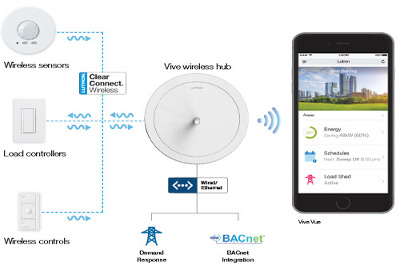
Networked lighting controls (NLC) offer added savings potential: on average 47% additional savings are possible after LED conversion (DLC 2017). NLC adoption has been limited to date by
- the expensive and complicated nature of the systems
- under-trained contractors
- poorly understood benefits
- limited (or poorly designed) utility support
Additionally, NLC adoption is hindered when utility programs focus on the lowest cost incremental saving opportunities such as LED tube retrofits. Unfortunately, if C&I LED products are installed without networked lighting controls, the opportunity to capture much of the savings potential that they offer can become stranded for many years because retrofitting NLC systems onto already installed LED products is both expensive and technically challenging.
The slow adoption to date of NLC systems has not yet adversely affected total C&I savings potential in a significant way. However, with adoption of indoor LED products accelerating rapidly, we are now at a crossroads for NLCs. If current levels of relatively limited utility promotion of NLCs continue into the future, the additional savings NLCs will provide will be very modest throughout the 2020s. However, if utilities aggressively promote and support NLCs, the additional savings possible result in total NLC savings of more than twice as much compared to what might be realized under the current path by 2035.
Accelerating the adoption of NLCs ensures that more systems are coupled with LED products at the time of installation. Aggressive utility promotion of networked lighting controls will push the peak savings to a higher level in the mid-2020s and will enable C&I utility lighting savings to be maintained at or above 2017 levels until 2030 — twice as long when compared to LED fixtures and lamps alone. This long-term potential offered by NLCs is even more important when considered in the context of net savings. Lighting controls have historically had very low levels of free ridership, so NLCs offer a potentially dependable path for utility savings.
To capitalize on the NLC opportunity, utilities should consider employing strategies that address both breadth and depth. Prescriptive and midstream program designs are simple to understand, make participation easy for customers, and are preferred by supply chain partners. Increasingly, utilities are using these program models to more rapidly reach scale of NLC adoption. These widget-based programs are especially well suited to networked lighting control solutions that are integral to LED lighting fixtures.
When establishing prescriptive and midstream NLC rebate levels, utilities should consider shifting resources away from stand-alone LED lighting measures and toward the system solution of LED + NLC. Performance-based or space-based program models are being employed by some utilities to accommodate more complex NLC systems and/or larger scale projects. While these program designs tend to be more complicated and are less likely to reach high volumes, they can maximize the per-project savings of NLCs. And finally, other industry solutions such as lighting as a service hold promise for accelerating NLC adoption.
Savings by product application
The most significant C&I savings opportunity exists within the linear LED lamp and fixture category when installed with networked controls. This upgrade opportunity will be ubiquitous among C&I customers. The parking area/garage product category offers the second highest remaining potential due to a large installed base coupled with an excellent opportunity for networked controls. Meanwhile screw base LED products, which have been a major source of utility savings for both residential and C&I portfolios over the past 10 years, represent a much smaller portion of the remaining savings potential.
Conclusion
C&I utility programs have the potential to capture significant lighting savings — and associated carbon reductions — for many years to come with ongoing support of LED and NLCs. Regardless of region, a path exists to maintain C&I lighting portfolios at or above current levels until at least 2028. Utility programs must aggressively pursue these opportunities using a multitude of strategies and service delivery models. The promotion and adoption of networked lighting controls is critical to ensure that utilities and customers capture the full benefit of LED systems being installed today.
This article was first published online as a report by DesignLights Consortium. It has been lightly edited here. Download the full article and watch a webinar discussion of the report here: www.designlights.org/resources/energy-savings-potential-of-dlc-commercial-lighting-and-networked-lighting-controls/.
Photo source: Lutron
Dan Melinger is a Senior Consultant with Vermont-based Energy Futures Group, where he works to advance clean energy policies throughout North America. Dan specializes in commercial program design, lighting technology, market analysis, and program strategy. He has advised on hundreds of commercial efficiency projects and has helped advance national industry standards for lighting and energy. Prior to joining EFG, Dan spent 13 years with Efficiency Vermont where he designed, planned and administered industry-leading commercial lighting programs. He received his degree in Electrical Engineering from Michigan State University, is a licensed Professional Engineer in Vermont and is Lighting Certified.