Safe at Sea — The History of Lighthouses
August 6, 2018
Dotted along rugged coastlines and harbor entrances around the world, lighthouses have long prevented disasters and saved lives at sea. They have also captured our imagination. Even today, with automation replacing the role of lighthouse keepers, a certain curiosity remains regarding these reassuring structures and the tales their former guardians have to tell.
As the urban myth goes, the captain of a U.S. Navy warship is on a collision course with what he thinks is a Canadian ship. In communicating with it, he demands that the ship change its course. “Change your course,” is the retort. At this point, the U.S. naval officer puffs his chest out and reiterates his command: “This is the aircraft carrier USS Lincoln, the second largest ship in the United States’ Atlantic fleet. We are accompanied by three destroyers, three cruisers and numerous support vessels. I demand that you change your course 15 degrees north, that’s one five degrees north, or countermeasures will be undertaken to ensure the safety of this ship.” To which the reply from the Canadian comes, “I’m a lighthouse. Your call.”
First came fire
Often seen as an archetypal public good — lighthouses provide “free” light to ships — light has in fact long been used to ensure safety at sea. The earliest examples are fires on hilltops that marked dangerous coastlines or hazardous shoals and reefs. The iconic structures as we know them today first appeared in the 18th century following advances in structural engineering and lighting equipment. Over time, carbon arc burners, oil lamps and Dalén lights (a light produced by burning carbide gas, combined with a solar sensor) gave way to electric lights, which had become dominant by the 1960s.
The human touch
With lighthouses came lighthouse keepers. They were responsible for maintaining the buildings and operating the lamps, from trimming wicks and replenishing fuel, to winding clockworks. Keepers normally lived on site, sometimes with their families. However, rather than being permanently based in just one location, it was common for them to be moved to different places throughout their careers. Different keepers would also often live together and share the work. It wasn’t always an easy task. Many structures didn’t have running water or heating, while others were somewhat isolated from the outside world.
Of course, everything has its day. And for lighthouse keepers, it seems the ship has now mostly sailed. With advances in technology, automation first started to be introduced in the 1980s, but was fully implemented in the 1990s. As remote monitoring and automatic bulb changing became increasingly common, paid keepers became a thing of the past.
The role of light lives on
Interestingly, despite the advent of GPS and modern navigation technology on ships, warning lights along the coast are still regarded as an important backup. Should navigation technology fail or weather conditions be too severe, light on the coastline can still prevent disaster and aid orientation. One such example is the barrier coral reef in the Florida Keys. Arcing for 200 miles, primarily along the coast of the Keys and on the edge of the powerful Gulf Stream, it has been a menace to hundreds of vessels who have unknowingly rammed into it. In 2013, based on the opinion of the mariner community, the U.S. Coast Guard installed two new 40-foot-tall steel structures with LED lights that can be seen from 14 nautical miles away, in all directions.
Lighthouse legacies
Elsewhere, while many historical structures were initially neglected or faced demolition; such is their charm and nod to the past that several have now been turned over to government agencies or non-profits to maintain and administer. Others have taken on a completely new function: think luxury hotels and alternative wedding venues. And the keepers? While they have mostly moved on, through books and memoirs, their stories and legends will live on long after the lights go out.
This article was first published online by LEDVANCE; www.ledvance.com/news-and-stories/stories/safe-at-sea/index.jsp
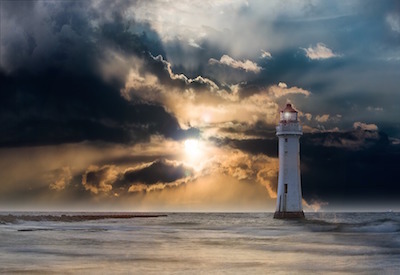
Photo source: PIRO4D on Pixabay.