Report Explores Energy Savings from Networked Lighting Control Systems
December 8, 2017
While connected lighting currently comprises less than 1% of all luminaires in the United States, a recent study conducted by DesignLights Consortium (DLC) found average energy savings from networked lighting controls (NLCs) to be 47%. These results match an estimate from the U.S. Department of Energy that connected lighting represents up to 45% of total lighting energy savings potential. Results from the DLC study “bring us a step closer to being able to realize the full potential of energy data from lighting and building systems,” says the organization.
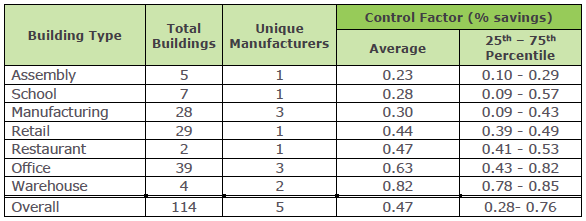
The research project collected, aggregated, and analyzed zone- and fixture-level energy monitoring interval data from NLC systems in 114 buildings across a variety of building types in North America, representing over 1,200 zones with an average of 60 days of monitoring data per building. Overall, the study found average energy savings from NLCs to be 47%, although values are highly site-specific (see table below).
The results presented in the report, Energy Savings from Networked Lighting Control (NLC) Systems, provide utilities, regulators, manufacturers, specifiers, and end-users with better estimates of NLC energy savings by utilizing embedded energy reporting capabilities and anonymized performance data from NLC systems across a variety of existing installations. Recommendations from this report could enable easier data collection from future installations, and brings the industry a step closer to realizing the full potential of energy data from lighting and building systems.
NLC energy monitoring data and the report have three primary intended uses:
- quantifying savings claims of interior NLC systems to potential customers: while many manufacturers, manufacturer representatives, and contractors typically use their own literature and calculators estimating energy savings, reliable third-party estimates improve customer confidence that NLC systems can achieve the savings claims touted by a manufacturer or salesperson
- Iimproving the utility evaluation process
- supporting utility program planners
What the study found
Here’s a summary of the findings.
1: Energy savings are highly site-specific, and there is no clear correlation between building type and energy savings due to NLCs, with the possible exception of warehouse and assembly. Site-specific variation is a much larger driver than general factors such as building type.
2: In this study, buildings with NLC systems have significantly longer hours than typical prescribed estimates of building operating hours. However, further study and a larger sample size are required to confirm, says the report.
3: Data authorization approval must be streamlined to facilitate data collection for future projects. Although manufacturers and utility programs have an installed base of thousands of sites, obtaining authorization for receipt of anonymized data was a major obstacle to data collection.
4: Most manufacturers do not have an existing mechanism to easily export the data required for utility program evaluation. Nearly all organizations had challenges exporting data in the appropriate format. Existing manufacturer reports focus on delivering insight to building owners and facility managers, both of whom have data reporting needs and interests that are different from those of a utility.
Recommendations
Among the recommendations were the following.
- Manufacturers and vendors should support utility program reporting needs by incorporating data sharing authorization clauses and service-level agreements into their customer contracts. Many manufacturers, vendors, and utilities also do not have existing data sharing authorization agreements in place with customers. Manufacturers and vendors should consider adding data authorization clauses into customer contracts and data sharing terms into service-level agreements that identify the parties responsible for providing data to utility programs.
- Future data collection efforts should focus on increasing the sample size, monitoring duration, and building operational characteristics to identify drivers of best-in-class NLC performance. NLC energy savings are highly site-specific. Future data collection efforts should focus on understanding how building characteristics and operational profiles affect energy savings. These findings can support the development of NLC program best practices and system configuration/operation recommendations to maximize energy savings.
Next steps
With additional funding, DLC hopes to conduct an update study in 2018 which will build on the findings, implement recommendations where possible, and expand the project sample size and data collection effort to develop a stronger understanding of the drivers of NLC savings in buildings, such as site occupancy patterns or controls settings such as the length of occupancy timeout delays. An expanded dataset could address some of these questions in the future, after product databases and sales contracts have been modified to support that goal
Find out more about the report: www.designlights.org/lighting-controls/reports-tools-resources/nlc-energy-savings-report/
Summary of inferred NLC savings by building type results