What’s the Difference Between full Gamut LEDs, Standard LEDs?
April 7, 2020
When it comes to setting a stage, few technologies make facilities and products shine like energy-efficient, high-performing LED lights and controls.
This easily-to-customize, low-maintenance technology is helping retail, hospitality, office and commercial spaces of all sizes hit on various types of lighting, in turn drawing more occupants and increasing value and sales opportunities.
In fact, standard and full gamut LED lights have helped enhance various types of lighting needs, including:
- Ambient lighting, so occupants can see well and feel comfortable.
- Task lighting, for spaces where more activity takes place and greater illumination is needed.
- Decorative lighting, for superior visual appeal and for invoking a desired emotion or tone.
- Accent lighting, to highlight specific areas and attract greater attention to certain products and displays, making those objects look more impressive and desirable.
But deciding which type of LED light to use—standard or full gamut LED—when and where can oftentimes be challenging for architects, contractors and designers.
Especially since neither LED is “better,” per se. It depends on the application. To decide, the following should be asked during the design process:
- What’s the application?
- Should colors look natural? Saturated? Desaturated?
- Should certain colors be emphasized over others?
Before we detail which type of light works better for which application, let’s touch on color rendering—what it is, plus a few accompanying metrics.
Understanding color rendering
Electricians, suppliers and other experts have measurements for properly comparing and evaluating light sources and their color quality. Three common ones are CRI, GAI and TM-30.
The Color Rendering Index (CRI) is the industry standard for measuring how accurately colors appear to the human eye, depending on the light source as compared to the sun. CRI utilizes a 100-point scale. The closer you are to 100, the more closely it matches the reference.
But CRI measures light fidelity, not output quality, and its score is based on an average of eight desaturated color scores. That’s why similarly scoring lights can render colors very differently.
The real world has more than eight colors, all fully saturated.
Thus, the Gamut Area Index (GAI) was created. It’s like CRI but differs in that it measures color saturation. A high GAI score is generally considered good.
CRI and GAI work best together. Designers and contractors prefer sources with high CRI and GAI scores, not just one or the other.
However, these metrics still don’t give enough information to get a full picture of a light’s output.
To do that, consider TM-30’s vector graphic, which indicates which colors will be saturated and which ones won’t be. It’s the closest thing to getting the whole story.
TM-30s’s fidelity and gamut indices are based on 99 real-world, saturated colors. This makes its reading more accurate for describing the quality of new lighting systems, namely standard and high gamut LEDs.
When to do use standard LEDs
Standard LEDs are the ideal light source to present objects in their truest, natural color. This makes them go-to options for residential uses and intimate hospitality settings like restaurant booths, hotel rooms and dressing rooms.
LEDs with a 90-plus score are also best for applications where skin tones are prominent. Think jewelry and cosmetic retail stores, both of which sell products that look good only in comparison to the user’s skin. If a face with makeup or a hand with jewelry looks weirdly unnatural or unhealthy when donning the merchandise, customers will surely pass on buying.
Art galleries—or a hospitality, office or commercial space looking to spotlight unique wall décor by maintaining the works’ original colors—would also benefit from using standard LEDs.
But this doesn’t mean standard LED lights alone should always be used instead of gamut LEDs in these applications. Sometimes gamut LEDs are the way to go.
Other times, both should be used.
When to use gamut LEDs
Full gamut LEDs are designed to oversaturate colors. They razzle-dazzle by making natural colors pop with LED chips that deliver color saturation across a larger spectrum than standard LEDs.
This makes them ideal for certain applications where color is needed to wow.
A large hospitality space with bright accent walls, for example, would look very good under full gamut LEDs. In retail, a high gaunt source would make products pop from window displays and in-store aisles.
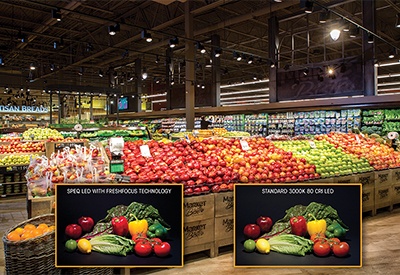
Case in point: Supermarkets are using tunable LED lighting solutions to reinvent their in-store shopping experience.
Because online competition has chipped away at dry-good revenue, grocers are shrinking their center aisles and using tunable lighting systems with full gamut abilities to draw attention to their renovated perimeter aisles. This is where higher-margin departments including produce, dairy, meats, seafood, floral and premade meals are placed.
These lighting systems help showcase the natural colors of these foods and make them look fresher and crisper. The meats look redder, the veggies greener.
Sometimes, applications can require standard and full gamut LED lights, depending on where in the store.
Take a clothing retailer. On the floor, full gamut lights would make the clothes pop and entice shoppers to hit the dressing rooms. There, standard LED lights would help make the shoppers look good when trying the clothes on, the garments’ colors complimenting the users’ skin tone, luring these shoppers up to the register, items in hand.
When used appropriately, standard and full gamut LED lights—separate or paired—are powerful tools in helping architects and designers create beautiful, efficient retail and hospitality experiences.