University of Oregon Evaluates Impact of Daylight, Views, and Controllable Lighting
Oct 22, 2019
By Craig DiLouie
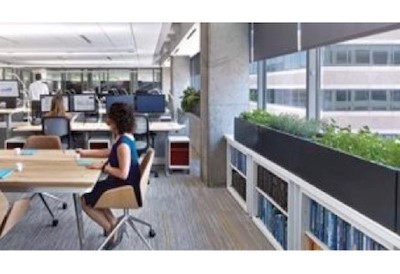
In August 2019, the University of Oregon published a whitepaper, The Impact of Lighting and Views in the Workplace of the Future. The paper concludes that daylighted spaces with controlled lighting and views can improve occupant well-being, workplace productivity, and satisfaction by positively influencing various physiological and psychological processes. Lighting and views also impact property value and employee recruitment and retention, the researchers said.
“If current trends hold, the demand for daylight, views, and personal controls will only increase,” the paper’s authors write, “and design solutions that integrate natural elements with intuitive control and automation technology will be highly favoured.” The authors include Paul Ward, Jeff Kline, and Kevin Van Den Wymelenberg of the university’s Energy Studies in Buildings Laboratory and Siobhan Rockcastle of the Baker Lighting Laboratory.
Key assertions
The researchers supported their conclusions with a deep review of peer-reviewed journal articles, research, and employee surveys. These conclusions hinged on five key assertions:
- Greater access to daylight and views correlates with greater productivity.
- Views, particularly views of vegetation and water, increase property value.
- Occupants value daylight and views, which contribute to employee retention and may aid recruitment by influencing initial space impressions.
- Shading control systems can have a significantly positive impact on occupant comfort.
- Personal dimming control improves occupant satisfaction, while colour tuning offers potential to influence mood.
Granular design
“In the past, we spent a lot of energy trying to make our lighting systems as uniform as possible,” said Rockcastle, Director of the University of Oregon’s Baker Lighting Lab. “We now know that it matters when, where, and how much light we are exposed to, and the field is working to develop lighting systems that offer more holistic benefits.” Specifically, personal shading and electric lighting control systems can help realize the benefits of daylight and views while significantly improving comfort, satisfaction, and energy performance.
“The demand for daylight, views, and personal controls are continuing to increase in the workplace,” said Van Den Wymelenberg, Director, Energy Studies in Buildings Laboratory, Institute for Health in the Built Environment. “At the Institute for Health in the Built Environment, we believe that enough is known about the influence of the visual environment on human well-being and performance to recommend action.” The whitepaper discusses literature indicating the value of daylight indoors to support of healthy circadian rhythms and improve sleep quality. However, the paper cautions against over-generalizing what are currently highly contextual and typically discreet findings related to light and health.
The white paper recommends a measured approach to lighting practice, utilizing natural daylight where possible and electric lighting, patterned on the cycles of the natural environment, that reinforces the body’s natural rhythms.
This approach should be dynamic. Studies show occupant preferences vary drastically in different contexts, and the ability to respond to these changes is a key predictor of user satisfaction. Furthermore, lighting should not be evaluated only with respect to visual-task performance. The experiential qualities of daylight, as well as the natural connections fostered by views, have the potential to significantly improve aspects of health and mood.
Personal dimming and shading
Lighting and shading controls give occupants the ability to control daylight and optimize local lighting conditions to preference and task. The whitepaper references four studies correlating personal dimming controls with increased occupant satisfaction. It then cites multiple studies demonstrating occupants are more satisfied when they have shading controls, though pointing to evidence suggesting an optimal solution is a hybrid automatic-manual system.
“Personal controls can be considered an integral part of a careful daylighting scheme that also considers building form, aperture size and orientation, interior space layouts, furniture designs, daylight and solar controls, and integrated lighting controls,” the researchers stated in their conclusions. “We recommend a complementary approach, based on such a scheme, using a combination of automated solar and electric lighting control systems along with personal controls with automated system overrides. This approach can help modulate illumination, glare, solar gain, access to view, and circadian stimulus to produce individualized, comfortable, and healthy visual environments.”
Read the whitepaper, which was sponsored by Lutron Electronics HERE
Craig DiLouie, LC, is Education Director for the Lighting Controls Association. Reprinted with permission of the Lighting Controls Association, www.lightingcontrolsassociation.org