Adaptive LED Current Ripple Suppressor from Diodes Incorporated Enables High Power Factor and Flicker-Free Professional LED Lighting
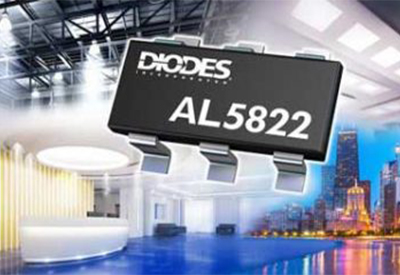
LDS Diodes AL5822 400

June 24, 2019

Diodes Incorporated recently announced the availability of the AL5822 LED current ripple suppressor, which provides high levels of ripple suppression while maintaining high power factor for commercial and industrial lighting applications.

It is now mandatory to meet regulatory requirements to suppress low frequency ripple (100Hz to 120Hz) in LED lighting applications in many markets, enforced through standards such as the California Energy Commission Title 24. The AL5822 delivers a high level of ripple current suppression in single-stage, high power LED installations, even when triac or PWM dimming techniques are being used to vary the light level. This ensures there is no sign of flicker or strobing across the entire dimming range, while still maintaining a high power factor.

The AL5822 has been designed and tested to comply with the Title 24 building code requirement of less than 30% flicker. The results show that the AL5822 suppresses over 97% of ripple while still achieving a power factor of greater than 0.9.

By monitoring the current flowing through the LEDs, the AL5822 compensates for ripple by adjusting the drive voltage for the external MOSFET. This control loop keeps the MOSFET operating in the saturation region to deliver a constant current.

With support for various pre-stage circuits, the AL5822 can work with a number of drivers, such as the AL1665 single stage PFC flyback buck/boost controller, also from Diodes Incorporated. The integrated features of the AL5822 remove the need for magnetic discrete components, minimizing the overall bill of materials.

The AL5822 operates over an input voltage range of 24VAC to 305VAC. Safety features include LED short-circuit, over-temperature, and over-current protection.

Go HERE for more information
Related Articles


Changing Scene


Design

  • Omnify: 7 Common Light Panel Mistakes (And How to Fix Them)

    Omnify: 7 Common Light Panel Mistakes (And How to Fix Them)

    You’ve invested in premium LED light guide panels for your retail display or commercial project. The specs looked perfect. The samples were gorgeous. But now? Something’s off. Maybe the lighting is uneven, or panels are starting to fail way before they should. Here’s the thing, most LED light guide panel problems aren’t manufacturing defects. They’re… Read More…

  • Legrand: The Benefits of DMX Lighting in Modern Commercial Spaces 

    Legrand: The Benefits of DMX Lighting in Modern Commercial Spaces 

    DMX lighting is a powerful control protocol originally developed for theaters and entertainment venues, but its reach has expanded far beyond the stage. Today, DMX is increasingly used in commercial, educational, healthcare, and architectural environments to create dynamic, color-rich, and adaptable lighting experiences. Where traditional lighting systems focus primarily on on/off and dimming control, DMX… Read More…


New Products

  • RENO Lighting: Aerolux – Adaptive Area Light with Field-Adjustable Distribution

    RENO Lighting: Aerolux – Adaptive Area Light with Field-Adjustable Distribution

    Meet the Aerolux Series—a sculpted area light with on-site adjustable distribution, delivering precise, adaptable illumination across a range of applications. With a slim, curved profile and durable die-cast aluminum construction, Aerolux combines refined design with lasting performance and durability. One fixture. Multiple configurations. No compromises. Aerolux reduces SKU complexity while increasing on-site flexibility, and is… Read More…

  • LEDVANCE: SYLVANIA TruWave Technology

    LEDVANCE: SYLVANIA TruWave Technology

    TruWave Technology is a lighting technology developed by SYLVANIA. It provides the closest possible lighting experience to natural light by mimicking the natural light spectrum. Natural light is the most common light source in daily life, and it helps regulate body clocks and improve mood and focus. However, in indoor environments, the amount of natural… Read More…