Castor’s Award-Winning Induction Wall Light
August 6, 2018
Castor Design is a Toronto-based practice run by Brian Richer, a trained architectural stone carver with a degree in English literature and philosophy, and Kei Ng, a trained architect with a background in set design. They are interested in the middle ground between art and design, bringing a sense of irreverence to each project. Materials and their reuse make up an important part of Castor’s aesthetic: burnt out bulbs to make lighting, a rusty shipping container to make a sauna.
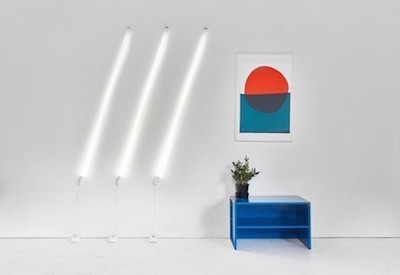
This brings us to Castor’s award winning Induction Wall Light, which uses a scientific concept to approach lighting in a unique way. It powers a burnt-out fluorescent bulb through an electromagnetic field.
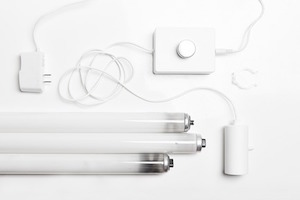
A fluorescent bulb is normally lit with a wired connection at each of its pins, sending power through the filaments at either end and causing collisions between electrons inside the tube, which then give off light as they pass through the bulb’s phosphorous coating. When a bulb is burnt-out, it will be blackened on its ends, indicating that the fuses are blown and that it will no longer work in a standard fluorescent lighting setup. Despite the fact that the bulb seems useless as is, it can still be lit through electromagnetic induction.
Electromagnetic induction is the production of voltage due to a change in the magnetic field. Inside the Induction Wall Light’s box is a circuit and a coil of copper wire wrapped around an iron core. Stomping on the Induction Wall Light’s foot switch activates a circuit inside the switch base, transferring power around the iron core, which then sends electrical current through the wire to the bulb resting in the lamp holder. The active current stimulates the gases inside the fluorescent bulb, which in turn causes the bulb to emit light.
Recalling that a fluorescent bulb is normally lit through a wired connection at its pins, the Induction Wall Light leaves the bulb’s pin exposed to further demonstrate that it uses a magnetic field to transfer electrical current to a regular fluorescent bulb. When lit through induction, the quality of the light is also different. Compared to standard fluorescent lighting, the bulb’s glow is less harsh overall, and is slightly brighter in the side closest to the field source. The temperature of the light given off depends on the amount and type of gas in the bulbs.
The Induction Wall Light offers an opportunity to find interesting new uses for existing materials without letting them go to waste. Rather than destroying a fluorescent bulb, which would release gases that might be environmentally harmful (i.e. Argon and Mercury gases are commonly used in fluorescent bulbs), the Induction Wall Light can power any intact fluorescent bulb. It demonstrates that there is still life left in old bulbs even though they seem exhausted.
Castor Design has won awards from the A+ Awards, A’ Design, AZ Awards, and from numerous design shows. The Induction Wall Light received Best Lighting Design at the 2018 AZ Awards, in addition to a Metropolis Magazine award in New York during ICFF 2018.
Castor’s products are sold in shops around the world, and they have worked on interior projects, custom lighting and furniture design, and public art commissions throughout North America, Europe, and Asia. Their experience in restaurants and love of music inspired them to open Parts & Labour (www.partsandlabour.ca/), a space that combines a fine-dining room with a punk rock basement venue, and its offshoot, P&L Burger (www.thepnlburger.ca/).
Photos credits: Peter Andrew Lusztyk