Voice Control for Lighting
February 15, 2018
Virtual personal assistants provide many services to consumers, such as Internet lookup, playing music and video, and buying products. The most popular platforms are Apple’s Siri, Google Assistant, Amazon Alexa, and Microsoft Cortana. These assistants use speech recognition technology to execute user voice commands.
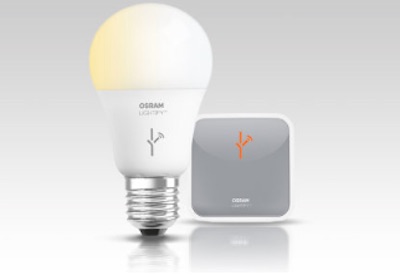
A new application is control of home systems, such as lighting, shades, thermostats, A/V, security, and other smart devices. A typical solution includes a virtual assistant device (phone or speaker), WiFi connection, downloadable smart device app, and a compatible lighting or home automation system. Voice assistant devices are agnostic in that they can control products from many manufacturers. (Shown in photo: LEDVANCE’s Lightify.)
By selecting a control system compatible with these devices, voice becomes another input alongside any others installed, such as keypads, mobile apps, motion sensors, etc. (With voice control, standard controls still have their place.) Benefits include convenience and easier lifestyle.
An occupant walks into a house with arms full of groceries, and simply tells the home system to turn on the lights. An occupant wants to change the mood and voices a command to choose a scene, whether it’s a date, dinner, or movie night. An occupant gets into bed and tells all lights to turn OFF. The occupant wakes up and says, “Good morning” to activate selected house lighting. An occupant with a disability limiting freedom of movement can control everything from lighting to shades to temperature to music without moving.
Gaining this control input requires installing a lighting or home automation system that recognizes inputs from, e.g., Amazon Alexa (with an Echo device), Apple Siri (with HomeKit), Google Assistant (with Google Home), and/or Microsoft Cortana (with Harman Kardon Invoke).
Examples include LEDVANCE’s Lightify; Leviton’s Decora Smart with Wi-Fi Technology and Decora Smart with HomeKit Technology; Lutron Electronics’ Caséta Wireless, RA 2 Select, RadioRA2, and HomeWorks QS; and Philips Lighting’s Hue system, among others. Different systems offer varying levels of size, scalability, programmability, and simplicity.
When the user voices a command, it is sent to a cloud-based service and translated into a control signal at the control provider’s cloud service via an application programming interface. The manufacturer’s cloud-based service then signals the controller in the home. Response is virtually immediate.
For consumers, it provides a convenient and familiar method of controlling home systems to gain lifestyle benefits, with smart lighting being a good starting point. For contractors and distributors, it’s a key selling feature for smart lighting and an avenue to help customers adopt home automation. With smart lighting installed, the benefits are immediately experienced.
Start with the home and how it’s used, ensure the home has a robust network connection, choose a manufacturer that offers appropriate levels of support, select an appropriate solution with confirmed interoperability, and overall, keep it simple. While voice control offers convenience, it is recommended to use voice control in concert with smart manual controls in typical locations. One approach is to start with a few control points, perhaps a room, such as a living room or kitchen, and grow from there as the user immediately experiences the benefits.
Photo source: LEDVANCE
Craig DiLouie, LC, is Education Director for the Lighting Controls Association. Reprinted with permission of the Lighting Controls Association, www.lightingcontrolsassociation.org