Tailored Light Improves Sleep Quality, Depression, Agitation in Older Adults With Alzheimer’s Disease
March 6, 2020
Most people associate Alzheimer’s disease with profound memory loss, but it is often the symptoms—sleep disturbances, depression, and agitation—that are a challenge to treat, and can significantly reduce the quality of life for both the affected individual and their family members and caregivers.
In a research project funded by the National Institute on Aging (NIA), Dr. Mariana Figueiro, Professor and Director at the Lighting Research Center (LRC) at Rensselaer Polytechnic Institute, is investigating whether a tailored lighting intervention can lessen the impact of these symptoms in older adults living with Alzheimer’s disease and related dementias (ADRD) and has published her latest findings in the Journal of Clinical Sleep Medicine.
Using a variety of light sources such as floor luminaires, light boxes, and light tables to deliver the tailored, individualized lighting intervention, this 14-week randomized, placebo-controlled, crossover design clinical trial administered an all-day active (high circadian stimulus [CS] of 0.4) or control (low CS of < 0.1) lighting intervention to 46 patients with moderate to late-stage ADRD in eight long-term care facilities. The study employed wrist-worn actigraphy and standardized measures of sleep quality, mood, and behavior.
The study’s primary aims were to extend earlier studies and to again validate the CS metric in the field by investigating the impact of the intervention on subjective and objective measures of nighttime sleep. The secondary aim was to determine whether the lighting intervention would improve caregiver-assessed participant scores in measures of depression, agitation, and quality of life. The CS metric is a measure of how effective a light exposure is for stimulating the human circadian system. Developed by the LRC from several lines of biophysical research, including those from basic retinal neurophysiology, the CS metric has been applied successfully in numerous field applications to improve sleep at night and reduce sleepiness during the day.
Results revealed that, compared to baseline, the active lighting intervention significantly improved sleep quality, and reduced depressive symptoms and agitation behavior. Read the full journal article.
The 24-hour light and dark pattern strongly determines a person’s sleep–wake (circadian) cycle, telling the body when to go to sleep and when to wake up. Studies have demonstrated that daytime light exposure of CS > 0.3 (approx. 350–500 lux at the eyes) can improve nighttime sleep efficiency and increase daytime wakefulness by promoting circadian entrainment.
Lighting in long-term care facilities is usually not bright enough during the day and perhaps too bright during the evening. Typical indoor lighting provides less than 100 lux at the eye, whereas being outside on a sunny day will provide anywhere from 1,000 to more than 10,000 lux at the eye. Older adults in long-term care facilities often spend their days and nights in dimly-lit rooms with minimal time spent outdoors, and thus, are not experiencing the robust daily patterns of light and dark that synchronize the body’s circadian clock to local sunrise and sunset.
Therefore, it is understandable that many older adults in long-term care facilities are plagued by insomnia and other sleep disorders—yet, sleep could not be more important to their overall health and wellbeing. Recent research has shown that poor sleep may directly impact the onset and progression of Alzheimer’s disease, and conversely, healthy, regular sleep patterns may prevent or slow progression of the disease. This research suggests a bidirectional relationship between sleep disruption and the deposit of amyloid beta, the main component of the amyloid plaques found in the brains of individuals diagnosed with Alzheimer’s disease.
Older adults with ADRD experience severe dysfunctions of their sleep–wake cycle that clinically present as sundowning, excessive daytime sleepiness, nocturnal wandering, agitation, irritability, day–night reversal, and decreased cognitive functioning. Sleep problems are exacerbated in those with ADRD, whose circadian rhythms can become less consolidated, as manifested in increased nocturnal wandering. This population is also at higher risk for depression and agitation behavior. These disturbances can lead to their placement in long-term care facilities, where they experience even greater inactivity and reduced exposure to daytime circadian-effective light, exacerbating their symptoms further.
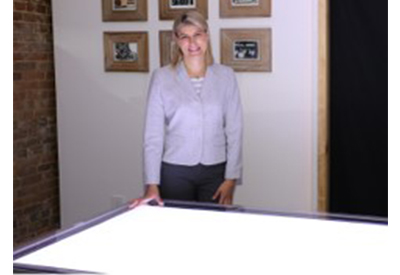
Dr. Figueiro began work on her first major research grant from the NIA in 2010, measuring circadian light exposures in individuals with ADRD. Her research revealed that individuals with ADRD were exposed to lower light levels, exhibited lower activity levels, and experienced greater circadian disruption than healthy older adults. She then focused on a specific challenge: delivering light in a way that was highly effective for individuals with ADRD. A successful example of this tailored, personalized lighting intervention is the light table, which can deliver a strong dose of light at the eyes, an important factor in stimulating the circadian system. Light has to enter the eye to be effective for circadian entrainment.
Although a Cochrane review published in 2014 casts doubt on the efficacy of light therapy for improving sleep and behavior in ADRD patients, if carefully specified and implemented, tailored lighting designed to maximally impact the circadian system can be a powerful nonpharmacological intervention for improving sleep, mood, and behavior in persons living with ADRD, as shown in this study and in previous studies.
“When delivered appropriately, using CS and different delivery modes, and accurately measured, using calibrated personal light meter devices, a lighting intervention tailored to maximally entrain the circadian system will significantly improve sleep quality, depressive symptoms, and agitation behavior in patients with ADRD,” said Dr. Figueiro. “It is important to use, deliver and measure the right lighting to see the positive effects.”
“We are hopeful that designers of senior facilities will now have the confidence to specify lighting solutions that provide a minimum CS of 0.3 during the day to this often neglected population,” said Dr. Mark Rea, who was one of the authors of the study.