Study Grows Wheat Twice as Fast Under LEDs
July 23, 2018
Pioneering new lighting technology could accelerate the global quest for crop improvement in a development that echoes the Green Revolution of the post war period.
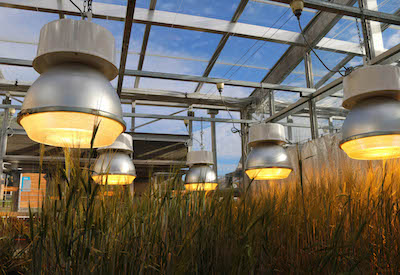
The speed-breeding platform developed by teams at the John Innes Centre, University of Queensland and University of Sydney, uses enhanced LED lighting in a greenhouse or artificial environment to create intense day-long regimes that speed up the search for better performing crops.
Using the technique, the team has achieved wheat generation from seed to seed in just eight weeks. This means that with special lighting it is now possible to grow as many as six generations of wheat every year — a threefold increase on techniques currently used by breeders and researchers.
This technique uses LED lights optimized to aid photosynthesis in intensive regimes of up to 22 hours per day. LED lights significantly reduce the cost compared to sodium vapour lamps, which have long been in widespread use but are less effective because they generate much heat and emit poor quality light.
Dr. Brande Wulff of the John Innes Centre, Norwich, a lead author on the paper, explains why speed is of the essence: “Globally, we face a huge challenge in breeding higher yielding and more resilient crops. Being able to cycle through more generations in less time will allow us to more rapidly create and test genetic combinations and find the best combinations for different environments.”
For many years the improvement rates of several staple crops have stalled, leading to a significant impediment in the quest to feed the growing global population and address the impacts of climate change.
Speed breeding, says Dr. Wulff, offers a potential new solution to a global challenge for the 21st century.
“People said you may be able to cycle plants fast, but they will look tiny and insignificant, and only set a few seed. In fact, the new technology creates plants that look better and are healthier than those using standard conditions. One colleague could not believe it when he first saw the results.”
The exciting breakthrough has the potential to rank, in terms of impact, alongside the shuttle-breeding techniques introduced after the second world war as part of the green revolution.
Dr. Wulff goes on to say: “I would like to think that in 10 years from now you could walk into a field and point to plants whose attributes and traits were developed using this technology.”
The international team also proved that the speed breeding technique could be used for a range of important crops. They have achieved up to six generations per year for bread wheat, durum wheat, barley, pea, and chickpea; and four generations for canola. This is a significant increase compared with widely used commercial breeding techniques.
The speed breeding technology has been welcomed by wheat breeders, who have become early adopters.
The full paper, Speed breeding is a powerful tool to accelerate crop research and breeding, is available at Nature Plants: www.nature.com/articles/s41477-017-0083-8.
Photo courtesy of the University of Queensland