New Computational Methodologies Enable SSL to Measure and Self-Adjust Based on Conditions

May 6, 2019
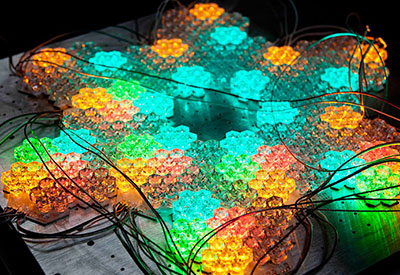
An article published in the SPIE journal Optical Engineering, “Arbitrary spectral matching using multi-LED lighting systems,” marks a substantial advance in lighting science and technology. In their paper, the researchers announce a two-pronged approach to both measure and self-adjust the spectral power distributions (SPDs) of LED lighting systems. Their methodology demonstrates the system’s ability to maintain consistency and stability over an extended period of time.
Solid state lighting (SSL) can be used to enhance our vision, sleep patterns, and wellbeing. SSL benefits are evident across their wide use in residences and offices as well as across industrial and commercial sectors, including the ongoing development of applications in medicine, imaging, agriculture, communication, transportation, and museum lighting. Some of these applications require highly precise light spectra that don’t produce optical power variations or shifts in colour over time.
The four graphs show the best fit (blue solid line) to daylight D65 (a), an incandescent spectrum (b), the Melanopic (c) and a white LED spectrum (d) (Ph-LED YAG) (dashed black lines) made by optimizing the weights of the 10 different channels of the LED light engine (coloured dash-dot lines). In all cases the spectra were normalized and are shown in arbitrary units.
The open-access paper addresses two challenges: how to keep temperature changes and age-based deterioration from impacting a light emission’s strength, consistency, and colour, as well as providing a reliable, internal, self-monitoring method.
The authors use a fast-computation, high spectral fidelity algorithm to determine channel weights of a targeted SPD; in conjunction with that method, an internal microprocessor provides a closed-loop control system that monitors and corrects the spectral output, compensating for shifts due to temperature changes or LED wear and tear. The authors’ use of a general framework for multi-channel SSL systems ensures the universal applicability of their findings across different lighting technologies.
According to Optical Engineering Associate Editor, SPIE Senior Member, and U.S. Air Force Research Laboratory Technical Advisor Daniel A. LeMaster, the research showcases significant advances in terms of lighting technologies, “This method to monitor and quickly compensate for the colorimetric issues that arise from junction heating and LED aging will be of great utility in the global LED lighting market.”
The article authors are Aleix Llenas, of the Catalonia Institute for Energy Research (IREC) and Ledmotive Technologies, Spain, and Josep Carreras, of Ledmotive Technologies.
Michael T. Eismann, an SPIE Fellow and senior scientist at the U.S. Air Force Research Lab, is the editor-in-chief of Optical Engineering. The journal is published in print and digitally by SPIE in the SPIE Digital Library, which contains more than 500,000 publications from SPIE journals, proceedings, and books, with approximately 18,000 new research papers added each year.
About SPIE
SPIE is the international society for optics and photonics, an educational not-for-profit organization founded in 1955 to advance light-based science, engineering, and technology. The society serves 257,000 constituents from 173 countries, offering conferences and their published proceedings, continuing education, books, journals, and the SPIE Digital Library. In 2018, SPIE provided more than US$4 million in community support including scholarships and awards, outreach and advocacy programs, travel grants, public policy, and educational resources; www.spie.org.
This article was first published online by SPIE, the International Society for Optics and Photonics;spie.org/about-spie/press-room/press-releases/solid-state-lighting-self-adjusts-based-on-conditions.