Where No LED Has Gone Before
You may soon be able to add “growing space vegetables” to the list of uses for LEDs.
Researchers at the University of Guelph’s Controlled Environment Systems Research Facility (CERF) are looking at ways that LEDs can help grow plants on other planets, specifically the moon and Mars.
The project, called InTICE (Innovative Technologies in Challenging Environments), also has applications right here in Canada for remote Northern regions where fresh food is scarce.
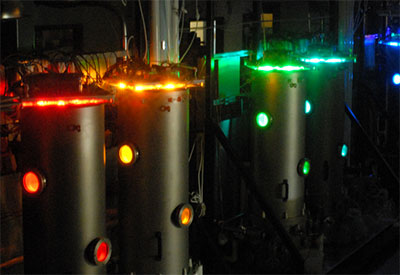
The team developed automated food-growing boxes that use water, minerals and electricity to grow the vegetables. As water, minerals and electricity are rare in space, the boxes come equipped with sensors that monitor which minerals the plants have absorbed. This allows the system to be precise with fertilizing. The lighting system would work the same way. “We’ve got a nine-band LED system where you can tweak individual wavelengths across the rainbow and look at how different light recipes promote growth,” researcher Cody Thompson told Scientific American. “It’s precision agriculture.”
Historically, light technologies that have been used for plant production have been everything from fluorescent, incandescent, high pressure sodium and metal halide, as well as plasma and induction lamps. But LEDs have opened up a whole new world.
“The electrical efficiency of these systems and the intensity you can get out of LEDs now is far beyond what I would have thought possible as little as five years ago,” Mike Dixon, professor and chair of Guelph’s environmental biology department, told CBC.
LEDs have 256 unique wavelengths, each of which is easy to control. The CERF researchers have created their own custom LEDs that can generate light four times the power of the sun and use nine different wavelengths. As plants need different levels of energy during their stages of growth, the trick is finding the right mixture of wavelengths at the right time.
Dixon told CBC that the project is still in the early stages, but he believes that “in the next 15 to 20 years it’s certainly within the bounds of technical possibility that humans can being growing plants, doing plant science experiments, on the surface of the moon in preparation for life support requirements on Mars.”
Back here on Earth, the technology is getting some serious attention from both the public and private sector. According to Scientific American Syngenta, an Agrochemical company, has designs to use the technology to develop climate change resistant plants, while the Canadian Federal Government and the Northwest Territories are working with Dixon and his team to grow food in remote aboriginal communities and mining sites.
The Ontario Centres of Excellence (OCE), an organization that co-invests with industry on new technologies that have significant commercial success potential, is also betting on the technology with an investment of nearly $200,000.
“The prospect of establishing LED greenhouses in areas of the north, including northern Ontario, and all the economic and societal benefits that would flow from that makes this a sound investment for OCE,” Richard Worsfold, Business Development Director at OCE, explained to First Nations Resource Magazine.
But there are more benefits to be had Worsfold said. “This will go a long way toward improving the diet of northern communities and, in turn, addressing some prevalent medical conditions such as diabetes. Also, the growth facilities can be located in remote communities and will create local jobs in areas such as gardening, plumbing and electrical work. This can also create the industries needed to build and install the growth chambers.”
All that from one little diode.