How the Right Lighting Could Save the Mona Lisa
July 22, 2019
Next time you’re in a museum or art gallery, observe each painting a little more closely. You may notice cracks on the surface of the canvas, especially if the painting is very old.
The damage you see is caused by radiant energy striking the painting’s surface — and light (visible radiation) causes irreversible damage to artwork.
However, all is not lost. Our new research shows that optimized smart lighting systems can reduce damage to paintings while preserving their colour appearance.
The dilemma
Damage to artwork by infrared, ultraviolet and visible radiation is well documented. When a photon (an elementary light particle) is absorbed by a pigment in paint, the pigment molecule elevates to a higher energy state. In this excited state, the molecule’s chemical composition changes. This is called a photochemical action.
Viewed from the human perspective, the photochemical action manifests itself as cracks, discolouration, or surface hardening.
Not surprisingly, daylight, which includes infrared and ultraviolet radiation, is highly damaging to paintings. In museums, it is common practice to use incandescent, and more recently, LEDs, to reduce damage.
However, a group of researchers showed that light can cause colour degradation regardless of the lighting technology. Bright yellow colours in Van Gogh’s famous Sunflowers are turning dark brown due to absorption of blue and green light from LEDs. Research on the conservation of artwork makes it look like this is a losing battle.
Of course, you will be right in thinking that the best conservation method would be the complete absence of light. But we need light for visibility and to appreciate the beauty of a painting. This leaves us with a dilemma of two conflicting parameters: visibility and damage.
Light optimization
Lighting technology in itself may not be enough to tackle this dilemma. However, the way we use technology can make a difference.
Our approach to address this problem is based on three key facts:
- light triggers photochemical actions only when it is absorbed by a pigment
- the reflectance factor of a pigment (its effectiveness in reflecting light) determines the amount of light absorption
- light output (composition of the light spectrum, and the intensity of the light) of lighting devices, such as LEDs, can be fine-tuned.
It is possible to measure the reflectance factor of a painting and optimize lighting to reduce absorption. Previous research shows that optimizing light to lessen absorption can reduce energy consumption significantly, and with no loss in visual experience. Objects look equally natural and attractive under optimized light sources compared to regular white light sources.
In this new study, we optimized LEDs for five paintings to reduce light absorption. Using a genetic algorithm (an artificial intelligence technique), we reduced light absorption between 19% and 47%. Besides the benefits for the painting, this method almost halved the energy consumed by lighting.
In addition to increased sustainability and art conservation, the colour quality of the paintings was another parameter in our optimization process. Colour appearance and brightness of paintings were held constant not to lower the appreciation of the artwork.
This is possible due to a quirk in our visual system. Photoreceptor cone cells, the cells in our retinas that enable human colour vision, are not equally sensitive to the whole visible spectrum.
Different combinations of wavelength and intensity can result in identical signals in our brain. This understanding gives us the flexibility of using different light sources to facilitate identical colour appearances.
This smart lighting system requires scanning of the artwork to obtain colour information. Then, a precise projection system emits optimized lighting to the painting.
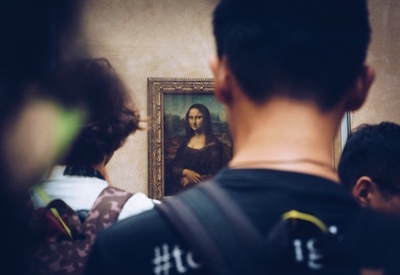
This method offers a solution to extend the lifetime of works of art, such as the world-famous Mona Lisa, without leaving them in the dark.
Dorukalp Durmus is an Honorary Associate, University of Sydney. This article was first published online by the University of Sydney: theconversation.com/how-the-right-lighting-could-save-the-mona-lisa-95938. It has been lightly edited.
Photo source: Juan Di Nella on Unsplash