Illuminating the Canadian Museum of History
January 8, 2018
After two years of work, Lightemotion has added another noteworthy project to its list with the lighting design for Gatineau’s Canadian Museum of History. The museum welcomes over 1.2 million visitors each year to its celebrated complex in the heart of the National Capital Region, making it the country’s most-visited museum. With roots stretching back to 1856, it is one of Canada’s oldest public institutions and a respected centre of museological excellence, sharing its expertise in history, archaeology, ethnology and cultural studies both within Canada and abroad.
For Lightemotion’s President, François Roupinian, designing the lighting for this type of museum is an exciting challenge: “The light should act as a magic wand, directing the viewer’s attention to key areas.” Through a skillful combination of museum and architectural lighting, Lightemotion has highlighted the work of architect Douglas Cardinal while showcasing the museum’s history.
Success is in the details
To accomplish such a feat with a maximum spectrum of effects, the team used over 40 kinds of light fixtures. From theatrical floodlights to gobo projectors and miniature LED heads for subtly illuminating even the smallest details of the displays, all equipment used was carefully studied and adjusted in order to create a unique path of light.
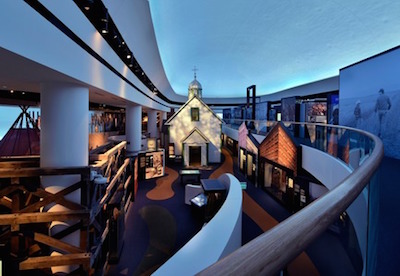 According to François Roupinian, “Flexibility is important for creating the right lighting.” Nothing was left to chance, with features including interchangeable lenses, zoom, anti-glare accessories, an integrated potentiometer to adjust the lighting level for conservation needs and ambience, and the option to add colour filters. For this purpose, the lighting manufacturers were chosen with particular care so that a wide range of choices would be available to ensure colour consistency.
A technical challenge
Beyond the myriad fixtures required, this type of project comes with its own set of challenges. The first is using LED technology to recreate the warmth and subtlety of halogen, as LEDs are often too bright for the more subtle needs of a museum. Another important element to take into account was that certain fragile artifacts are sensitive to heat. When fine-tuning the lighting, Lightemotion worked closely with the museum’s conservation team to provide consistent and suitable lighting, carrying out tests that included thermal models to ensure optimal conservation conditions for the artifacts.
 The museum’s unifying element
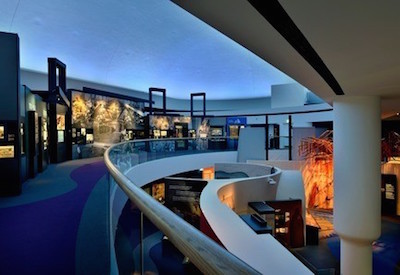
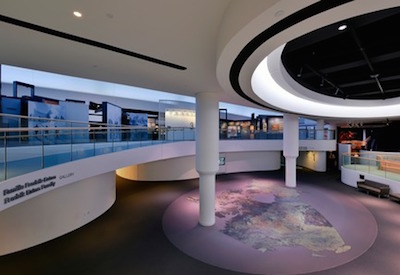
The Canadian Museum of History’s emblematic dome acts as a visual reference point throughout most of the museum pathway. As the dome is an immense structure where it is impossible to install lighting, the team had to use a special approach: “We wanted to use this constraint as an advantage. That’s where we got the idea to use the dome to create light with indirect lighting. We wanted to make it the centrepiece of the museum’s ecosystem.” After many colour tests, the team was able to create their desired effect: a timeless tone for a comfortable atmosphere where visitors feel as if they have stepped into the museum’s very own world.
As explained by François Roupinian, “The light ultimately needs to tell a story. The visitors shouldn’t have to be aware of the technical feats behind the scenes. The lighting should create a complete sensory experience.”
Lightemotion is a lighting design consultant with offices in Montreal and Toronto, and award-winning local and international projects. Lightemotion’s project portfolio spans across many diverse project types from cultural, hospitality, retail, corporate, government, transportation and academic to landscape and master planning; www.lightemotion.ca
Photo credit: Gordon King