How Integrated Sensors in Luminaires are Changing Commercial Real Estate

October 2, 2018
Luminaires are becoming smart nodes on powerful data networks. How is this happening and what are the benefits of a sensor-rich network?
Lighting is pervasive throughout a built environment and by integrating sensors into every luminaire, each light is transformed into a data node on a connected lighting system network. These integrated sensors are able to collect useful data which could include occupancy, traffic flow, light levels, temperature, humidity, air quality, and more at a granular level because lighting is everywhere in a built environment. Lighting systems are becoming the perfect conduit for ubiquitous sensing and can collect environmental and space usage data at any given time.
How pervasive will sensing technologies in built environments become in a few short years? Deloitte estimates that sensors in commercial real estate will grow at a 78% annual growth rate between 2015 and 2020, with 1.3 billion sensors deployed by 2020.
Let’s take a closer look at how smart buildings are benefiting from integrating sensors in luminaires.
Save energy
Installing sensors that automate lighting is a given for modern offices. In fact, some building energy codes require occupancy and light sensors for lighting control. It’s a great way to save energy and the related costs quickly and easily.
Sensors integrated within luminaires help to further optimize lighting usage because of the granular level of information and control that can be realized. These sensors supply data to the lighting system to turn a single or group of luminaires on/off as employees enter/leave spaces, and create appropriate light levels for specific tasks within the space. Energy is not wasted on lighting unused areas therefore you only use (and pay) for the amount of energy you require. Individual tasks can be completed more efficiently with light levels optimized for the particular task. Facility managers can fine-tune smart lighting systems and save energy using smart control strategies, including:
- task tuning
- daylight harvesting
- occupancy sensing
- time scheduling
- personal control
Create an optimized workspace
The workplace is changing rapidly. A new generation of workers is seeking modern offices that offer a variety of work spaces for different activities rather than traditional, assigned desks. More employees are working remotely with occasional visits to the office so there’s no need to have an office workspace assigned to them exclusively. Additionally, the corporate landscape in many industries is changing with rapid staff growth or cutbacks, mergers and acquisitions, and lots of reorganizations. Office space has to adjust quickly to changing requirements.
Sensors in every luminaire track occupants’ locations and movements, providing valuable insight into how and to what extent spaces are used. Sensor data, including historical usage and trends, can be used to reduce unused space and the related costs, plan future space requirements, support greater employee collaboration, and more. Sensor data are also essential for restacking space and supporting some of the latest workspace trends, such as hoteling and hot desking.
Boost comfort and productivity levels
A study conducted by the American Society of Interior Design indicated that 68% of employees complain about the lighting situation in their offices. The same lighting control strategies used for energy savings — task tuning, daylight harvesting, and time scheduling – also help create a better lighting environment in the workplace, and this can affect productivity and employee well-being.
Harsh lighting causes eyestrain and headaches. Dim lighting causes eyestrain, headaches, drowsiness and lack of focus — all of which affect productivity. Daylight harvesting is a lighting control strategy that is used to combat dimly or harshly lit environments. It enables a building to collect and utilize natural daylight and distribute it effectively into the building. Using light sensors, automated lighting control systems measure the amount of natural light in a space, and dim or switch off artificial light levels when sufficient ambient light is present. The light sensors enable a consistent lighting level and the control system uses only as much artificial light as necessary thus providing an optimum level of light for the occupant.
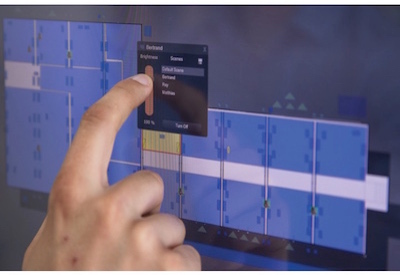
Personal scene settings allow an individual to adjust lighting levels in their space to their personal preferences. An individual may favour brighter or dimmer light levels than a co-worker doing the same task. By enabling workers to adjust and set lighting scenes to their personal preferences, their working environment and productivity level can be improved.
Get ready for the future
Osram recently introduced the first product in the SensiLUM Wireless Integrated Sensor product family. It is integrated into the luminaire during the manufacturing process by fitting into an industry standard ½-inch knockout in any luminaire. The SensiLUM sensor enables occupancy detection, daylight harvesting and individual or group control of luminaires, and can be adjusted through the Encelium Extend Networked Light Management System by OSRAM.
SensiLUM sensors offer 0-10V dimming or DEXAL (Data Exchange (interface) for Advanced Lighting) control options. The DEXAL interface option enables bi-directional communication and power between the driver and the SensiLUM sensor making it ideal for smart building applications that require exact luminaire-specific data, including power consumption, temperature profile, operating hours and diagnostics.
This article was first published online by Osram: https://info.osram.us/blog/how-integrated-sensors-in-luminaires-are-changing-commercial-real-estate