How Many Studies Does it Take to Change a Lightbulb? – Part 2 – We (hopefully) Look Where We’re Going
April 15, 2024
By Noah Sabatier
The role of eye movement and gaze control in visual field detection while driving at night
In the previous article we discussed how the retina adapts to different levels of light, and what this means for optimizing outdoor dusk-to-dawn lighting. We will now move on to the mechanisms that our visual system uses to aim our eyes. Compared to the rudimentary considerations that luminance adaptation got in professional lighting guidance, there was virtually no examination of eye movements or gaze control. The first major study that tested whether or not roadway lighting guidance was accurate without the aforementioned considerations was conducted in 2015. This is several years after organizations such as the IESNA began to recommend white lighting for general dusk-to-dawn illumination. To put it mildly, the cart was several miles ahead of the horse.
The human visual field is divided into 2 primary sections, focal and peripheral. Recalling from the last article, focal vision is mediated by cone cells while peripheral vision is mediated primarily by rod cells, with a lesser share of cone cells. Focal vision holds precious little area in our visual field, considering the dominant role it plays in visual tasks. The focal region of each eye is only 2 degrees; however, our visual system has a way of expanding this.
Saccadic eye movements subconsciously happen several times per second, rapidly scanning an area of focus to build a larger field of focal vision. Our vision is processed in a way that we do not see the blurred movements, only a final result. There is little consideration for saccadic eye movements in current roadway lighting guidance. This often results in an unrealistic weighting between focal and peripheral vision.
Perhaps more glaring of an issue, reliance on visual performance models for roadway lighting guidance creates an assumption that drivers do not move their eyes or head while driving. In tests conducted for mesopic visual performance models, such as the Unified Photometry System, test subjects did not exhibit natural visual behavior. Instead, test subjects were trained to focus on a central point so that peripheral stimuli are viewed solely through peripheral vision. Based on this artificial reliance upon peripheral vision, bluer spectrums of light found favor for theoretical advantages in rod-cell mediated peripheral vision. Whether this assumption was realistic or not hadn’t been tested before lighting guidance and marketing began to utilize it.
In 2015, the Federal Highway Administration released an extensive research paper on visual performance while driving at night. This 240-page report was based on over a year of testing at a real-world track with full-scale streetlights, vehicles and simulated pedestrians. The final tests conducted for the report were perhaps the most important. The goal of these tests was to measure real world reaction distances under different lighting spectrums, and compare them to model predictions. The results of these tests would have changed the course on white LED lighting implementation worldwide – had those in charge of lighting paid attention.
In the first test, subjects drove down the road while fixating on the centerline. Subjects were specifically instructed to detect peripheral targets without moving their eyes or head to recreate the visual performance model tests. This test found slight, but inconsistent, detection distance advantages for white LED lighting when detecting peripheral targets with a fixed gaze. An additional test found more consistent advantages under white LEDs for the minimum contrast threshold needed to detect peripheral targets with a fixed gaze.
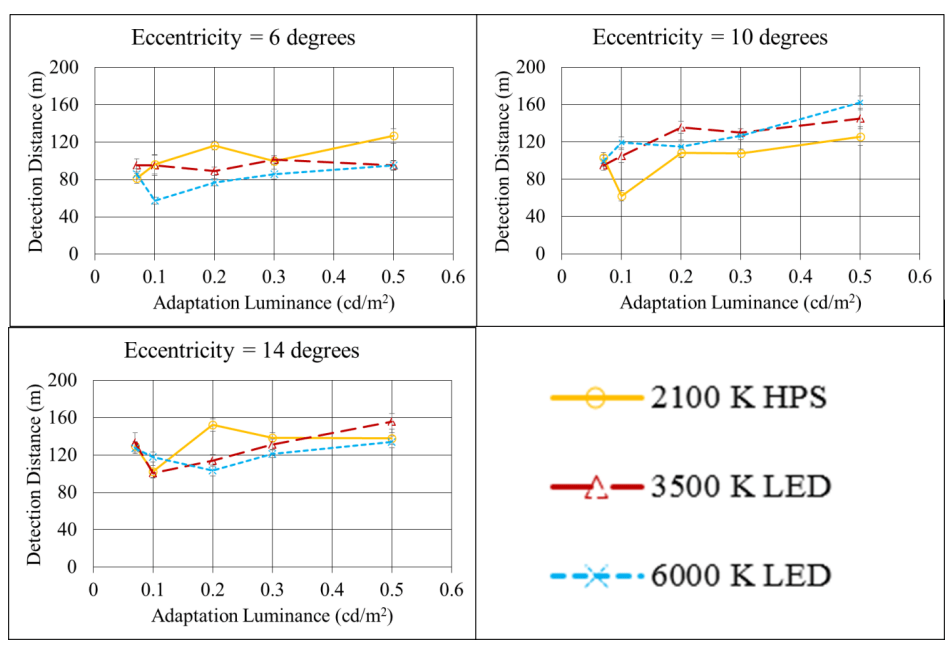
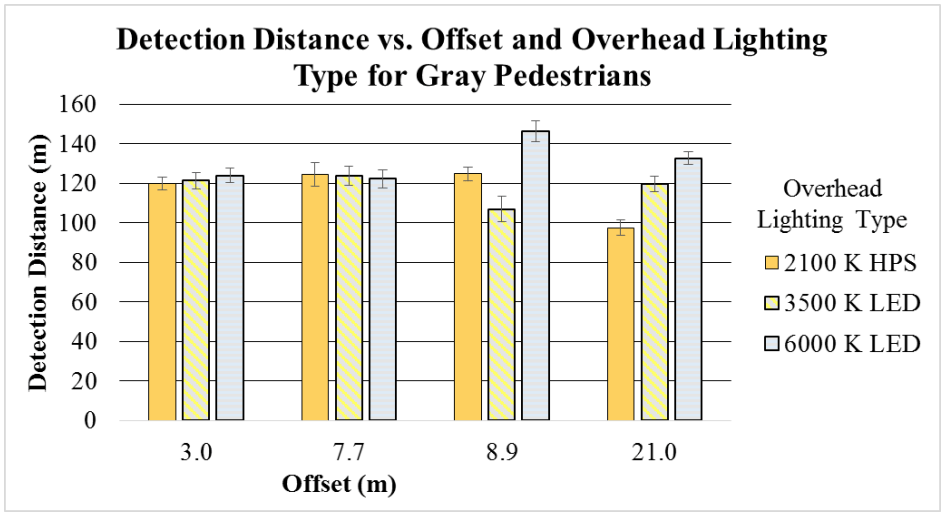
The second test could be described as a natural, real-world experiment. Participants were allowed to behave as they would during normal, every-day driving. This included the freedom to scan the visual field while driving, instead of focusing centrally as was done in laboratory tests. Detection distances under the 3 tested lighting spectrums were surprisingly similar. Consistent increases in detection distance from bluer spectrums of light did not happen until the pedestrian was within the practical extremities of peripheral vision. The results of this test showed a complete failure of the mesopic vision models that are behind streetlight selection guidance.
A more complete picture of visual system operation under artificial lighting is emerging, but a final assumption needs to be tested. Even after the real-world test results revealed a lack of advantages for bluer spectrums of light, there was still a belief that this only applied to faster roadways. It was theorized that slower roadways, specifically those in residential areas, had a higher workload within the peripheral field of drivers. On paper this increased peripheral workload at the lower lighting levels of residential areas created an opportunity for rod cells to provide better vision under shorter wavelengths of light.
A different study was conducted to determine the gaze behaviors of drivers in different environments. Tracking equipment traced both eye and head movements on a main commercial road and a slower residential road. Contrary to the assumption of increased peripheral vision dependance, visual behavior had changed with speed. Drivers took advantage of the lower residential speeds to increase the range of their head and eye movements. These movements allowed drivers to scan a larger area with focal vision. In both the residential and commercial roads, gaze behavior was based on perceived areas of immediate potential conflict. Drivers on the commercial road focused further ahead, down the road itself. Drivers on the residential road consistently glanced to the sides where pedestrians may approach the roadway, as well as vehicles with right-of-way.
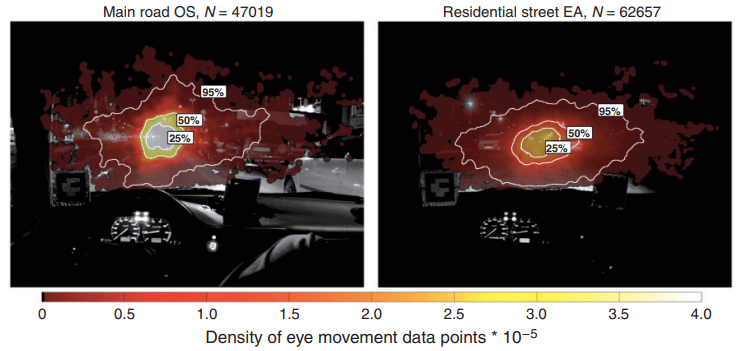
We have reached a similar and equally troubling conclusion to that of the previous article on visual adaptation to light. There is a wide gap between the predicted performance of mesopic vision models and that of real-world tests. This gap is largely driven by the failure of mesopic visual performance models to account for the natural eye and head movements of drivers. For example, instead of detecting a pedestrian with peripheral vision at low speeds, drivers would generally find this pedestrian within their focal vision by scanning the road. Under peripheral vision there are advantages for shorter wavelengths of light, but focal vision favors yellow light. This missing factor is the difference between lighting guidance recommending vastly different lighting spectrums. In future articles we will examine environmental factors, glare and ecological impacts.
Noah Sabatier is a photographer and lighting researcher that is dedicated to advocating for better outdoor lighting. Noah has spent the past 5 years living with a night shift sleep schedule, during this time he realized that the streetlights in his city were far from optimal – and recent changes had only made them worse. He has spent the past 2 years extensively reviewing scientific literature and technical documents alongside others advocating for better lighting. Noah is now working to raise awareness of common misconceptions that lead to bad lighting and the better practices needed to solve this problem.
Reach him at: noahsabatierphoto@gmail.com
More information available here
Works Cited:
Winter J, Fotios S, Völker S. Gaze direction when driving after dark on main and residential roads: Where is the dominant location? Lighting Research & Technology. 2017;49(5):574-585. doi:10.1177/1477153516632867
Gibbons, Ronald B. ;Meyer, Jason E.; Terry, Travis N.; Bhagavathula, Rajaram; Lewis, Alan; Flanagan, Michael; Connell, Caroline; Evaluation of the Impact of Spectral Power Distribution on Driver Performance; Virginia Tech Transportation Institute, United States. Federal Highway Administration. Office of Safety Research and Development Report Number : FHWA-HRT-15-047
Rea M, Bullough J, Freyssinier-Nova J, Bierman A. A proposed unified system of photometry. Lighting Research & Technology. 2004;36(2):85-109
Goodman T, Forbes A, Walkey H, et al. Mesopic visual efficiency IV: a model with relevance to nighttime driving and other applications. Lighting Research & Technology. 2007;39(4):365-392.
Bommel, W. Road Lighting. Fundamentals, Technology and Application; Springer: Berlin/Heidelberg, Germany, 2015. Doi: 10.1007/978-3-319-11466-8
Related Article
Part 1: How Many Studies Does it Take to Change a Lightbulb?
Changing a light bulb in our home is perhaps the most simple task in which we can still credit ourselves for performing household maintenance. The amount of thought such an operation receives rarely extends beyond looking for the most efficient pack of bulbs