LHRC Releases Version 2.0 of Circadian Stimulus Calculator
September 21, 2021
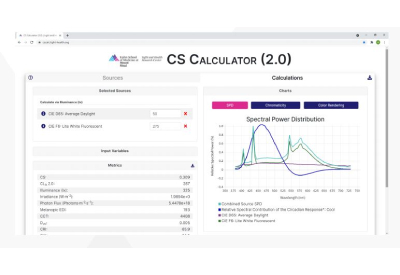
The Light and Health Research Center (LHRC) at Mount Sinai has released an extensively revised version of its free, openaccess circadian stimulus (CS) calculator based on recent advances in the understanding of light’s effects on the human circadian system. As with earlier incarnations of the tool created when LHRC researchers were based at Rensselaer Polytechnic Institute in Troy, NY, the CS Calculator version 2.0 is designed to help lighting professionals quantify potential circadian-effective light exposures in architectural spaces.
Building on the previous tool’s capability for calculating CS levels from multiple sources and enhanced functionality for displaying results, CS Calculator version 2.0 now features:
• Addition of exposure duration, with times apportioned in 15-minute increments
• Refined accuracy of CS predictions for narrowband sources
• Availability of CIE α-opic irradiances in the output metrics
• Upload/download capability in TXT and JSON formats
• User interface improvements
• Backwards compatibility with older versions of the CS Calculator
• Bug fixes
Lighting professionals can use the CS Calculator 2.0 to compare the effectiveness of various light sources and light levels for stimulating the circadian system based on the circadian light (CLA) and CS metrics. CLA characterizes the spectral sensitivity of the circadian phototransduction circuits in the human retina and CS reflects their operating characteristics, from threshold to saturation. CS is, therefore, postulated to be a measure of the effectiveness of optical radiation incident on the retina for stimulating the master biological clock.
The CS metric was developed by LHRC from biophysical research and retinal neurophysiology, as most recently articulated in two major scholarly articles detailing the neuroanatomical and computational models of circadian phototransduction, formulated by LHRC researchers and published in Frontiers in Neuroscience. LHRC researchers have pioneered applications of the CS metric to reduce depression and agitation in persons living with dementia, improve sleep and mood in office workers, and promote entrainment in U.S. Navy submariners.
The LHRC has also developed a documentation webpage with information on how to use the calculator, the math and science behind the results, and much more.
The CS Calculator 2.0 can be found at: https://cscalc.light-health.org/
Documentation on the calculator can be found at: https://docs.light-health.org/cscalc