LRC Study Finds Robust Morning Light Improves Sleep and Mood, Lowers Stress in Office Workers
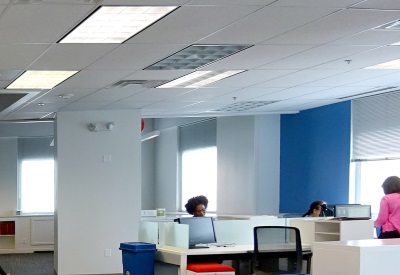
A new study from the Lighting Research Center (LRC) at Rensselaer Polytechnic Institute found that office workers who receive a robust dose of circadian-effective light in the morning, from electric lighting or daylight, experience better sleep and lower levels of depression and stress, than those who spend their mornings in dim or low light levels.
The LRC research team, led by Dr. Mariana Figueiro, professor and director of the LRC’s Light and Health program, investigated the connection between circadian stimulus (CS), a measure of light’s impact on the circadian system, and sleep, depression, and stress in office workers.
Results of the study were published in the June issue of Sleep Health, the journal of the National Sleep Foundation, in an article titled, “The impact of daytime light exposures on sleep and mood in office workers”.
The study included 109 participants at five office buildings managed by the U.S. General Services Administration (GSA). Sites included the GSA Central Office in Washington, D.C.; the Edith Green-Wendell Wyatt Federal Building in Portland, Oregon; the Federal Center South Building 1202 in Seattle, Washington; the Wayne N. Aspinall Federal Building and U.S. Courthouse in Grand Junction, Colorado; and the GSA Regional Office Building in Washington, D.C.
Each study participant wore a Daysimeter, a research tool developed by the LRC in 2004, and used in frequent studies to measure the amount of CS a person actually receives, along with their activity patterns. In the present study, each participant was asked to wear the Daysimeter as a pendant for seven consecutive days during data collection periods in winter, between December and February, and again in summer, between late May and August. Data collection was conducted between 2014 and 2016.
LRC researchers collected data on the participants’ sleep and mood using five questionnaires: the Center for Epidemiologic Studies Depression Scale (CES-D), the Perceived Stress Scale (PSS-10), the Pittsburgh Sleep Quality Index (PSQI), the Positive and Negative Affect Schedule (PANAS), and the Patient-Reported Outcomes Measurement Information System (PROMIS) Sleep Disturbance (SD). Participants were also asked to keep a sleep log of bedtimes and wake times, sleep latency, quality of sleep, and any naps taken.
Dr. Figueiro and her team found that office workers receiving a morning CS of at least 0.3, regardless of source (electric lighting and/or daylight), exhibited greater circadian entrainment, were able to fall asleep more quickly at bedtime, and experienced better quality sleep than those receiving a morning CS of 0.15 or less. CS, the calculated effectiveness of light’s impact on the circadian system, ranges from 0.1, the threshold for circadian system activation, to 0.7, response saturation.
Participants who received high CS (at least 0.3) in the morning were able to fall asleep faster at bedtime than those receiving low CS (0.15 or less), and this association was even stronger in the winter months. At bedtime, participants receiving low CS lay in bed for approximately 45 minutes before they could actually fall asleep, which can lead to reduced sleep duration for those with a fixed wake time.
Participants who received high CS in the morning reported lower levels of stress than those receiving low CS, and this finding was consistent during both summer and winter.
While receiving high CS in the morning is hypothetically the most beneficial for entrainment, participants receiving high CS during the entire workday (8:00 a.m. to 5:00 p.m.) experienced better sleep quality and felt less depressed compared to those receiving low CS.
The CS metric has been successfully applied to quantify lighting interventions in many other laboratory and field studies. In the laboratory, CS was used to predict melatonin suppression from self-luminous devices, and in the field, CS was used to predict entrainment in U.S. Navy submariners, and sleep quality and mood in persons with Alzheimer’s disease living in long-term care facilities.
“Our study shows that exposure to high CS during the day, particularly in the morning, is associated with better overall sleep quality and mood scores than exposure to low CS,” said Figueiro. “The present results are a first step toward promoting the adoption of new, more meaningful metrics for field research, providing new ways to measure and quantify circadian-effective light.”
“We are supporting this type of research so we can learn more about the connections between lighting and health,” said Bryan Steverson with GSA. “The data from this research will help support our efforts in developing new lighting practices that can optimize health benefits for federal employees working in our federal buildings.”
Along with Figueiro, co-authors of the study include Bryan Steverson, Judith Heerwagen, and Kevin Kampschroer of the GSA. LRC co-authors include Mark Rea, Kassandra Gonzales, Barbara Plitnick, and Claudia Hunter.
The present study is the first to measure personal circadian light exposure in office workers using a device calibrated to measure circadian-effective light. It is also the first to directly relate circadian-effective light measures to mood, stress, and sleep outcomes.
Resources
Sleep Health journal article: http://www.sciencedirect.com/science/article/pii/S2352721817300414
Reuters news story: http://www.reuters.com/article/us-health-sleep-daylight-idUSKCN18E23E