JDRF Electromag Presents – Introduction to Self-Commissioning Luminaire Level Lighting Control Course
February 19, 2026
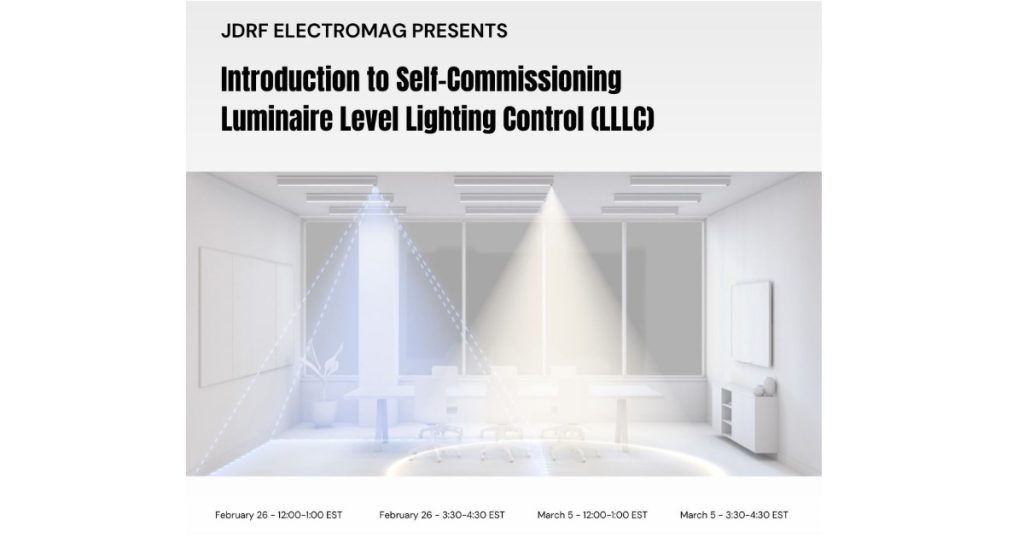
JDRF Electromag Presents: Introduction to Self-Commissioning Luminaire Level Lighting Control Course – Feb 26 & March 5, 2026
This course introduces participants to AI-enabled Luminaire Level Lighting Control (LLLC)—a major technical advancement in commercial smart lighting. The program explores how artificial intelligence enables true self-commissioning lighting systems, eliminating many of the complexities traditionally associated with setup and configuration.
Participants will gain a clear understanding of: How the technology works and the role of AI in self-commissioning. Key differences between AI-driven self-commissioning systems and conventional LLLC offerings. Where the greatest value is realized in real-world applications, from energy optimization to reduced installation costs. By the end of the course, participants will understand how self-commissioning fits within the broader LLLC landscape, the advantages it provides, and how it effectively eliminates the trade-offs between capital expenditure and energy conservation—unlocking smarter, more sustainable lighting solutions.
Learning Objectives
- Identify Challenges to LLLC Adoption: Examine the key barriers to widespread implementation of Luminaire Level Lighting Controls (LLLCs), including installation complexity, configuration requirements, and user adoption issues.
- How AI Enabled Luminaires Remove Barriers to LLLC Adoption: Understand how AI-enabled luminaires can reduce barriers to LLLC adoption through self-commissioning features. Explain how these systems function in practice, including sensor integration, communication protocols, and automated setup processes.
- Compare Self-Commissioning with Traditional LLLC Approaches: Analyze the technical capabilities of self-commissioning luminaires—such as discovery, adaptation, and self-governance—and compare them with conventional networked or app-based LLLC systems, considering their impact on installation, scalability, and ongoing maintenance.
- Evaluate the Impact on Architectural Specification and Design: Assess how AI-driven lighting systems may influence lighting specification, design, and deployment workflows. Discuss potential applications across commercial, educational, and industrial sectors, and explore their relevance in both new construction and retrofit scenarios.
- Evaluate How Self-Commissioning Systems May Avoid Traditional Trade-Offs in Lighting Projects: Minimizing capital expenditure at the expense of long-term energy savings — particularly during the planning and budgeting phases of architectural development.
Prerequisite Knowledge
Prerequisite Knowledge: No prerequisite knowledge is required. However, familiarity with traditional LLLC systems is recommended to gain the most benefit from the course.
Sessions
For more information about this course, contact the provider.
- Session 1.) Feb 26, 2026, 12:00 PM to 01:00 PM [ET (UTC -5) Eastern Time] – Register
- Session 2.) Feb 26, 2026, 03:30 PM to 04:30 PM [ET (UTC -5) Eastern Time] – Register
- Session 3.) Mar 05, 2026, 12:00 PM to 01:00 PM [ET (UTC -5) Eastern Time] – Register
- Session 4.) Mar 05, 2026, 03:30 PM to 04:30 PM [ET (UTC -5) Eastern Time] – Register

Register HERE
For more information on JDRF Electromag lighting solutions HERE

View original LinkedIn post HERE

JDRF Electromag JDRF Electromag JDRF Electromag