LRC Releases Free, Open Access Horticulture Luminaire Calculator
May 11, 2020
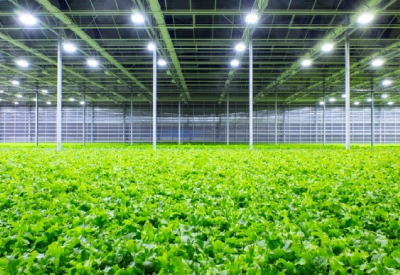
The Lighting Research Center (LRC) at Rensselaer Polytechnic Institute has developed a free, easy-to-use online tool that will assist growers to evaluate the performance, efficiency, and economics of a wide variety of horticultural luminaires, typically used in greenhouses and other controlled agricultural environments. This online tool, called the horticulture luminaire calculator allows growers to accurately compare several luminaires and select the one that will be most effective for their particular application.
Electric lighting is essential to providing supplemental light in many greenhouses and is the only source of light for indoor agricultural environments. These lighting systems are extremely expensive to purchase and install, so it is important for growers to select a lighting system that will provide the most effective lighting for their application at the lowest overall operating cost.
The horticulture luminaire calculator developed by the LRC, is based on a metric called photosynthetic photon flux density (PPFD). PPFD is analogous to photopic illuminance on a work surface in an architectural application. Just as it is only valid to compare the power densities of alternate lighting systems at equal illuminance levels on the work plane, the power densities of alternate horticultural luminaires should only be compared when they provide the same PPFD on the plant canopy.
Growers can easily be misled by considering luminaire efficacy alone, when selecting lighting products for horticultural applications. Luminaire efficacy does not take into account important factors such as the luminaire intensity distribution, optimal luminaire layout, and the number of luminaires that will be required to reach a criterion PPFD. All of these factors are significant when evaluating the overall cost-effectiveness of various horticulture luminaire options.
The horticulture luminaire calculator allows a grower to determine the best arrangement and mounting height of each luminaire they are considering. Using the calculator, growers can determine the number of each type of luminaire that will be needed to light their space to their desired light level, and select the product that will provide the optimum lighting, at the lowest cost. It would take several days to make these calculations using traditional methods. The horticulture luminaire calculator does it in a manner of minutes.
“Energy use and lifecycle costs vary widely among LED lighting systems used in controlled environment horticulture,” said LRC Professor Dr. Mark Rea. “It has been the standard approach for many years in the field of architectural lighting, and is becoming readily apparent in horticultural lighting, that we must conduct complete system energy and lifecycle cost analyses to generate an accurate picture of which technology would work best for each particular application. The horticulture luminaire calculator provides an easy way for growers to make this determination.”
This project was funded by Natural Resources Canada and other members of the Lighting Energy Alliance, including Efficiency Vermont, Energize Connecticut, National Grid, Northwest Energy Efficiency Alliance, and ComEd.
You can access the calculator HERE