Nanowires: the LEDs of the Future?
Research from the University of Copenhagen shows that LEDs made from nanowires will use less energy and provide better light. Researchers from the university’s Niels Bohr Institute studied nanowires using X-ray microscopy, and with this method they can pinpoint exactly how to design nanowire so that it gives the best properties. The results are published in the scientific journal, ACS Nano.
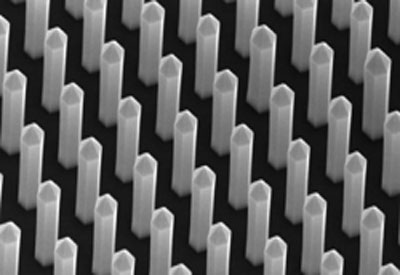
Shown in the photo is a series of nanowires comprising an inner core of gallium-nitride (GaN) and a shell of indium-gallium-nitride (InGaN). The nanowires are 2 micrometers high (1 micrometer is a thousandth of a millimetre) and 400 nanometers in diameter (1 nanometer is a thousandth of a micrometer).
Nanowires are very small — about 2 micrometers high (1 micrometer is a thousandth of a millimetre) and 10-500 nanometers in diameter (1 nanometer is a thousandth of a micrometer).
Nanowires for LEDs are made up of an inner core of gallium nitride (GaN) and a layer of indium-gallium-nitride (InGaN) on the outside, both of which are semiconducting materials.
“The light in such a diode is dependent on the mechanical strain that exists between the two materials, and the strain is very dependent on how the two layers are in contact with each other,” explains Robert Feidenhans’l, professor and head of the Niels Bohr Institute. “We have examined a number of nanowires using X-ray microscopy and even though the nanowires should in principle be identical, we can see that they are different and have very different structures.”
Surprisingly efficient
The studies were performed using nanoscale X-ray microscopy in the electron synchrotron at DESY in Hamburg, Germany. The method is usually very time consuming and the results are often limited to very few or even a single study subject. But here researchers have managed to measure a series of upright nanowires all at once using a special design of a nanofocused X-ray without destroying the nanowires in the process. The researchers scanned a series of nanowires and measured the reflections from the different crystal planes of the nanowires. The location of the reflections provides information about tilt and deformations in the nanowires.
The X-ray images of each nanowire also show the distribution of the scattering intensity and the mechanical strain in the core of gallium-nitride and the shell of indium-gallium-nitride. The strain shows that the shell fits perfectly with the core.
“We measured 20 nanowires and when we saw the images, we were very surprised because you could clearly see the details of each nanowire. You can see the structure of both the inner core and the outer layer. If there are defects in the structure or if they are slightly bent, they do not function as well. So we can identify exactly which nanowires are the best and have the most efficient core/shell structure,” says Tomas Stankevic, a PhD student in the research group ‘Neutron and X-ray Scattering’ at the institute.
Professor Robert Feidenhans’l explains that there is great potential in such nanowires. They will provide a more natural light in LEDs and they will use much less power. In addition, they could be used in smart phones, televisions and many forms of lighting. The researchers expect that they could in use within five years.