LRC Issues New Guidance for Implementing Circadian-Effective Lighting in Schools and Hospital Patient Rooms While Minimizing Energy Use
January 21, 2021
The Lighting Research Center (LRC) at Rensselaer Polytechnic Institute has recently published new guidance documents for designing circadian-effective lighting in K-12 classrooms and hospital patient rooms while avoiding increased energy use.
“With increased importance given to the health-related effects of lighting in many applications – especially in education and healthcare – the design community finds itself with a new challenge of delivering sufficient vertical illuminance for circadian stimulation without dramatically increasing lighting power demand,” said Charles Jarboe, a research scientist at the LRC and one of the lead authors of the guidance documents. “But providing energy-efficient and healthy lighting does not have to be an either-or proposition.”
The guidance documents provide background information and summaries of recent research into the benefits of lighting for circadian entrainment for K-12 students and hospital patients. The primary aim of the publications is to offer guidance for achieving effective, healthy lighting solutions in both applications while limiting increased energy use to the greatest extent possible.
For circadian entrainment and improvements in sleep quality and psychological health, high daytime light levels at the eye are necessary, followed by low evening/nighttime light levels in order to achieve a robust 24-hour light-dark pattern. However, the recommended light levels in K-12 classrooms and for general (non-exam) lighting in hospital patient rooms are generally too low for daytime circadian stimulation. Providing the necessary light levels using design strategies typically intended to deliver illuminance to the horizontal workplane (as opposed to vertical illuminance at the eye) can have the unwanted result of increasing energy use compared to lighting installations designed with only visual performance in mind.
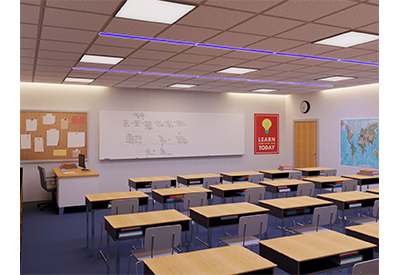
To avoid increased energy use, designers should employ luminaires and luminaire locations that maximize the vertical-to-horizontal illuminance ratio while also avoiding discomfort glare, especially in patient rooms. Designers can also increase the circadian-effectiveness of the overhead lighting by increasing overall light levels to 500 lx on the workplane for at least 2 hours during the daytime and using correlated color temperatures (CCTs) of 3500 K or higher. The most energy-efficient technique for designers to consider, however, is the addition of a supplemental layer of narrowband short-wavelength (blue) light in conjunction with typical overhead lighting. This method can avoid increasing overall light levels or using very cool CCTs while providing effective circadian lighting and only minimally increasing energy use.
The guides provide resources including links to the LRC’s newly released Lighting for Healthy Living website, and the LRC’s web-based circadian stimulus calculator.
Support for this research was provided by the Lighting Energy Alliance: Efficiency Vermont, Energize Connecticut, National Grid, the Northwest Energy Efficiency Alliance, and ComEd Energy Efficiency Program, as well as the Light and Health Alliance: Armstrong Ceiling and Wall Solutions, Axis Lighting, CREE, GE Current a Daintree Company, Ledvance, OSRAM and USAI Lighting.