Steve Mesh Talks Luminaire-Level Lighting Controls
March 11, 2019
“Luminaire-level lighting controls” (LLLCs) — that’s a mouthful of Ls! This relatively new term in the lighting controls industry indicates that every fixture controlled by a networked lighting control system (NLC) incorporates two specific things: 1) a “controller,” and 2) sensors.
Controllers are the components that contain a relay (for turning a fixture on and off) and some method for sending a dimming signal to that fixture. In an NLC, controllers usually communicate with a central server. The server is where things like schedules and other system-wide variables usually reside. A schedule residing in the central server may govern the operation of every fixture in the space. For example, all fixtures in a space may turn on based on a scheduled event that occurs every morning during the work week at 7:00 a.m. They may also turn on only when occupancy is detected by some form of sensor, such as a PIR, ultrasonic or dual-tech occupancy sensor.
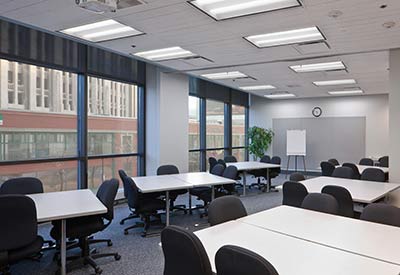
In the past, many occupancy sensors had fairly large coverage patterns, such as 2,000 ft2. For an omnidirectional ceiling-mounted sensor, that translates into a circle with a 50’ diameter, or a 45’ x 45’ square. Let’s say for sake of argument that you’re in an office where each employee has a cubicle that’s 10’ x 10’ – or 100 ft2 per employee. If the NLC has occupancy sensors covering 2,000 ft2, then each sensor could potentially respond to movement/occupancy of up to 20 different people (2,000 ft2 sensor coverage/100 ft2 per employee). If all of the fixtures in that area are assigned to respond to input from that one occupancy sensor, then they will all turn on even if only one person enters the area.
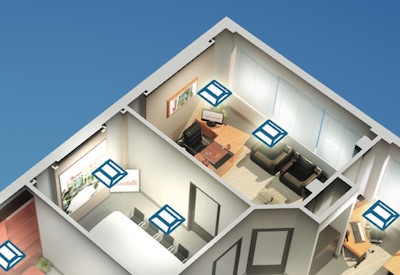
In the new paradigm of “luminaire-level lighting controls,” every fixture has its own controller and sensors. Let’s say that the same office space previously mentioned has a carefully crafted lighting plan where one fixture providing ambient light is associated with each 10’ x 10’ cubicle. If the coverage pattern of the on-board occupancy sensor is small enough, then it may only react to movement/occupancy of someone in that particular cubicle. If an occupancy sensor has a 200 ft2coverage pattern, for example, as opposed to 2,000 ft2 as in the previous example, then it will cover an area that’s roughly 8’ x 8’. For a 10’ x 10’ cubicle in an office space, that’s almost a perfect match. As a result, the fixture in a particular cubicle will likely turn on only when the occupant of that particular cubicle is present. Conversely, someone entering an adjacent cubicle will likely not trigger the fixture-integrated occupancy sensor in your fixture if you are not at your desk.
What is the benefit of this increased “granularity”? Increased energy savings. Plain and simple. Because the cost and size of sensors have dramatically decreased over time, it’s now economical to use luminaire-level lighting controls in an NLC. Almost every NLC manufacturer now offers fixture-integrated sensors and low-amperage controllers. However, most still offer controllers with higher-amperage capacity as well, in the event that you still feel strongly about controlling a group of fixtures together. For example, you might decide that all round LED downlights in a long corridor should turn on at the same time regardless of where someone enters the corridor. Incorporating fixture-integrated controllers and sensors in round, recessed downlights is a less common offering by many manufacturers. So it may in fact be a reasonable decision to control the switching and dimming of all of the downlights in that corridor with one higher-amperage controller, and one or more occupancy sensors. If more than one occupancy sensor is used, then their operation will be “paralleled,” so that someone entering the corridor anywhere along the length will turn all fixtures on.
Other than some specific applications as just mentioned, fixture-integrated (LLLC) deployment of controllers and sensors makes sense in a wide variety of spaces, not just offices. For example, a warehouse deploying an NLC with LLLC (fixture-integrated) controllers and sensors may get a similar energy savings benefit since only fixtures where people are walking or driving vehicles such as forklifts will turn on.
It’s important to note that you don’t have to think of fixtures only turning full on and full off depending on whether the occupancy sensor detects the presence (or absence) of people. Most NLC systems have options to set specific dimming levels based on occupancy or vacancy. In fact, some energy codes specifically require that fixtures in certain spaces energize to a “partial on” state; for example, “auto on to 50%” (where the occupant would have to manually flip a switch to override the 50% setting and turn lights on to full). Conversely, in certain energy codes, fixtures in spaces such as stairwells can dim upon the sensors detecting “vacancy”, but cannot turn fully off, since a stairwell is a route of emergency egress. By using an NLC that has these types of options in its software — and most currently do — you can comply with energy codes and save energy all at the same time.
Some energy codes are beginning to square with the latest advances in technology, slowly (!!!), but they are. For example, the 2018 version of IECC now contains references to LLLCs. As stated in Craig DiLouie’s LCA post on 7/27/2018:
“Possibly the biggest change in the mandatory controls requirement section is a new choice of two compliance paths. The code now includes an alternative path in which luminaire-level lighting controls (LLLC) are installed alongside manual controls and controls for specific applications such as accent and supplemental task lighting.
“The IECC defines LLLC as a system in which luminaires feature embedded intelligence, occupancy and light sensors, wireless networking capability, and where required local override switching capability. The code requires the luminaire to be independently capable of occupancy sensing, dimming to maintain a desired light level, and configurability including dimming set-points, timeouts, fade rates, sensor sensitivity, and wireless zoning.”
The phrase “light sensors” refers to what are generally called “photosensors.” Many manufacturers use terms such as “daylight sensors,” “ambient light sensors,” and so on. Regardless of what you call them, the cost and size of these components has also come way down over time, similar to occupancy sensors. Therefore, it is now economical for manufacturers to incorporate them into LLLCs as well. This increased granularity may help to reduce energy similar to occupancy sensors, but more importantly it may also help to provide greater uniformity of target illumination. What would happen if, for sake of argument, the dimming signal from a single photosensor commanded fixtures to dramatically increase in light output because a shadow from a column obscured the incident light hitting that photosensor? If that photosensor were assigned to all fixtures in a large area, the light output of all fixtures would increase in response, cancelling out the opportunity for greater energy savings. Conversely, what if a strong but narrow beam of incident light just happened to hit that same photosensor? Then it would command all fixtures in that area to dim, even if most needed to be at higher output to maintain the same target illuminance level. Clearly, individual fixture-integrated (LLLC) photosensors are just as beneficial as fixture-integrated occupancy sensors.
As mentioned, luminaire level lighting controls are now incorporated into some of the latest code versions, such as IECC 2018, as one possible method of code compliance with stringent energy codes. However, in certain areas local utility companies are also incentivizing the deployment of LLLCs as opposed to NLC systems that do not use fixture-integrated components. For example, there has been a big push among utilities in the U.S. northwest for deployment of NLCs with luminaire level lighting controls.
Whether or not the applicable energy code requires LLLCs… or allows them as a possible prescriptive path to compliance… or the local utility incentivizes them… using LLLCs always provides the maximum granularity, and therefore the maximum flexibility, and very likely the maximum energy savings in offices, warehouses and many other space types. Make sure to ask any vendor you are considering if they have components allowing for luminaire level lighting controls.
This article was first published at lightingcontrolsassociation.org/2019/02/04/steve-mesh-talks-luminaire-level-lighting-controls/
Steven Mesh is an award-winning lighting designer who has designed lighting and control systems for a variety of project types (commercial, museums, schools, residential, restaurants, retail, historic, healthcare, etc.). As an educator, he has taught classes and given presentations about lighting and controls across North America and internationally. One of his is developing lighting and lighting controls courses that rely on hands-on and/or interactive content. He has been a repeat speaker at LightFair for eight years.