Montreal Undertakes One of North America’s Largest Smart Lighting Projects

October 16, 2018
One of the largest smart lighting projects in North America, converting an entire city’s street lighting infrastructure from standard high-pressure sodium (HPS) fixtures to connected and remote-controlled LEDs, is underway in Montreal, Quebec. Set on an island in the St. Lawrence River, this cosmopolitan city has a population of more than two million people and is a cultural, economic and touristic powerhouse. Given its favourable geographical attributes, awesome lifestyle, and innovative culture, Montreal has become one of Canada’s fastest-growing cities, attracting and retaining a wide range of businesses as well as residents from all over the world.
The challenge
The city of Montreal plans to initially convert more than 132,000 fixtures from HPS to LEDS distributed through 19 boroughs. Among this number, 85,000 streetlights are cobra heads and the remaining 47,000 are decorative lights. In 2016, 70% of these fixtures reached their end-of-life expectancy and needed to be replaced. Consequently, the city took the decision to convert the HPS fixtures that it had been using for several years to LED fixtures, which require less energy and have higher life expectancy. Besides this modernization need, the lighting system at the time did not allow remote computerized management. Streetlights were equipped with a simple controller that used a photocell or an astronomical clock to turn them on or off.
The whole infrastructure was obsolete and needed improvements that could accommodate new capabilities such as inventory management, maintenance management and telemetry.
Here is a non-exhaustive list of problems the city faced that prompted the city to convert its legacy lighting infrastructure into a smart lighting system:
- impossible to guarantee street lighting performance
- no inventory of deployed equipment was available
- absence of a management system that could account for interventions and maintenance operations that were routinely performed on the lighting infrastructure
- no scheduling function available
- status of the equipment or maintenance operation could not be monitored or recorded for proper reporting
- light intensity adjustment was not possible
- no automated detection of faults
- warranty management history not available
- preventive measures to replace/maintain the equipment was impossible to plan ahead of time and therefore imprecisely budgeted
What’s being done
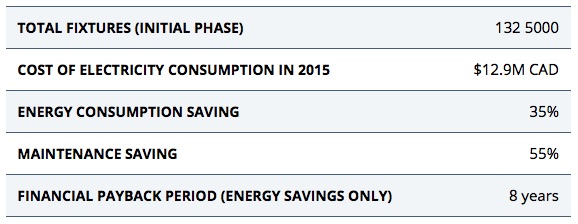
Montreal is now undertaking the LED streetlight conversion project, a $110 million investment to replace of all of its 132 500 high-pressure sodium (HPS) cobra head type with LED. The remaining 47,000 decorative and other types of fixtures will also be converted. Litenode wireless relays and Gateways from Dimonoff, combined with nodes from other companies are installed on every fixture throughout the city. Conversion began in December 2017 and is planned to be completed in 2022.
Considering the proven leverage provided by smart street lights as a backbone for many smart city applications, Montreal positions itself once again at the forefront of innovation by combining its lighting infrastructure network with advanced metering and communications technology, enabling optimized management of all IoT city assets and devices already in use or installed in the future.
To manage all these new smart lighting fixtures, the city adopted SCMS Connect{ED} : a state-of the art IoT management platform developed by Dimonoff that can manage up to 2 billion assets and devices per system. Whether they are equipped with external nodes or internal nodes in the case of the decorative fixtures, no matter the brand of fixture, every streetlight will be remotely managed and diagnosed using a single platform. Specially equipped with RF communication combined with innovative, secure and robust firmware, Montreal’s streetlights can now be centrally managed along with the various sensors or IoT devices communicating with them. By deploying a secure smart city network over the entire city, the city is taking a big step forward in favor of the digital revolution.
In addition to this first phase of converting 132,500 streetlights, more than 110,000 lights of many types and installed in public and private areas such as parks, parking lots, bike lanes, sports venues, etc, are being added to the pipeline of lights to be converted and controlled using SCMS Connect{ED}.
Benefits
Besides providing the control of every street light remotely and in real time, SCMS Connect{ED} maps the city’s connected assets and devices and instantly detects their state of operation, allowing failures, power outage and other anomalies to be detected and efficiently resolved. The city can adjust the brightness of part or all of its street lights and measure the change in electricity consumption in real time. This multicomponent system allows for scalability and addresses the most important criteria of any innovative smart city network: security and adaptability/interoperability to new technologies and future applications. As a first newfangled IoT add-on remotely managed using DimOnOff’ SCMS Connect{ED}, Montreal is gradually integrating digital parking signs and digital snow removal panels.
Here are, in summary, the main advantages of Montreal’s smart lighting system:
- real-time monitoring of lighting performance 24/7
- real-time energy consumption
- systematic up-to-date equipment and operations inventory
- alarms are triggered when failures or service errors or interruption occur
- customizable lighting control scenarios: events, absence of traffic, city operations, construction sites, 911 calls, etc.
- optimization of maintenance planning
- customizable assignment of control and management responsibilities of all smart city applications connected to the smart lighting network
The project at a glance
This article was first published online by Dimonoff, www.dimonoff.com/library/cases-studies/city-of-montreal/. Dimonoff develops and manufactures remote management system to control, monitor and meter light fixtures of all types for the municipal and commercial markets. The firm is based in Quebec City; www.dimonoff.com