LAMP Names 2016 Lighting Design Winners
{loadposition slideShow22}
November 8, 2016
The just concluded third annual Lighting Architecture Movement Project (LAMP) competition continues to provide an international opportunity for up-and-coming lighting designers to showcase their talents in a unique conceptual exploration of light. It’s a one-of-a-kind lighting design competition and exhibition held yearly in Vancouver, BC.
This year’s theme was “Cosmic,” exploring the link between sculptural object and far-reaching technologies.
LAMP was founded in 2013 as a group installation and exhibition showcasing light and form through the lens of architectural design. In 2014, LAMP launched its International Lighting Design Competition with a mandate of offering designers the opportunity to engage their talents in unique conceptual explorations and to connect the local community to architecture and design. Each year presents a new theme and new set of guidelines to challenge entrants.
LAMP is run by founders Annika Hagen and Nicole Fox. Our interests and abilities span writing, film, dance and design. We are performers, producers and audience members. We joined forces in the interest of producing interesting, dynamic and enjoyable events that people will remember.
Find out more about LAMP: www.welovelamp.ca.
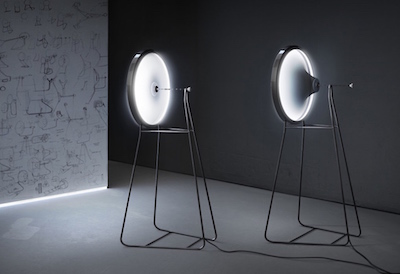
LAMP 2016 winners
From 132 submissions from 80 cities in 27 countries, LAMP’s judges chose 10 from each of the three categories, and from these entries selected first and second prize winners in each category. Three submissions also received People’s Choice awards, based on results from a public exhibit.
1st place
- Established — Black Hole Lamp
- Emerging — Antitesi
- Student — Henyx
2nd place
- Established — Diaphanous
- Emerging — Equilibrio
- Student — The Curious One
People’s choice (chosen by online public vote):
- Established — Black Hole Lamp
- Emerging — Beton Floor Lamp
- Student — Carbolight
Canadian finalists
Two Canadian entries achieved finalist status in the Established category.
Diaphanous, created by Matthew Kennedy
Concept statement: diaphanous lights the night hours with starlight. Diaphanous is a map to the stars, recreating the actual patterns of the night sky from any point of view on earth, shown here as the night sky of the Northern hemisphere. The ancients believed a firmament separated the heavens from the earth, a hemisphere from where the stars shone down to lighten our darkest hours. Diaphanous recreates this cosmic order, a luminaire fashioned with an LED waveguide dome, floating above, with light extractors fashioned by custom laser etching to represent the multitude of stars and nebulae of the cosmos.
Project specs: Diaphanous is an LED waveguide luminaire measuring 180mm tall by ø900. The minimal parts and innovative, screw-free assembly makes Diaphanous sustainable and cost effective, comprised of a waveguide, a circular LED array, a central ring-shaped heatsink and conductive support cables, capable of creating intense or dimmed light at a staggeringly energy-efficient 130 lumens per Watt with superior CRI 92 colour rendering.
URL: www.loom.lighting
Location: Chilliwack, BC
Introspection, by Rachel Tardif and Tatev Yesayan
Concept statement: the design of this lamp was achieved by exploring a variety of themes related to the cosmos which were used as analogical tools. Foremost were the concentric motions of the cosmic spheres (the moon revolves around earth, which revolves around sun, which revolves around the galactic center), as well as the poetic aspect of the constellations that shows how humans create a connection with the infinite by applying their own scale onto the stars. Indeed the purpose of this project was to create an object that can recreate the narrative of our obsession to understand the universe and find our origins in the stars. It does so through this introspective and contemplative experience of playfully pivoting the concentric spheres to find the light at its center. The shape of the lamp was inspired by the observatory’s wandering eye and the gyroscope’s multiple pivoting axes.
Project specs: dimensions (approximately) — 8″x8″x8 2/3″; materials — 3D printed plastic (acrylic polymer), 1/2″ copper pipe, copper rings, LED light. The three spheres are 3d printed in halves to be inserted into each other. The copper rings hold the halves together and support the pivot points for each sphere.
Place of origin: Montreal, PQ
Pierre de lune, created by Vincent Le Bon and Emilie Steprans
Concept statement: Pierre de lune celebrates the singularity of bedtime rituals by creating a soft, warm and unique light. The digital tools used to produce each one of its parts make “Pierre de lune” a unique home object who’s detailing remains minimal and elegant. The concrete sphere expresses the simplicity but also the imperfect shape and surface of our moon. Its weight, however, is somehow related to gravity, taking you right back on Earth. The maple wood lens was chosen in order to create a natural and soothing light. The angle of the projected light also mimics the effect of the sun disappearing on the horizon.
Project specs: concrete sphere width ø 15cm; wood lens diameter ø 11,1cm
URL: www.binx.co
Place of origin: Montreal, PQ
See all finalists: www.welovelamp.ca/2016-competition-finalists.