8 Popular Misconceptions about LEDs and Controls
In the last five years, LEDs and controls have been widely used in a broad range of general lighting applications, from residential to commercial. However, there are a number of persistent misconceptions about LEDs — many based on knowledge of legacy fixtures — that do not apply. In fact, for commercial and industrial applications, high-quality LED fixtures offer unique and compelling characteristics:
• extremely low energy use
• long lifespan
high-quality light
durability
• none of the maintenance (re-lamping, re-ballasting) associated with traditional incandescent and fluorescent sources
• inherent controllability (instant on/off, full-range dimming), creating additional energy savings opportunities.
Because LEDs are relatively new compared to legacy lighting types, it’s time to dispel the myths and set the record straight about their performance, value, and applicability.
Myth 1: all LEDs are basically the same
Fact 1: LED fixtures vary dramatically in quality, lifetime, and light output.
Commercial and industrial LED fixtures are not all the same. There is a broad range of fixture quality and variation, which impacts expected fixture lifespan, light output, and the ability to ensure that light is distributed appropriately for the environment and application. In addition, LED chip lifetimes can vary dramatically due to the quality of the LED chip itself, and by the driver and thermal infrastructure built around it. Optics are instrumental in directing the concentrated light output from LED chips to the target area as well.
There is also the question of whether to select plain LED fixtures or fixtures with embedded sensors and controls. Plain LEDs provide one-time energy savings, while intelligent systems offer greater efficiency, flexibility, control, and long-term value.
Best advice: understand your facility’s light level and distribution requirements, and evaluate products that
• deliver required light levels at the task level
• meet your organization’s energy efficiency goals
• offer the optics required for your environment
• have well-documented certifications that verify the design quality of the fixture
More Information: for resources on evaluating LED fixture quality, please refer to the U.S. Department of Energy’s Solid State Lighting website www.energy.gov/eere/ssl/, along with the DesignLights Consortium at www.designlights.org/content/about
Myth 2: LEDs are too expensive
Fact 2: LEDs are more expensive up front, but intelligent LEDs are substantially more cost-effective for most commercial and industrial applications.
Lighting projects are like icebergs: initial cost is what people see. Upfront cost is only the tip, and invisible costs, such as years of electricity, plus demand charges and maintenance costs, can be catastrophic. When considering LEDs, the choice is typically between plain LED fixtures and intelligent LED systems. Initially, both are more expensive than HIF alternatives and eliminate maintenance and re-lamping costs. However, plain LEDs offer only one-time wattage savings of 40-50% and no opportunity for additional savings from controls. In contrast, intelligent LEDs save more than 90% on lighting energy use over alternatives by combining aggressive controls with the added benefits of flexibility, analysis, and insight.
In financial terms, systems with lower up-front costs typically have a much higher lifetime total cost of ownership (TCO) than intelligent systems. And, LEDs have no ongoing maintenance requirements (re-lamping or re-ballasting) so there is no looming iceberg.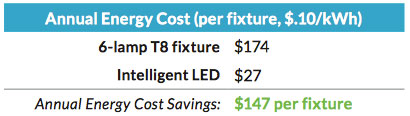
Even adding a sensor to a plain LED fixture leaves savings on the table. In addition to greater efficiency, intelligent LED lighting systems offer additional benefits to the operation and enterprise that range far beyond energy savings.
Myth 3: LEDs are so efficient that controls are unnecessary
Fact 3: controls are the key to driving down energy use and achieving rapid payback periods.
Switching to LEDs creates a one-time savings event, typically reducing lighting energy use by up to 50%. Integrated sensing and controls can nearly double those energy savings, making controls essential for maximum savings and project economics.
In systems with fully integrated controls, light is delivered precisely where and when needed, with no wasted lumen output. Why? Sensors embedded in every fixture assess the environment and turn on to specified light levels when people are present. If there is daylight, sensors register available light and provide only the artificial light necessary to ensure the target light levels are met in the facility. And, all settings can be adjusted and fine-tuned to maximize efficiency on a continuous basis.
With plain LEDs, any controls are typically after-market integrations, and do not offer the fine-grained ability to manage all control variables for maximum efficiency. In addition, fully managed systems — with a software back-end — have the ability to integrate with other systems of record in the enterprise to share data, creating opportunities for additional enterprise value. Software-controlled lighting systems give facility managers the chance to future-proof their investments and take advantage of advanced energy services like demand response.
Myth 4: Dimming LEDs doesn’t work well and shortens fixture lifetime
Fact 4: well-designed LEDs dim smoothly without negatively affecting lifetime.
Unlike legacy lighting types, dimming LED fixtures does not negatively affect their lifetime or increase maintenance requirements. Well-designed LED fixtures offer:
• digital dimming that smoothly varies the amount of light reaching a particular surface. Output levels can be varied by shift and zone, assuming that fixtures have integrated controls. As one of the most effective energy-efficiency strategies, dimming needs to be implemented on every fixture for maximum impact.
• dim ramping, which enables the gradual and graceful increase or decrease in light output across groups of fixtures. This approach eliminates complaints about abrupt on/off control action, allowing operators to use aggressive control settings while maximizing occupant comfort.
More Information: the TM-21 standard published by IENSA is a neutral, scientifically based document that allows fixture manufacturers to accurately project the aging of LED chips within a given fixture. “Time at temperature” is the factor that drives lumen depreciation, so a well-designed fixture that (a) carefully manages its thermal loads, and (b) spends the most possible time at the lowest possible power can easily retain 70% of its initial output for well over a decade.
Myth 5: control capabilities (bells and whistles) are not necessary
Fact 5: an intelligent LED lighting system with integrated controls provides value beyond cost-effective light.
Control capabilities are not optional when efficiency is the goal. In addition to energy efficiency savings, intelligent LED lighting systems with granular controls provide:
• unprecedented visibility into energy and other valuable operational data. For example, facility staff can view occupancy patterns over a given period of time to see where activity is concentrated and correlate that information with other enterprise data to optimize merchandise placement in retail and distribution environments.
• the ability to monitor energy loads from non-lighting systems and circuits, and share these data — with permission-based access — with other users across the enterprise.
• an API to exchange data between the lighting software platform and third-party systems, simplifying corporate sustainability reporting, for example.
Myth 6: LED prices will go down, so it pays to wait
Fact 6: waiting for LED fixture prices to drop will cost you money.
The major LED chip price drops have already happened; the rest will be incremental. However, the energy savings from upgrading to LEDs far exceed any modest price declines in LED-based fixtures. So waiting for a price drop will cost more in energy savings than savings from LED price declines. Here’s why: a quick glimpse at a typical facility’s operating budget shows that lighting is one of the largest non-process energy loads.
The major factors associated with industrial lighting are up-front costs and energy use. By reducing energy usage 50% to 90%, LEDs pay back in energy savings much more than could ever be accrued through incremental LED price declines. If anything, energy’s upward price trend makes waiting even more costly.
The math: using the same $0.10/kWh rate, for example, a single 6-lamp T8 fixture typically consumes $174 in lighting-related energy costs per year. An intelligent LED fixture consumes just $27, resulting in a net savings of $147 per year (not including the additional daylight harvesting, maintenance, and/or refrigeration savings associated with intelligent LEDs).
Myth 7: LEDs don’t work well in high-temperature environments
Fact 7: well-designed LEDs work well in a broad range of environments.
During temperature tests conducted by independent labs, LEDs performed equally as well as fluorescents and HID fixtures (see note below on testing parameters). Quality matters, and a well-designed lighting system that carefully manages heat dissipation is a prerequisite for lighting operating at any temperature — hot, cold, or anywhere in between.
At the same time, it is important to note that LEDs perform extraordinarily well in cold environments, an area that has been particularly challenging for other types of lighting, such as fluorescent and HID.
Note: an important indicator of the quality of an LED solution’s thermal management is junction temperature, which measures the internal temperature of the LED chip within the fixture for specified operating intervals — usually 6,000, 10,000, or even 18,000 hours. These values are commonly available as part of industry standard tests performed by independent testing labs.
Best advice: be sure to request all testing data from LED fixture vendors, including LM-80 (LED chip) and TM-21 (LED chip within specific fixtures).
Myth 8: LEDs are too bright, or not bright enough
Fact 8: well-designed LED fixtures provide the right light output to manage glare and light placement while eliminating the yellowish colours of high-pressure sodium and HID lights.
LED fixtures vary dramatically by fixture, with different options for lumen output, optics, directionality, and colour temperature. Fixture layout and mounting height also play key roles in successful lighting plans.
Important to note:
• high lumen output does not necessarily correlate to adequate light levels at the target surface(s). In fact, many fixtures that advertise high lumen output do not manage light effectively. These fixtures are sometimes labelled “glare bombs,” and are often sub-par performers, even if premium priced.
• well-designed optics are used to direct the lumen output from LED chips to the target surface. Look for fixtures with optics options to match your environment’s needs. Narrow, wide, aisle, or diffuse lenses should all be available.
• directionality is important. Look for fixtures with flexible light bars that can deliver light in the direction needed, including to the ceiling if necessary.
• colour temperature choices are important, and vary from environment to environment. Higher colour temperature — typically 5,000 K — is used in warehousing or manufacturing, while 4,000 K is used in convention centres or retail environments.
• high-quality fixtures with options for lumen output and optics packages can provide flexibility to reduce fixture count in certain applications. Variables include mounting height, foot-candle requirements, and space layout. With the ability to position light bars for optimal light distribution, sometimes a smaller number of higher output fixtures can be the better solution.
• work with a qualified and proven lighting partner who will present the best and most economical lighting design that meets the facility’s needs.
Closing thoughts
Interest in LED lighting is at an all-time high as energy efficiency and corporate sustainability initiatives are increasingly important worldwide. But because LEDs are fundamentally different from other lighting types, it is critical to understand the characteristics, benefits, and opportunities they present.
This article was first published online as a Digital Lumens white paper: http://digitallumens.com/resources/white-papers/