Steve Mesh on Space Optimization with Networked Lighting Control

Nov 20, 2019
by Steve Mesh
Saving energy is a huge benefit when you use a networked lighting control system. Fixtures can be turned off when not needed. Or they can be dimmed in response to available daylight or other input. Saving energy is a great reason to deploy a networked lighting control system, but it’s not the only one. There are quite a few other “non-energy benefits” (or NEBs).
“Space utilization” and “indoor positioning” are two such non-energy benefits. On the surface, these may sound esoteric. However, rest assured that they can provide additional value in a project, beyond simple energy savings.
Until the recent past, large real estate companies have analyzed space utilization for things like offices and meeting rooms by manually noting when they were or weren’t occupied. Alternately, they could also draw conclusions about how many hours a given space was used by looking at a schedule – for example for a meeting room. Thankfully it’s 2019, and guess what? To quote from the Six Million Dollar Man – “We have the technology!!!” Energy codes require the use of occupancy sensors in many space types. If every space in your building has one or more occupancy sensors, and you have a networked lighting control system, then you have the infrastructure you need to automatically generate data about space utilization for future analysis.
In the past, an occupancy sensor directly controlled one or more fixtures because it was wired upstream of the loads, just like a switch is. However, in a networked lighting control system, an occupancy sensor is simply one type of component that ultimately talks to the central server. The sensor may be standalone, fixture-embedded, wired, wireless, etc. It really doesn’t matter. Regardless of whether it’s embedded in a fixture or not, it is designed to send data to the server the same way that switches and fixture controllers do. Typically, these sensors send information only when they change “state.” For example, if someone enters a room, the sensor senses “occupancy” and sends that information to the server, which records that “event” in a log for future analysis. The same thing happens once the sensor senses “vacancy.” Based on these raw event “stamps,” it’s very easy to analyze the space utilization over time.
What can you do with this raw information and how can that be valuable for the owner or facility manager? Let’s say you have an office floor with open office space, private offices, and six conference rooms. After recording occupancy vs. vacancy over a period of a few months, you determine that the conference rooms are only used on average 60% of the time. You could decide to convert two of the six conference rooms into more private offices, or even into additional open office area. Since four of the six conference rooms (66%) will still be available, that should cover the average existing usage (60%). In a large building with a multi-floor tenant, this analysis might have a substantial effect on maximizing the use of expensive office space. It might also help to serve as the basis for lease negotiations.
As you can imagine, a typical occupancy sensor used in a lighting control system has no way to count the number of people in a given space. All it can do is to know when one or more people are in the space versus none. However, there are other emerging technologies that can in fact do a pretty good job of counting the number of people. One such example is BLE (Bluetooth Low Energy). BLE “beacons” connect with your smart phone. Let’s assume that everyone coming to a particular conference room for a specific meeting brings their phone with them. If so, then the control system can in fact discern how many phones (and therefore people) are in the space. Of course, someone may not bring their phone into the meeting room, so this may not be 100% accurate in terms of the number of people in a given space. But it can be reasonably accurate. That information – the number of people in a space – can provide additional opportunities for providing value.
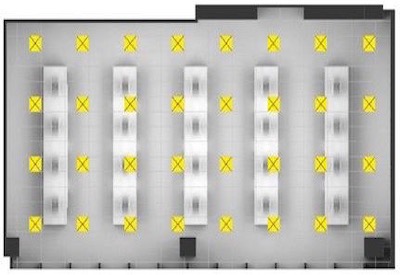
For example, if there are fewer people in the space, VAV boxes can be manipulated to change the amount of cool air entering the room from the HVAC system. Obviously, this has nothing whatsoever to do with lighting! However, it’s extremely convenient to embed the BLE beacons in light fixtures. Remember that even if these are low-voltage devices, they still require electricity in order to operate. In addition, light fixtures are ubiquitous. Let’s say you have an office space with fixtures located 10’ on center in both directions. That is a very dense grid of fixtures. If every single fixture has a BLE beacon, then you are absolutely assured of adequate coverage. BLE is designed to operate within a range of approximately 30’.
In addition to potentially sensing the number of people in a space, BLE has the added benefit of enabling “indoor positioning”. How does “indoor positioning” work? It is remarkably similar to how GPS (global positioning system) works. In GPS, a receiver monitors signals from three or more satellites. By calculating the distance to each satellite, the system effectively “triangulates” your position in space – either on the ground or even in the air. A networked lighting control system that has embedded BLE beacons can do the same thing in interior spaces. By analyzing signal strength to different beacons, the system can determine where you are. This information can be used in a variety of ways.
If you have a map of the interior spaces – let’s say on your phone just like Google Maps – a BLE beacon system can help you navigate, just like a GPS system can help you get to your destination while driving. That can be used to pinpoint the location of an item you’re looking for in a store. Or a specific doctor’s office in a hospital. Or a particular rack in a warehouse. In retail environments, this information can be even more useful. In a retail application, indoor positioning offers retailers the chance to allow customers to better navigate the store through their online applications. At the same time, the retail establishment has the chance to harvest this shopping experience into marketable insight into where and how a customer shops.
Beyond navigation, BLE offers potential beyond a consumer’s phone into things like shopping cart tracking and bag tracking. This can allow information about a customer experience to extend well beyond just those shoppers that are using an application on their phone. This is accomplished by BLE beacons embedded in in-store devices such as shopping cart BLE beacons or other tracking technology that is then picked up by the lighting infrastructure.
Some of these non-energy benefits may seem rather futuristic, but this is just the beginning. In this new world, everything is a data point! It is worth asking any vendor about the non-energy benefits that their system can provide – whether or not you think you have an immediate need for that. The more you can do with a networked lighting control system, the greater perceived value it has, and the more likelihood there will be for the system to be deployed. Then you can also start saving wads of energy and money at the same time!
Published with the permission of lightingcontrolsassociation.org