A Qualitative Policy of Urban Lighting in the Master Plan: Roadway Lighting — Tonality, Public Health and Light Pollution
Gilles Arpin
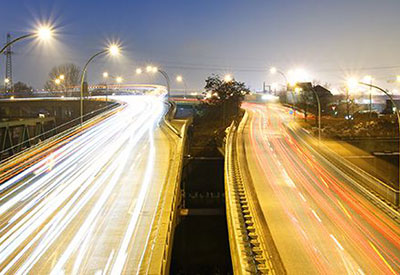
In years to come urban lighting will transform itself and thereby transform our relationship to nightlife. The transition of roadway lighting from yellow high pressure sodium to white LED is no longer in doubt.
This leaves us with what tonality to use for lighting. Recent research has established a relationship between light and reduced secretion of melatonin, a hormone that predisposes us to sleep. This is particularly true for the blue component of emitted light. For the majority of applications that I would call “skin tone” (i.e., for people), I personally promote the use of light sources emitting up to 3000K, which project a warm white light. 4000K sources include a certain amount of blue light, which may be appropriate on plants or in a park. But considering the effect of blue light at 5000K+, perhaps these light sources are best suited to locations where greater vigilance is required, such as highways or parking lots to prevent loitering — provided of course you prevent the potentially intrusive light from polluting the neighbourhood.
With LED technology, remember that that warmer the tone, the less efficient (lm/watt) the lamp. Light sources below 2700K are barely effective for urban lighting. Also, don’t blame urban lighting for all of the evils related to lack of sleep. Most studies focus on domestic interior light and personal nighttime habits that expose us to light in our homes. The duration of exposure and power (+5 lux) play an important role. Let’s hope that the brightness of the tablet or the screen on which you’re reading this article plays a more decisive role than the street lighting where you live…
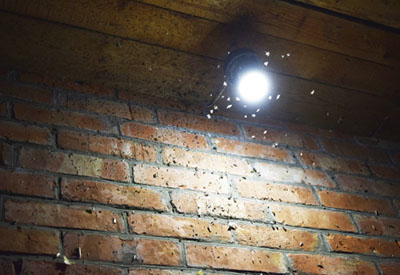
At the end of the 20th century, the lighting industry focused on light pollution from urban lampposts. We developed devices that significantly diminish light pollution while increasing our visual comfort. However, to achieve the desired lighting levels and consistency, this practice involves using more luminaires positioned closely together. Since pollution is caused not just by light sources but also by light bounced upward from reflective surfaces, it’s possible a combination of emitted and reflected light may prevent us from achieving our goals. This was rare when white light sources were rare, but imagine what could happen if the transition to white LEDs occurs indiscriminately.
The transition to LEDs is motivated mainly by energy savings, the long life of the lamps, the guarantees accompanying them, and the resulting maintenance savings. My primary concern is that decision-makers will focus on monetary savings without sensitivity to the potential for light pollution and visual discomfort — two issues I will come back to in future.
Gilles Arpin is a lighting designer. He has 30 years of experience as a technician, lighting designer, technical director, production manager and producer for various ballet, opera and musical productions. Since 1996 he has been interested in the lighting of public places and residential and commercial spaces, and founded the firm Éclairage Public. Several of his projects have won awards and recognition.
View a project portfolio at http://www.eclairagepublic.ca/index.php/en/. Professional associations include the Illuminating Engineering Society (IESNA) section Montreal, IALD International Association of Lighting Designers, and IDA International Dark Sky Association.