How Meteor Helps Unlock Innovation at Google’s Bay View
May 1, 2023
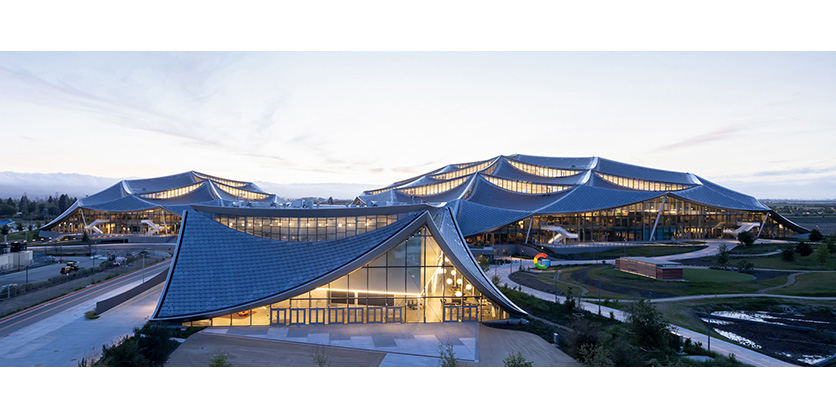
A look at how Meteor Lighting helps unlock innovation at Google’s new Bay View campus.
Located in Mountain View, California, the newly opened 1.1 million sq. ft. structure is Google’s first major ground-up development project and was designed in collaboration with architects Bjarke Ingels Group and Heatherwick Studio.
The campus’s design sprang from three core values: innovation, nature, and community. For the team at Google, it was imperative to build buildings that arouse a sense of belonging and connection within the community, but to build a once-in-a-generation building, it takes vision, leadership, and the ability to suspend disbelief to see what’s possible.
“To build a once-in-a-generation building, it takes vision, leadership, and the ability to suspend disbelief to see what’s possible”
Meteor’s Involvement
Meteor’s involvement with the Google Bay View project dates back more than five years to November 2016, when FMS Lighting – Lighting Consultants, approached us to navigate a series of lighting challenges. From blueprint formation, Meteor has been involved right from the start.
The design of the dragonscales at both buildings allows for maximum daylight penetration that can generate up to 7 megawatts of energy. However, all of that changes during the night. As night falls, the interior of the space is not illuminated with any downlighted luminaires, and instead, purely through Indirect lighting to maintain a clean, human centric design. Now that’s where Meteor comes in.

These buildings are some of the largest in the world to pursue the LEED Platinum v4 certification as well as the living Building Challenge Petal certification.
We were tasked to design a luminaire powerful, yet discreet enough on a ceiling design that was curved, had 92% reflectivity, with open clerestory windows that allow for light spills to the outdoors, and not to mention the highly complex mounting situation on the ground. Sounds like a challenge?
First thing we had to tackle was the performance required. From ground zero to some of the highest point areas of the ceiling was 140 ft. The lumen requirement for light to travel from ground zero, to the ceiling, reflected back downwards for an average 20 fc illumination needed was at least 125,000 delivered lumens. None of our standard luminaires could possibly come close to those performance requirements, and so we started building a custom Tri-Head Light Module fixture using our BOLT floodlights.

The Bolt fixture is not only powerful enough to meet the performance requirements, but it also had the flexibility for a modular design, allowing single, dual, or now triple mount configurations.

The next challenge was the need for a discreet mounting on the floor level. The Tri-Head Light Module are installed on Poles that Meteor supplied, that direct upward and installed on raised floors. The pole design was vetted by the Google team and are 10’ to 12’ in height depending on location. Single module Bolt luminaires are also installed on top of the “Market” houses throughout the collaborative space. Also integrated to the poles are Enlighted Sensors to manage daylight and occupancy sensing delivering up to 40% energy savings.


Hear from the people behind the first campus built by Google
More information available here