Best Practices: California’s Title 24 and Electric Signs

May 14, 2019
Government-mandated policies such as California’s Building Code, Title 24 have been instrumental in identifying new ways to reduce energy consumption. Title 24 requires that, by 2030, all new nonresidential construction must meet zero net energy requirements, which means a building cannot emit more energy than it produces. Additionally, Title 24 compliance may be required in existing non-residential buildings in the event of certain lighting alterations. According to the California Energy Commission, standards like Title 24 and other energy efficiency efforts have helped keep the state’s per capita electricity use flat over the last 40 years.
A new document published by UL provides audit instructions, responsibilities of the manufacturer, and technical requirements for the certification of electric signs to the California Energy Commission (CEC) 2016 Building Energy Efficiency Standards Title 24, Part 6 of the California Code of Regulation. Here’s a sampling of the requirements.
Responsibilities of the manufacturer
- UL markings: restrict the use of markings that reference Title 24 to those products that are found by the manufacturer’s own inspection to comply with the requirements in this document. The use of such markings is further limited by the agreements that have been executed by the subscriber and UL.
- Access to facilities: during hours in which the factory is in operation, permit the field representative access to any portion of the premises where the product or components thereof are being fabricated, processed, finished or stored. The field representative shall be permitted to audit, prior to shipment, any product bearing or intended to bear markings referencing Title 24 as indicated in this document. If product disassembly is required, the manufacturer shall undertake it.
- Resolution of non-conformances: perform a root cause analysis of nonconforming test results reported by UL in order to determine and implement appropriate corrective actions. Upon request, the manufacturer shall submit the findings of their analysis and action plan for review and/or monitoring by UL.
Manufacturer’s technical representative (MTR)
Each manufacturer shall designate and maintain at least one representative that meets the criteria of a manufacturer’s technical representative for energy certification of electric signs to Title 24. To qualify, this individual shall successfully complete the UL University Online curriculum for Title 24 Energy Certification.
Compliance to this requirement will be verified by the UL representative by requesting the Certificate of Completion of the required UL University Sign Course for the designee(s).
Compliance assessment process
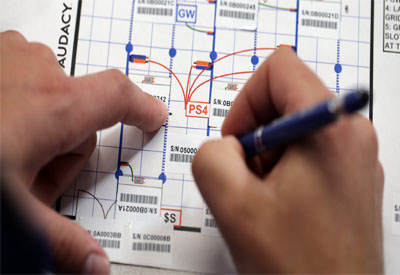
The manufacturer is responsible for conducting and documenting the compliance assessment process on a Master Compliance Record (MCR) for all products intended to bear the UL Title 24 mark.
The compliance evaluation is a review of the sign construction in accordance with all applicable requirements and a determination of compliance with those requirements.
1. Required documentation for each sign or sign construction will include the completion of the Master Compliance Record or MCR. A copy of this document is attached as Exhibit A. This form may be completed and stored electronically or in paper form.
2. For multiple signs identical in construction or for a family of similar signs, the documentation needs only to reference a representative sign or signs. Documented records shall be maintained for each product, group, or family of signs that bear the UL Listing Mark.
Responsibilities of the field representative
- Audits: perform in-factory audits to review samples of signs bearing, or intending to bear, the UL Title 24 energy efficiency mark. Additionally, the field representative is to audit records of past production if production is not available.
- MTR verification: during each Factory Visit, the UL field representative will verify the manufacturer has a qualified “manufacturer’s technical representative” that meets the requirements specified in the “Responsibilities of the manufacturer” section above. The manufacturer will be issued a document from UL University indicating successful completion of the course. This document is to be kept on file by the manufacturer to facilitate MTR verification by the field representative.
- Instructions for inspection reports: an inspection report is to be completed for the energy inspection and a copy is to be provided to the sign manufacturer. A separate inspection is to be completed for the energy audit; reports are not to be combined with the safety inspection.
- Instructions for variation notices (VNs): any nonconformance to the technical or documentation requirements found during the audit is to be documented on a variation notice. Corrective action is to be taken by the manufacturer if a sign displaying, or intended to display, the Title 24 Energy Certification mark does not conform to the requirements contained in this document.
Technical requirements — general
Sign lighting energy standards apply to both indoor and outdoor signs and contain two different prescriptive compliance options:
- Option A: maximum allowed lighting power (also referred to as the watts per square foot approach)
- Option B: Specific lighting source approach.
Either approach may be utilized to determine compliance.
Approach 1. maximum allowed lighting power approach (watts per square foot approach)
Maximum allowed lighting power approach specifies a maximum lighting power that can be installed, expressed in W/ft2 of sign area. Signs cannot exceed the following power limits:
- Internally Illuminated – shall not exceed 12 W/ft2
- Externally Illuminated – shall not exceed 2.3 W/ft2
Steps to determining compliance using the maximum allowed lighting power approach
1. Determine if the is sign internally or externally illuminated.
2. Calculate area of the sign face.
- For double-face signs, only one side is used for the calculation
- For changing message boards use the area of the message board face
3. Determine the total input wattage of the sign.
- For neon, fluorescent, HID and LED signs use the input amperage (A) multiplied by the input volts (V) of all ballasts or transformers; or the marked input wattage rating (if available).
- For incandescent signs use the wattage specified on the sign re-lamping label.
- For changing message boards use the input volts x amps and the area of the board face.
4. Divide the input watts by the calculated sign face area (square ft.).
- Internally Illuminated – shall not exceed 12 W/ft2
- Externally Illuminated – shall not exceed 2.3 W/ft2
Approach 2. specific lighting source approach
The specific lighting source approach specifies that signs illuminated exclusively with efficient lighting sources (e.g. electronic ballasts, high efficiency lamps, efficient power supplies and efficient transformers) comply with the energy requirements, regardless of the power consumed.
- Internally Illuminated – shall not exceed 12 W/ft2
- Externally Illuminated – Shall not exceed 2.3 W/ft2
The document also identifies light sources to be used with the specific lighting source approach and ;provided a sample master compliance record
See the full document here: industries.ul.com/wp-content/uploads/sites/2/2015/03/Title-24-Brochure.pdf.
Find out more about Title 24: www.energy.ca.gov/title24/
Photo source: Luca Bravo on Unsplash