Part 1: How Many Studies Does it Take to Change a Lightbulb?
March 18, 2024
By Noah Sabatier
How studies in vision inform lighting standards at Night
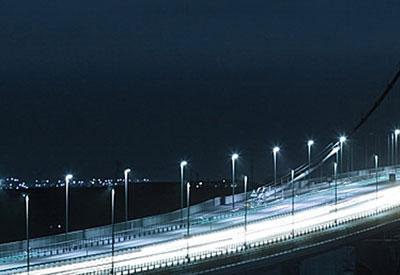
Changing a light bulb in our home is perhaps the most simple task in which we can still credit ourselves for performing household maintenance. The amount of thought such an operation receives rarely extends beyond looking for the most efficient pack of bulbs on a store shelf. What happens however, when a municipal utility department has over 100,000 streetlights to change?
The ideal dusk-to-dawn area light is often defined by lamp efficacy, while lamp efficacy is defined by the operating parameters of human vision. These parameters of human vision are defined by a series of laboratory tests, looking to answer a seemingly simple question – what spectrum of light enables the highest efficacy for vision on a roadway at night?
Depending on where you live, a lighting standards organization such as the CIE (Commission Internationale de l’Eclairage or International Commission on Illumination) or IESNA (Illuminating Engineering Society of North America more often called the IES) has provided your municipality with documents to answer this question. To simplify this exchange of information, a few assumptions have been made; While roadways are illuminated, streetlights themselves are not visible.
As a driver neither you nor your fellow road user drives with headlights at night, nor do you ever turn your head or move your gaze throughout the road. If this scenario sounds odd, you aren’t the only one wondering how billions of dollars were invested based on lighting specifications following these assumptions.
During the 1990s, sources of ‘white’ lighting such as metal halide and magnetic induction were raised as alternatives to the industry standard high-pressure sodium lamp. What millions of people simply knew as ‘the yellow streetlights’ were in operation for that exact reason. Yellow is the most efficient portion of visible light for human vision, at least during daytime hours.
To understand lighting research, one needs a crash course on human vision:
The human eye contains 2 classes of cells for vision. Cone cells operate in the ‘brighter’, photopic, end of human vision with a peak sensitivity to yellow light. Cone cells are located primarily in the center of the retina, provide sharp ‘focal’ vision and allow us to perceive color. Rod cells operate in the ‘darker’, scotopic, end of human vision with a peak sensitivity to bluish-green light.
Rod cells are located primarily in the peripheral region of the retina and provide colorless vision with low resolution. Rod cells require extensive time to generate photopigment in order to achieve sensitivity to light, upwards of 30 minutes for peak sensitivity. It only takes a few seconds, however, for this photopigment to be lost when exposed to bright light.
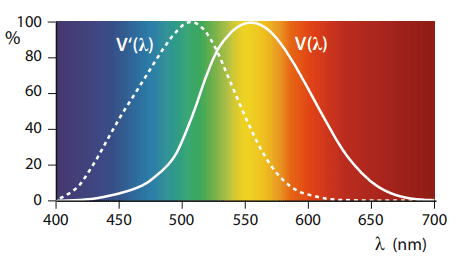
The primary research behind standards for roadway lighting is the Mesopic Optimization of Visual Efficiency, shortened to M.O.V.E. – mesopic being the range in which both cone and rod cells are theoretically active. MOVE studies consisted of participants in a laboratory performing simulated visual tasks, generally using test stimuli projected onto a background. At one point a driving simulator was utilized, although this also consisted of a simple series of light projections onto a background.
MOVE studies include 3 primary themes worth considering before their application to the real world. Firstly, subjects were given varying amounts of time in a dark room for their eyes to adapt to the luminance level being tested – up to 30 minutes. Secondly, visual performance tests utilized a fixation point and trained subjects to ensure that peripheral vision was being tested when peripheral stimuli was in use. Finally, subjects were never exposed to luminance levels above that of the test surface, up to 10 candela per square meter.
For those of us who don’t live inside a laboratory simulation, we can only dream of driving in the dark for 30 minutes without being subjected to oncoming headlights and other sources of bright light. When exposure to bright light occurs, a variety of biological processes happen within the eyes to adapt to this light. Firstly, the pupil narrows during the Post-Illumination Pupil Response. Shorter wavelengths of light have a much stronger PIPR impact than longer wavelengths of light, as has been observed in a variety of studies. The increased pupil response to blue light is additionally a trigger for physical discomfort.
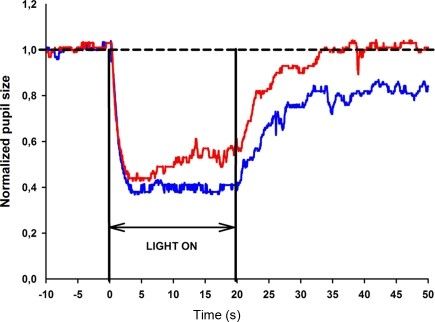
After PIPR takes place, a series of reactions happen within and between retinal cells. To summarize, the photopigment within rod cells absorbs light and becomes transparent. Should the photopigment become completely transparent, the rod cell is blind until the pigment can regenerate. Cone cells experience an adaptation process as well, albeit with less sensitivity and a much faster recovery time. We often see this as colored ‘splotches’ within our vision, matching the shape of the light source that we viewed.
Getting more complex, retinal cells can also receive adaptation ‘instructions’ from their peers. Specifically, cone cells being exposed to bright light results in rod cells across the retina adapting to the light source, resulting in a full-field reduction of light sensitivity.
When the results of the MOVE studies are placed within the context of visual adaptation mechanics, we can make the following conclusions:
- The theoretical advantage for shorter wavelengths of light in dusk-to-dawn lighting only exists for peripheral vision.
- This theoretical advantage, mediated by rod cells, exists up until 0.6 cd/m². Roadway luminance targets range between 0.3 and 2.0 cd/m².
- When driving at night, drivers are exposed to an onslaught of light sources. The luminance of these light sources are several magnitudes greater than the upper limit for rod cell function. Even cone cells are routinely blinded by bright lights, often leading to temporary full-field night blindness.
With these factors in mind, a troubling conclusion for much of the lighting field emerges. In a real-world scenario, there is no evidence that rod cells are able to reliably contribute to vision under standard artificial illumination. Whether you have been informed of a supposed 30% gain in efficiency, or a whopping 70% provided by increased sensitivity to blue light, there was never a foundation behind these numbers.
Without reliable vision from rod cells, we are left with our cone cells that perceive yellow light most efficiently. In the second part of this article we will examine real-world driving tests and see how they compare to the laboratory-based models used to select the streetlights outside your home.
Noah Sabatier is a photographer and lighting researcher that is dedicated to advocating for better outdoor lighting. Noah has spent the past 5 years living with a night shift sleep schedule, during this time he realized that the streetlights in his city were far from optimal – and recent changes had only made them worse. He has spent the past 2 years extensively reviewing scientific literature and technical documents alongside others advocating for better lighting. Noah is now working to raise awareness of common misconceptions that lead to bad lighting and the better practices needed to solve this problem.
Reach him at: noahsabatierphoto@gmail.com
More information available here