Market Snapshot: Luminaires and Lighting Controls
June 25, 2018
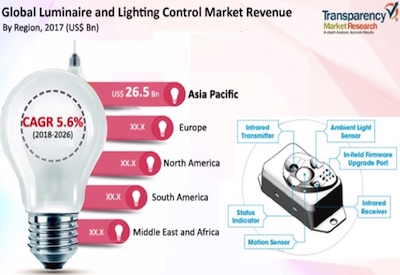
The global luminaire and lighting control market is projected to expand at a CAGR of 5.6% and reach US$111 billion by 2026.
The industry is going through diverse phases in different regions of the world. Rising awareness of energy-efficient light models is primarily fueling demand for lighting control systems. As electricity prices continue to rise, government organizations are switching to energy-efficient lights to reduce operational costs while improving safety and efficiency. The adoption of luminaire and lighting control is particularly gaining traction in urban areas for efficient lighting solutions. Another factor boosting the luminaire and lighting control market is the rise in living standards of urban communities in some countries. Governments as well as private organizations in these communities are making efforts to attain maximum efficiency in terms of lighting solutions.
Governments of metropolitan cities, especially in developed regions, are shifting to greener technologies so as reduce carbon footprint and electricity demand. In line with the same, several measures are being executed by implementing energy-efficiency standards, imposing added import tariffs on traditional lamps, and endorsing LED lights. In addition to the development of LEDs, multiple companies are focusing on developing and providing street lights solutions in order to help reduce energy consumption and increase profits margins. With an increasing emphasis on green and clean lighting products, the deployment of energy-efficient lighting products for street lighting applications is anticipated to rise in the coming years.
Another factor driving the luminaire and lighting control market in the near future is the trend toward smarter buildings. Technologies such as integrated lighting controls are increasingly being adopted in varied sectors such as residential and commercial building. There has been a considerable increase in spending on lighting solutions to improve energy consumption in residential and non-residential building spaces. One of the fundamental aspects covered under smart buildings is the smart lighting system. Furthermore, according to a research study conducted by the Massachusetts Institute of Technology, lighting represents around 14% of the overall energy needs of a building. Thus, it is a major area to incorporate energy-efficient products and services.
However, the luminaire and lighting control market faces a challenge due to higher installation costs. The major obstruction in implementing smart lighting control solutions is the cost associated with these products. For Instance, energy-efficient lights and light emitting diodes are priced at approximately US $35 each, whereas compact fluorescent bulb costs approximately $2 to $15 each. On an initial capital cost basis, LEDs are more costly than more conventional lighting technologies.
Several players in the luminaire and lighting control market are expanding their business through strategic mergers and acquisitions and partnerships with several industries due to expansion in the market and underlying latent demand. Osram acquired lighting services provider Maneri-Agraz, which will be a part of Osram’s lighting solution segment, to increase business in the U.S. South and Southwest regions. Prominent players in the luminaire and lighting control market include General Electric Co., Philips Lighting N.V., General Electric, Cree, Inc, Legrand S.A., Osram Licht AG, Eaton Corporation, Lutron Electronics Co., Inc, Acuity Brands, Inc., Hubbell Incorporated, and LSI Industries Inc. Companies are focusing on expanding their business through strategic acquisitions and partnerships with several end-use industries.