Lighting Patterns for Healthy Buildings Website Now Includes Designs for Healthcare
September 7, 2017
Lighting for healthcare presents unique challenges for accommodating the diverse populations who occupy this environment—from the physicians and nurses working dayshift or nightshift to the patients, all with varying needs, including the youngest and perhaps most vulnerable members of our population, infants in the NICU. To meet the ongoing needs of the patients, hospitals must operate 24 hours per day, 365 days per year, which places tremendous strain on the healthcare staff.
Lighting can be used to promote entrainment in various populations as well as promote alertness in healthcare staff working both at night and during the day, yet many lighting professionals are unsure of the best way to incorporate these advances in the science of lighting into their designs. To address this issue, the Lighting Research Center (LRC) at Rensselaer Polytechnic Institute has expanded its Lighting Patterns for Healthy Buildings website to include designs for the healthcare environment.
The LRC’s website provides lighting patterns, utilizing circadian stimulus (CS) as the primary design component, for three distinct healthcare environments and the needs of their respective end-users.
- Shiftwork environment: Dayshift and nightshift workers have different lighting needs. During the day, lighting should be designed to promote circadian entrainment
 and maintain alertness. At night, the lighting demands are more complicated. While those working at night need to maintain alertness, disruption of the circadian clock by exposure to light at night has been associated with negative health effects. Until more research has been conducted to better understand this relationship, we recommend delivering a lighting scheme that promotes alertness without disrupting the melatonin cycle.
- The NICU: Lighting in the NICU serves two unique populations with varying circadian requirements. Studies show that infants can benefit from receiving at least two hours of high CS in the morning to promote circadian entrainment to the solar day. Healthcare professionals, on the other hand, require light for circadian health and alertness throughout the entire shift. Balancing these different needs requires zones of light for each population to provide the proper amount, spectra and duration of light exposure at the appropriate time of day or night.
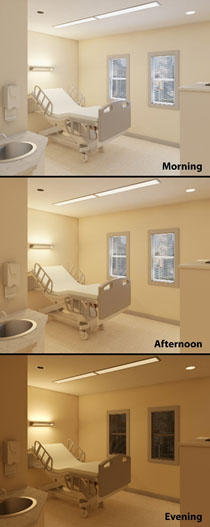
- Patient rooms: Lighting for patient rooms should be designed to promote circadian entrainment, providing high CS during the day and low CS in the evening, in order to increase patients’ sleep times and improve their sleep quality. Nighttime lighting should be conducive to patient sleep, while also accommodating visiting families and allowing healthcare professionals to perform their tasks.
The Lighting Patterns for Healthy Buildings website includes a section for each of these environments, providing detailed information on lighting for circadian health and alertness, as well as lighting for visual task performance.
The project is sponsored by the Light and Health Alliance, which includes Acuity Brands; Cree; Current, powered by GE; Ketra; OSRAM; Philips Lighting; and USAI Lighting.
About the Circadian Stimulus Metric
The circadian stimulus (CS) metric is a measure of how one-hour exposure to a light source of a certain spectral power distribution (SPD) and light level stimulates the human circadian system, as measured by acute melatonin suppression. The CS metric was developed by the LRC from several lines of biophysical research, including those from basic retinal neurophysiology, has been validated in controlled experiments, and has been used successfully in numerous field applications. Unlike other proposed metrics, such as melanopic lux or melanopic content, the CS metric takes into account both the absolute and the spectral sensitivity of the circadian system, ranging from 0.1, the threshold for circadian system activation, to 0.7, response saturation. The LRC has found that exposure to a CS of 0.3 or greater at the eye, for at least one hour in the early part of the day, is effective for stimulating the circadian system and is associated with clinically relevant outcomes, such as reductions in depression and agitation among persons with Alzheimer’s disease, entrainment in U.S. Navy submariners, and improved sleep and mood in office workers. Others have also shown that a CS of 0.3 or greater is associated with better sleep in older adults.